 Add to Chrome
 Add to Firefox
 Add to Edge
Hypernetworks for Dynamic Feature Selection
May 12, 2026
Dynamic feature selection (DFS) is a machine learning framework in which features are acquired sequentially for individual samples under budget constraints. The exponential growth in the number of possible feature acquisition paths forces a DFS model to balance fitting specific scenarios against maintaining general performance, even when the feature space is moderate in size. In this paper, we study the structural limitations of existing DFS approaches to achieve an optimal solution. Then, we propose \textsc{Hyper-DFS}, a hypernetwork-based DFS approach that generates feature subset-specific classifier parameters on demand. We show that the use of hypernetworks compared to mask-embedding methods results in a smaller structural complexity bound. We also use a Set Transformer encoding to create a smooth conditioning space for the hypernetwork, so that functionally similar tasks are also geometrically close. In our benchmarks, \textsc{Hyper-DFS} outperforms all state-of-the-art approaches on synthetic and real-life tabular data. It is also competitive or superior across all image datasets tested, and shows substantially stronger zero-shot generalisation to feature subsets never seen during training than existing DFS approaches.

A Fast Interpretable Fuzzy Tree Learner
Dec 12, 2025Fuzzy rule-based systems have been mostly used in interpretable decision-making because of their interpretable linguistic rules. However, interpretability requires both sensible linguistic partitions and small rule-base sizes, which are not guaranteed by many existing fuzzy rule-mining algorithms. Evolutionary approaches can produce high-quality models but suffer from prohibitive computational costs, while neural-based methods like ANFIS have problems retaining linguistic interpretations. In this work, we propose an adaptation of classical tree-based splitting algorithms from crisp rules to fuzzy trees, combining the computational efficiency of greedy algoritms with the interpretability advantages of fuzzy logic. This approach achieves interpretable linguistic partitions and substantially improves running time compared to evolutionary-based approaches while maintaining competitive predictive performance. Our experiments on tabular classification benchmarks proof that our method achieves comparable accuracy to state-of-the-art fuzzy classifiers with significantly lower computational cost and produces more interpretable rule bases with constrained complexity. Code is available in: https://github.com/Fuminides/fuzzy_greedy_tree_public
Crisp complexity of fuzzy classifiers
Apr 22, 2025Rule-based systems are a very popular form of explainable AI, particularly in the fuzzy community, where fuzzy rules are widely used for control and classification problems. However, fuzzy rule-based classifiers struggle to reach bigger traction outside of fuzzy venues, because users sometimes do not know about fuzzy and because fuzzy partitions are not so easy to interpret in some situations. In this work, we propose a methodology to reduce fuzzy rule-based classifiers to crisp rule-based classifiers. We study different possible crisp descriptions and implement an algorithm to obtain them. Also, we analyze the complexity of the resulting crisp classifiers. We believe that our results can help both fuzzy and non-fuzzy practitioners understand better the way in which fuzzy rule bases partition the feature space and how easily one system can be translated to another and vice versa. Our complexity metric can also help to choose between different fuzzy classifiers based on what the equivalent crisp partitions look like.
Compact Rule-Based Classifier Learning via Gradient Descent
Feb 03, 2025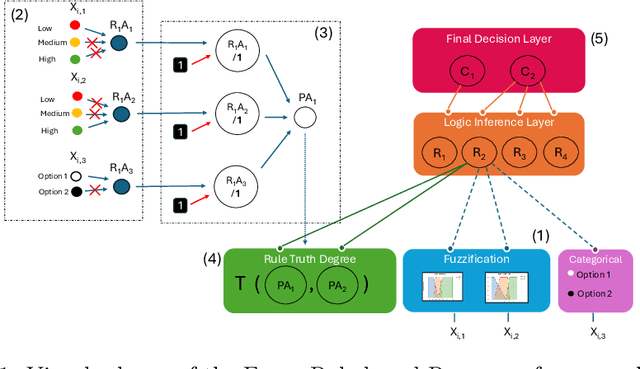

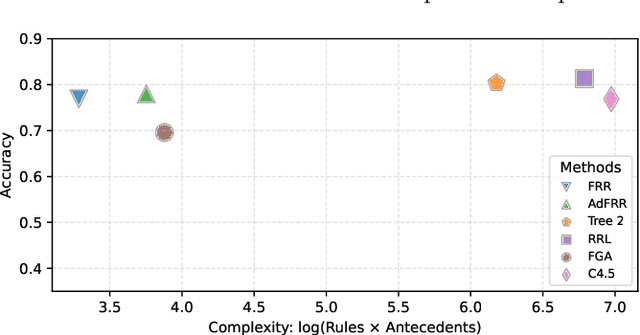

Rule-based models play a crucial role in scenarios that require transparency and accountable decision-making. However, they primarily consist of discrete parameters and structures, which presents challenges for scalability and optimization. In this work, we introduce a new rule-based classifier trained using gradient descent, in which the user can control the maximum number and length of the rules. For numerical partitions, the user can also control the partitions used with fuzzy sets, which also helps keep the number of partitions small. We perform a series of exhaustive experiments on $40$ datasets to show how this classifier performs in terms of accuracy and rule base size. Then, we compare our results with a genetic search that fits an equivalent classifier and with other explainable and non-explainable state-of-the-art classifiers. Our results show how our method can obtain compact rule bases that use significantly fewer patterns than other rule-based methods and perform better than other explainable classifiers.