 Add to Chrome
 Add to Firefox
 Add to Edge
How Fine-Grained Should a RAG Benchmark Be? A Hierarchical Framework for Synthetic Question Generation
Jun 11, 2026
Evaluating retrieval-augmented generation (RAG) systems requires benchmarks that capture diverse question characteristics, yet practitioners lack empirical guidance on which dimensions to vary and at what granularity. We present HieraRAG, a hierarchical framework for studying granularity in RAG benchmark construction, defining optimal granularity as the level that maximizes discriminative power (the standard deviation of generation quality across categories) within a given RAG configuration. As a case study, we generate 5,872 synthetic question-answer (QA) pairs from FineWeb-10BT across 3 dimensions (Question Complexity, Answer Type, Linguistic Variation) at 3 granularity levels (2, 4, and 8 categories). With a BM25+Falcon-3-10B pipeline, optimal granularity varies by dimension: complexity benefits from fine-grained distinctions (discriminative power: 0.053) while answer type and linguistic variation peak at medium granularity. We introduce a Coherence Ratio metric to quantify whether fine-grained splits cleanly subdivide parent categories, revealing structural differences across dimensions (Question Complexity: 0.40 vs. Answer Type: 1.44). Human evaluation of 110 stratified QA pairs confirms synthetic quality. While these specific findings reflect a single configuration, HieraRAG provides a portable procedure and validation metric for practitioners to determine evaluation granularity within their own RAG settings.

Direct Confidence Alignment: Aligning Verbalized Confidence with Internal Confidence In Large Language Models
Dec 12, 2025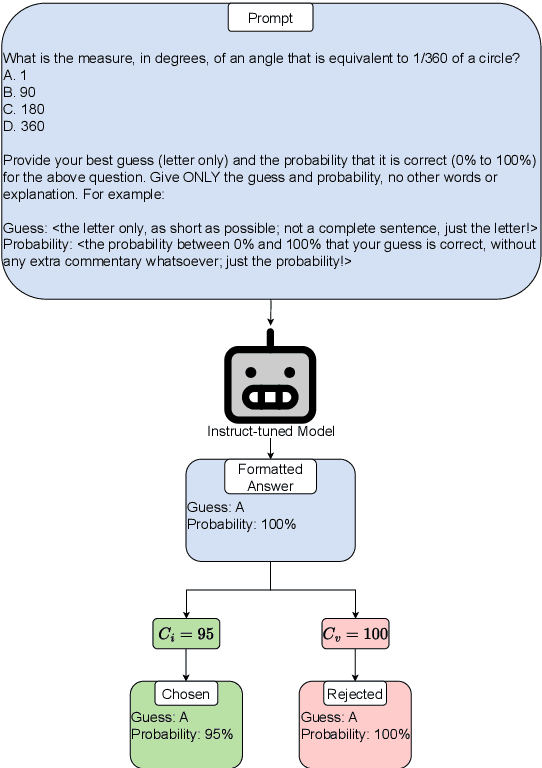
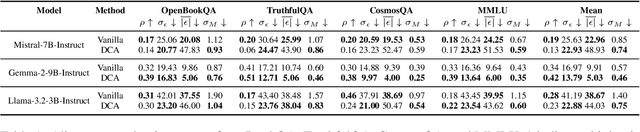

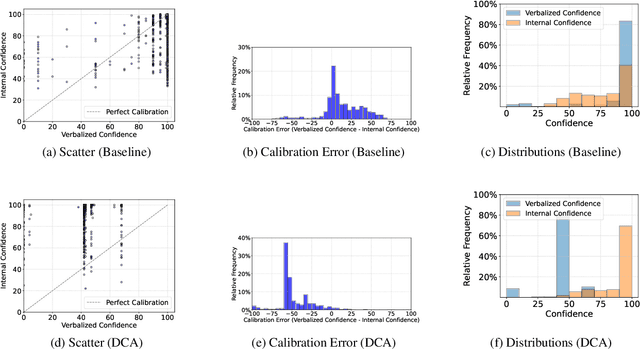
Producing trustworthy and reliable Large Language Models (LLMs) has become increasingly important as their usage becomes more widespread. Calibration seeks to achieve this by improving the alignment between the model's confidence and the actual likelihood of its responses being correct or desirable. However, it has been observed that the internal confidence of a model, derived from token probabilities, is not well aligned with its verbalized confidence, leading to misleading results with different calibration methods. In this paper, we propose Direct Confidence Alignment (DCA), a method using Direct Preference Optimization to align an LLM's verbalized confidence with its internal confidence rather than ground-truth accuracy, enhancing model transparency and reliability by ensuring closer alignment between the two confidence measures. We evaluate DCA across multiple open-weight LLMs on a wide range of datasets. To further assess this alignment, we also introduce three new calibration error-based metrics. Our results show that DCA improves alignment metrics on certain model architectures, reducing inconsistencies in a model's confidence expression. However, we also show that it can be ineffective on others, highlighting the need for more model-aware approaches in the pursuit of more interpretable and trustworthy LLMs.