 Add to Chrome
 Add to Firefox
 Add to Edge
Direct Confidence Alignment: Aligning Verbalized Confidence with Internal Confidence In Large Language Models
Dec 12, 2025
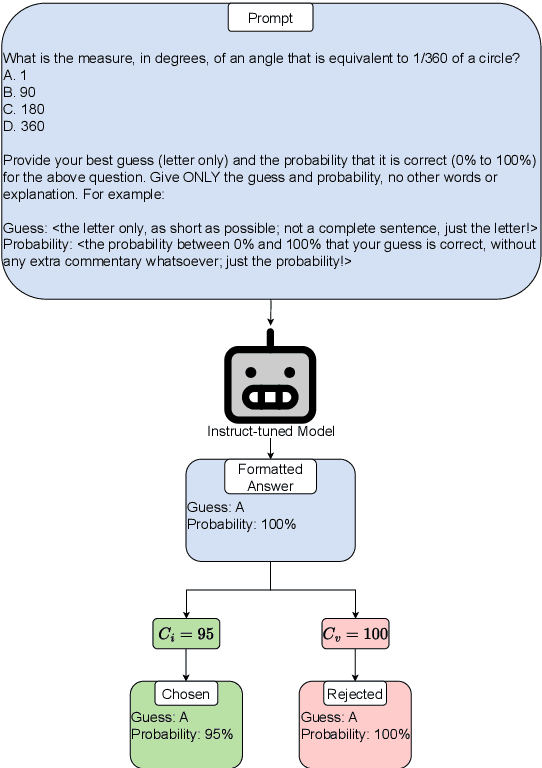
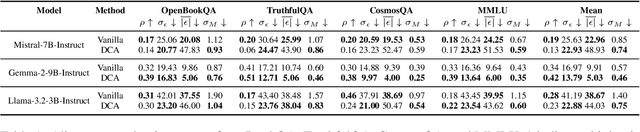

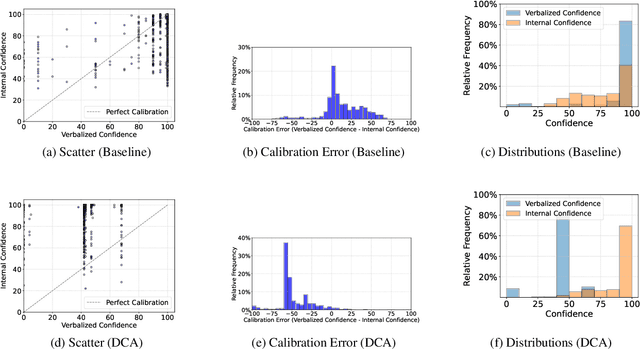
Producing trustworthy and reliable Large Language Models (LLMs) has become increasingly important as their usage becomes more widespread. Calibration seeks to achieve this by improving the alignment between the model's confidence and the actual likelihood of its responses being correct or desirable. However, it has been observed that the internal confidence of a model, derived from token probabilities, is not well aligned with its verbalized confidence, leading to misleading results with different calibration methods. In this paper, we propose Direct Confidence Alignment (DCA), a method using Direct Preference Optimization to align an LLM's verbalized confidence with its internal confidence rather than ground-truth accuracy, enhancing model transparency and reliability by ensuring closer alignment between the two confidence measures. We evaluate DCA across multiple open-weight LLMs on a wide range of datasets. To further assess this alignment, we also introduce three new calibration error-based metrics. Our results show that DCA improves alignment metrics on certain model architectures, reducing inconsistencies in a model's confidence expression. However, we also show that it can be ineffective on others, highlighting the need for more model-aware approaches in the pursuit of more interpretable and trustworthy LLMs.

Factor(U,T): Controlling Untrusted AI by Monitoring their Plans
Dec 12, 2025
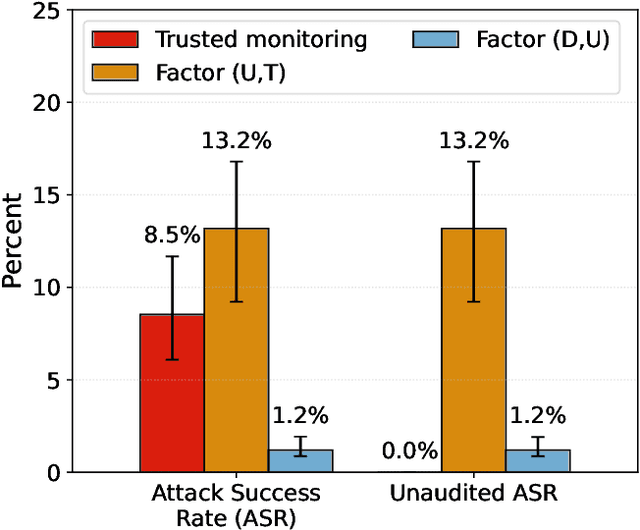
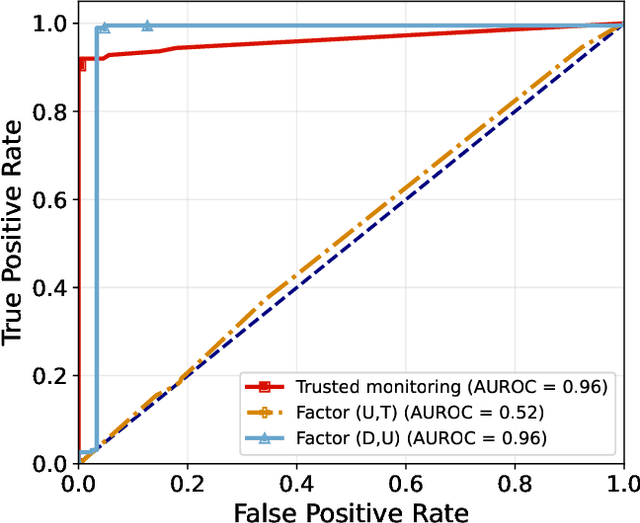
As AI capabilities advance, we increasingly rely on powerful models to decompose complex tasks $\unicode{x2013}$ but what if the decomposer itself is malicious? Factored cognition protocols decompose complex tasks into simpler child tasks: one model creates the decomposition, while other models implement the child tasks in isolation. Prior work uses trusted (weaker but reliable) models for decomposition, which limits usefulness for tasks where decomposition itself is challenging. We introduce Factor($U$,$T$), in which an untrusted (stronger but potentially malicious) model decomposes while trusted models implement child tasks. Can monitors detect malicious activity when observing only natural language task instructions, rather than complete solutions? We baseline and red team Factor($U$,$T$) in control evaluations on BigCodeBench, a dataset of Python coding tasks. Monitors distinguishing malicious from honest decompositions perform poorly (AUROC 0.52) compared to monitors evaluating complete Python solutions (AUROC 0.96). Furthermore, Factor($D$,$U$), which uses a trusted decomposer and monitors concrete child solutions, achieves excellent discrimination (AUROC 0.96) and strong safety (1.2% ASR), demonstrating that implementation-context monitoring succeeds where decomposition-only monitoring fails.