 Add to Chrome
 Add to Firefox
 Add to Edge
Knowing When Not to Predict: Self Supervised Learning and Abstention for Safer DR Screening
May 18, 2026
Self-supervised learning (SSL) is now a standard way to pretrain medical image models, but performance is still mostly judged by downstream accuracy. For safety-critical screening tasks such as diabetic retinopathy grading, this is not enough: a model must also know when its predictions are unreliable and defer uncertain cases for clinical review. In this work, we examine how the length of SSL pretraining influences calibrated confidence and confidence-based abstention. We evaluate multiple SSL checkpoints under a fixed fine-tuning protocol and assess calibrated confidence, coverage, selective accuracy, and selective macro-F1. Across datasets and data regimes, SSL pretraining improves selective prediction compared to training from scratch. Unlike prior SSL studies that primarily evaluate downstream accuracy or AUROC, we analyze how SSL pretraining duration influences confidence behavior under calibrated confidence-based abstention. However, once accuracy saturates, selective performance can still change markedly across checkpoints, and longer pretraining does not consistently improve reliability. These results underscore the importance of abstention-aware evaluation and suggest that pretraining length should be treated as an important reliability-related design choice rather than only a computational detail. Code is available at GitHub.

From Retinal Pixels to Patients: Evolution of Deep Learning Research in Diabetic Retinopathy Screening
Nov 14, 2025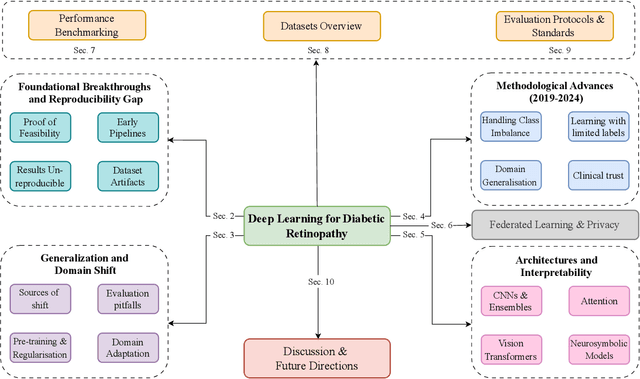
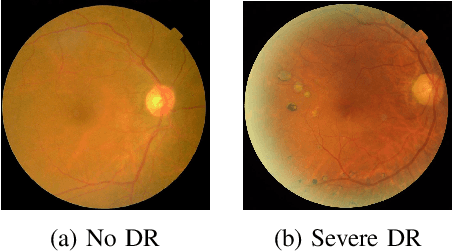
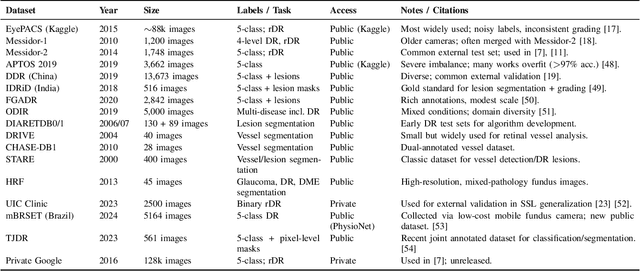
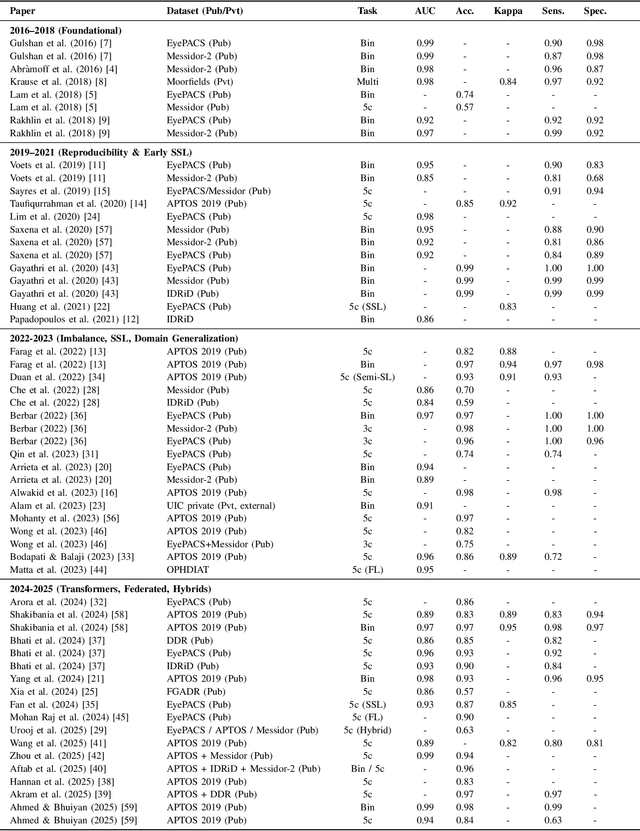
Diabetic Retinopathy (DR) remains a leading cause of preventable blindness, with early detection critical for reducing vision loss worldwide. Over the past decade, deep learning has transformed DR screening, progressing from early convolutional neural networks trained on private datasets to advanced pipelines addressing class imbalance, label scarcity, domain shift, and interpretability. This survey provides the first systematic synthesis of DR research spanning 2016-2025, consolidating results from 50+ studies and over 20 datasets. We critically examine methodological advances, including self- and semi-supervised learning, domain generalization, federated training, and hybrid neuro-symbolic models, alongside evaluation protocols, reporting standards, and reproducibility challenges. Benchmark tables contextualize performance across datasets, while discussion highlights open gaps in multi-center validation and clinical trust. By linking technical progress with translational barriers, this work outlines a practical agenda for reproducible, privacy-preserving, and clinically deployable DR AI. Beyond DR, many of the surveyed innovations extend broadly to medical imaging at scale.