 Add to Chrome
 Add to Firefox
 Add to Edge
Route Fragmentation Based on Resource-centric Prioritisation for Efficient Multi-Robot Path Planning in Agricultural Environments
Mar 13, 2026
Agricultural environments present high proportions of spatially dense navigation bottlenecks for long-term navigation and operational planning of agricultural mobile robots. The existing agent-centric multi-robot path planning (MRPP) approaches resolve conflicts from the perspective of agents, rather than from the resources under contention. Further, the density of such contentions limits the capabilities of spatial interleaving, a concept that many planners rely on to achieve high throughput. In this work, two variants of the priority-based Fragment Planner (FP) are presented as resource-centric MRPP algorithms that leverage route fragmentation to enable partial route progression and limit the impact of binary-based waiting. These approaches are evaluated in lifelong simulation over a 3.6km topological map representing a commercial polytunnel environment. Their performances are contrasted against 5 baseline algorithms with varying robotic fleet sizes. The Fragment Planners achieved significant gains in throughput compared with Prioritised Planning (PP) and Priority-Based Search (PBS) algorithms. They further demonstrated a task throughput of 95% of the optimal task throughput over the same time period. This work shows that, for long-term deployment of agricultural robots in corridor-dominant agricultural environments, resource-centric MRPP approaches are a necessity for high-efficacy operational planning.

Semantic Landmark Particle Filter for Robot Localisation in Vineyards
Mar 11, 2026Reliable localisation in vineyards is hindered by row-level perceptual aliasing: parallel crop rows produce nearly identical LiDAR observations, causing geometry-only and vision-based SLAM systems to converge towards incorrect corridors, particularly during headland transitions. We present a Semantic Landmark Particle Filter (SLPF) that integrates trunk and pole landmark detections with 2D LiDAR within a probabilistic localisation framework. Detected trunks are converted into semantic walls, forming structural row boundaries embedded in the measurement model to improve discrimination between adjacent rows. GNSS is incorporated as a lightweight prior that stabilises localisation when semantic observations are sparse. Field experiments in a 10-row vineyard demonstrate consistent improvements over geometry-only (AMCL), vision-based (RTAB-Map), and GNSS baselines. Compared to AMCL, SLPF reduces Absolute Pose Error by 22% and 65% across two traversal directions; relative to a NoisyGNSS baseline, APE decreases by 65% and 61%. Row correctness improves from 0.67 to 0.73, while mean cross-track error decreases from 1.40 m to 1.26 m. These results show that embedding row-level structural semantics within the measurement model enables robust localisation in highly repetitive outdoor agricultural environments.
Unified Map Handling for Robotic Systems: Enhancing Interoperability and Efficiency Across Diverse Environments
Apr 21, 2024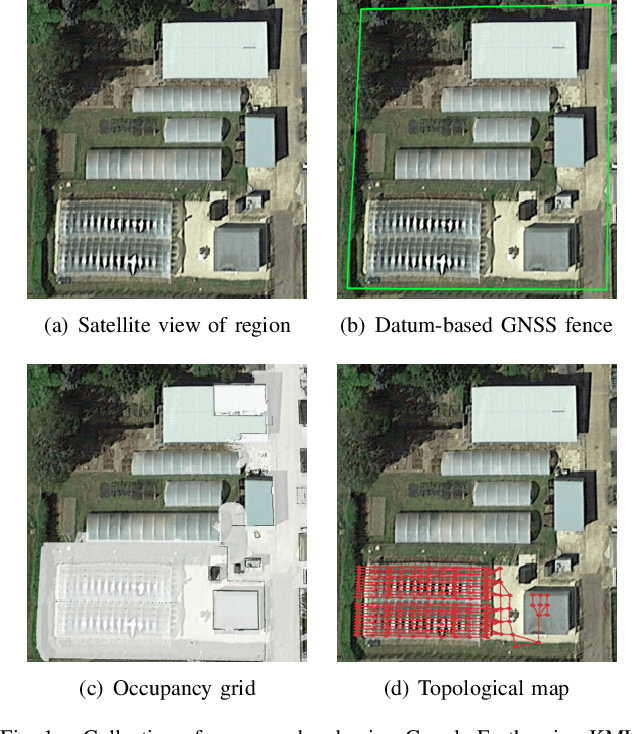

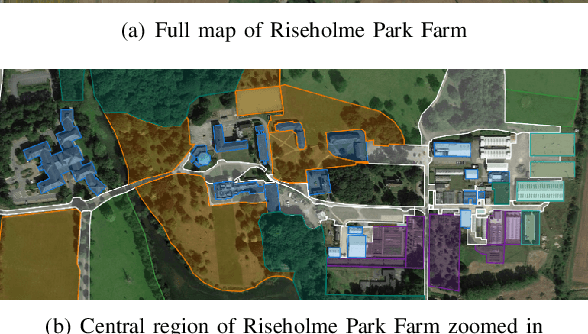
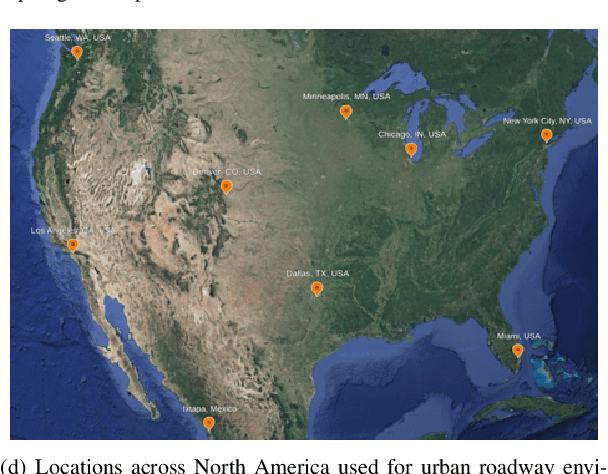
Mapping is a time-consuming process for deploying robotic systems to new environments. The handling of maps is also risk-adverse when not managed effectively. We propose here, a standardised approach to handling such maps in a manner which focuses on the information contained wherein such as global location, object positions, topology, and occupancy. As part of this approach, associated management scripts are able to assist with generation of maps both through direct and indirect information restructuring, and with template and procedural generation of missing data. These approaches are able to, when combined, improve the handling of maps to enable more efficient deployments and higher interoperability between platforms. Alongside this, a collection of sample datasets of fully-mapped environments are included covering areas such as agriculture, urban roadways, and indoor environments.