 Add to Chrome
 Add to Firefox
 Add to Edge
Amortising Bayesian Experimental Design for Sequential Information Gathering in LLMs
Jul 03, 2026
Large language models (LLMs) exhibit strong reasoning and world-knowledge capabilities, yet often struggle to gather information effectively across the multi-turn interactions required in sequential decision-making settings. We introduce Amortised Sequential Information Gathering (ASIG), a fine-tuning approach that amortises Bayesian Experimental Design (BED) into LLM policies via a multi-turn extension of Group Relative Policy Optimisation with an Expected Information Gain reward. Evaluated on the 20 Questions task, ASIG more than doubles the success rate of the 7B base model and reduces inference cost by over $25\times$ relative to BED-LLM, a competitive inference-time baseline. Applied to MediQ, a medical diagnosis benchmark unseen during training, ASIG improves information-seeking performance at the 7B scale, suggesting that the learned strategies can transfer out of distribution. Our findings show that amortising BED into LLM policies provides an effective and computationally efficient approach to sequential information gathering.

Optimizing Tensor Computation Graphs with Equality Saturation and Monte Carlo Tree Search
Oct 07, 2024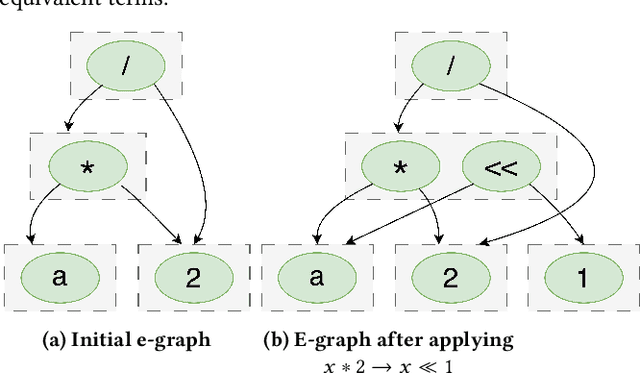

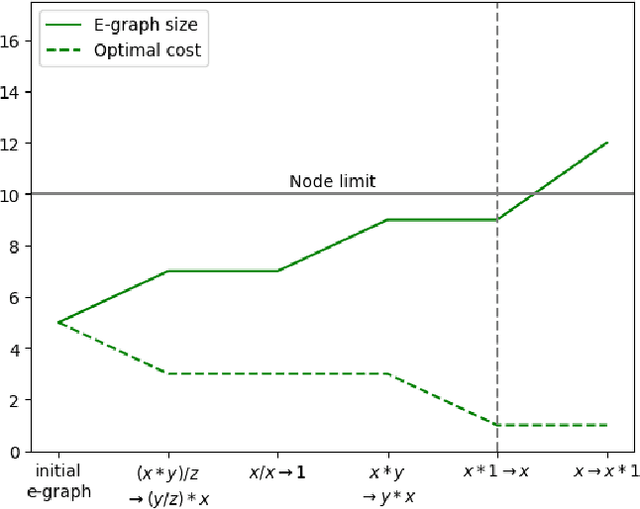
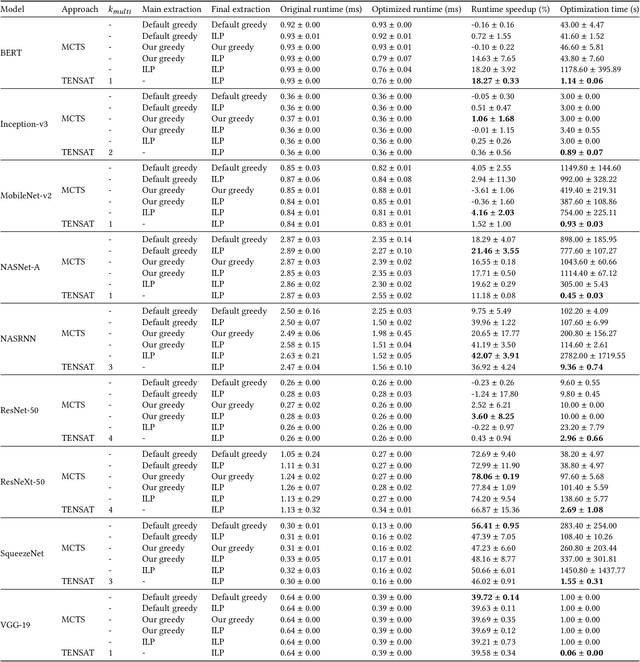
The real-world effectiveness of deep neural networks often depends on their latency, thereby necessitating optimization techniques that can reduce a model's inference time while preserving its performance. One popular approach is to sequentially rewrite the input computation graph into an equivalent but faster one by replacing individual subgraphs. This approach gives rise to the so-called phase-ordering problem in which the application of one rewrite rule can eliminate the possibility to apply an even better one later on. Recent work has shown that equality saturation, a technique from compiler optimization, can mitigate this issue by first building an intermediate representation (IR) that efficiently stores multiple optimized versions of the input program before extracting the best solution in a second step. In practice, however, memory constraints prevent the IR from capturing all optimized versions and thus reintroduce the phase-ordering problem in the construction phase. In this paper, we present a tensor graph rewriting approach that uses Monte Carlo tree search to build superior IRs by identifying the most promising rewrite rules. We also introduce a novel extraction algorithm that can provide fast and accurate runtime estimates of tensor programs represented in an IR. Our approach improves the inference speedup of neural networks by up to 11% compared to existing methods.