 Add to Chrome
 Add to Firefox
 Add to Edge
Rethinking Clinical Relevance in Chest X-ray Machine Learning: How Evaluation References Define Performance
Jul 28, 2026
Chest X-ray (CXR) machine learning relies heavily on automated evaluation using reference standards that aim to approximate clinical judgment. However, commonly used report-derived labels for pathology classification or generic image quality metrics for reconstruction may not reliably reflect clinical judgment. We systematically investigate how evaluation-reference choices affect model performance and ranking in both pathology classification and image quality assessment (IQA). To enable controlled comparison across evaluation references, we collected paired expert image- and report-derived labels for thoracic findings from a clinical cohort at Cambridge University Hospitals (CUH) and curated a subset of the public MIMIC-CXR dataset, along with expert ratings of diagnostic image quality. We show that for supervised image classifiers (ResNet, DenseNet), several zero-shot and fine-tuned vision-language models (e.g., MedKLIP, GLoRIA, and ConVIRT), changing the label source leads to substantial differences not only in performance estimates but also in model rankings. In parallel, alignment of IQA measures with expert judgment depends heavily on the choice of measure, and commonly used IQA metrics such as SSIM and PSNR often fail to align with expert assessments of diagnostic usability. Our results demonstrate that evaluation choices are crucial: they can determine which models and methods appear best and are therefore selected for further development or deployment. The selection of evaluation references should therefore be treated as a central component of clinical validity in CXR machine learning, and justified with respect to the pathology, imaging task, and intended downstream clinical use.

Parameter choices in HaarPSI for IQA with medical images
Oct 31, 2024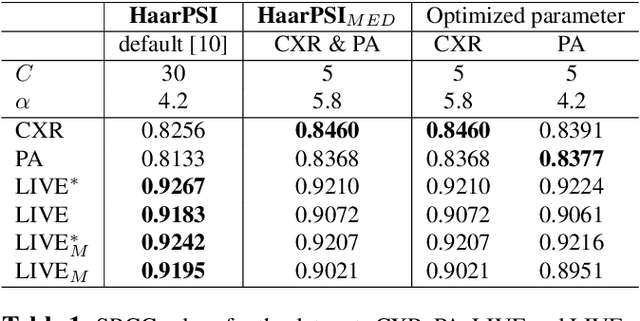
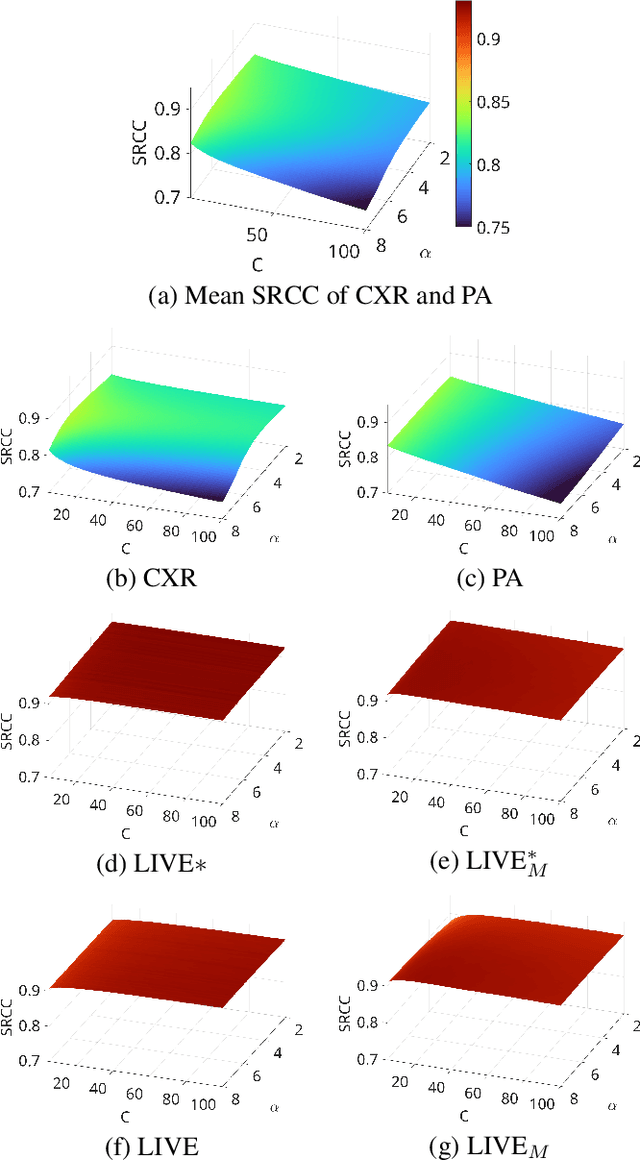
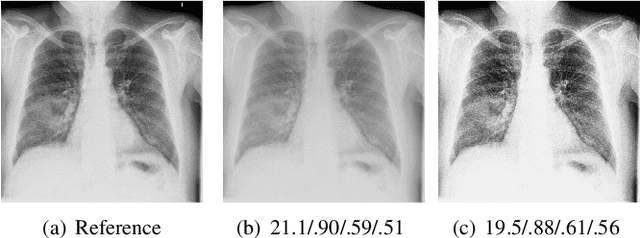
When developing machine learning models, image quality assessment (IQA) measures are a crucial component for evaluation. However, commonly used IQA measures have been primarily developed and optimized for natural images. In many specialized settings, such as medical images, this poses an often-overlooked problem regarding suitability. In previous studies, the IQA measure HaarPSI showed promising behavior for natural and medical images. HaarPSI is based on Haar wavelet representations and the framework allows optimization of two parameters. So far, these parameters have been aligned for natural images. Here, we optimize these parameters for two annotated medical data sets, a photoacoustic and a chest X-Ray data set. We observe that they are more sensitive to the parameter choices than the employed natural images, and on the other hand both medical data sets lead to similar parameter values when optimized. We denote the optimized setting, which improves the performance for the medical images notably, by HaarPSI$_{MED}$. The results suggest that adapting common IQA measures within their frameworks for medical images can provide a valuable, generalizable addition to the employment of more specific task-based measures.
A study on the adequacy of common IQA measures for medical images
May 29, 2024
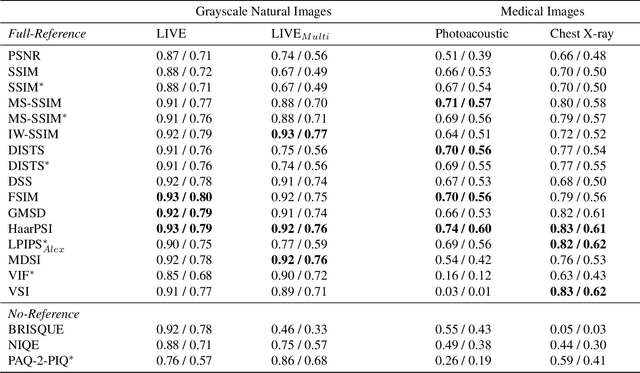


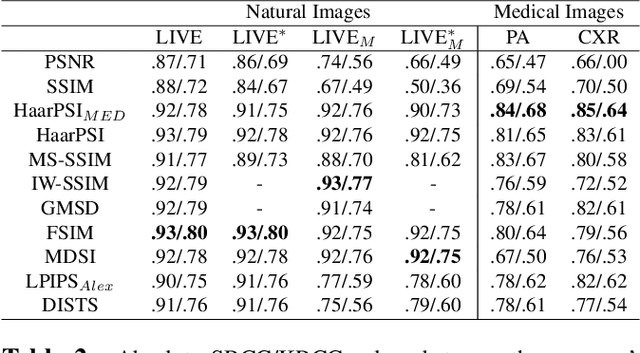
Image quality assessment (IQA) is standard practice in the development stage of novel machine learning algorithms that operate on images. The most commonly used IQA measures have been developed and tested for natural images, but not in the medical setting. Reported inconsistencies arising in medical images are not surprising, as they have different properties than natural images. In this study, we test the applicability of common IQA measures for medical image data by comparing their assessment to manually rated chest X-ray (5 experts) and photoacoustic image data (1 expert). Moreover, we include supplementary studies on grayscale natural images and accelerated brain MRI data. The results of all experiments show a similar outcome in line with previous findings for medical imaging: PSNR and SSIM in the default setting are in the lower range of the result list and HaarPSI outperforms the other tested measures in the overall performance. Also among the top performers in our medical experiments are the full reference measures DISTS, FSIM, LPIPS and MS-SSIM. Generally, the results on natural images yield considerably higher correlations, suggesting that the additional employment of tailored IQA measures for medical imaging algorithms is needed.