 Add to Chrome
 Add to Firefox
 Add to Edge
Revealing Multi-View Hallucination in Large Vision-Language Models
Mar 25, 2026
Large vision-language models (LVLMs) are increasingly being applied to multi-view image inputs captured from diverse viewpoints. However, despite this growing use, current LVLMs often confuse or mismatch visual information originating from different instances or viewpoints, a phenomenon we term multi-view hallucination. To systematically analyze this problem, we construct MVH-Bench, a benchmark comprising 4.8k question-answer pairs targeting two types of hallucination: cross-instance and cross-view. Empirical results show that recent LVLMs struggle to correctly associate visual evidence with its corresponding instance or viewpoint. To overcome this limitation, we propose Reference Shift Contrastive Decoding (RSCD), a training-free decoding technique that suppresses visual interference by generating negative logits through attention masking. Experiments on MVH-Bench with Qwen2.5-VL and LLaVA-OneVision demonstrate that RSCD consistently improves performance by up to 21.1 and 34.6 points over existing hallucination mitigation methods, highlighting the effectiveness of our approach.

Keep it SymPL: Symbolic Projective Layout for Allocentric Spatial Reasoning in Vision-Language Models
Feb 24, 2026Perspective-aware spatial reasoning involves understanding spatial relationships from specific viewpoints-either egocentric (observer-centered) or allocentric (object-centered). While vision-language models (VLMs) perform well in egocentric settings, their performance deteriorates when reasoning from allocentric viewpoints, where spatial relations must be inferred from the perspective of objects within the scene. In this study, we address this underexplored challenge by introducing Symbolic Projective Layout (SymPL), a framework that reformulates allocentric reasoning into symbolic-layout forms that VLMs inherently handle well. By leveraging four key factors-projection, abstraction, bipartition, and localization-SymPL converts allocentric questions into structured symbolic-layout representations. Extensive experiments demonstrate that this reformulation substantially improves performance in both allocentric and egocentric tasks, enhances robustness under visual illusions and multi-view scenarios, and that each component contributes critically to these gains. These results show that SymPL provides an effective and principled approach for addressing complex perspective-aware spatial reasoning.
Towards Comprehensive Scene Understanding: Integrating First and Third-Person Views for LVLMs
May 28, 2025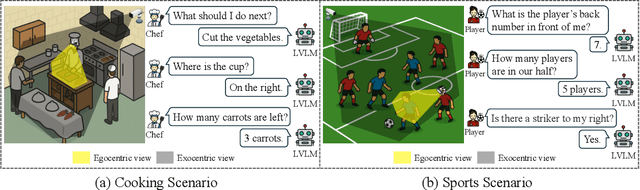

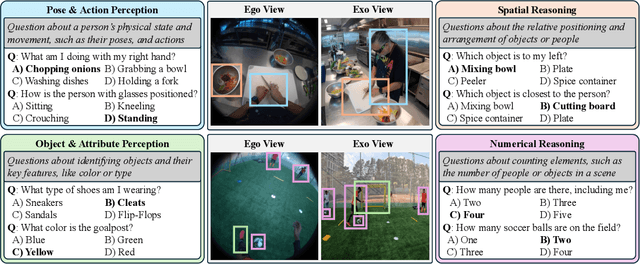
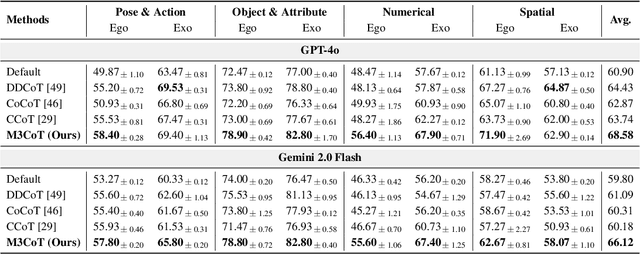
Large vision-language models (LVLMs) are increasingly deployed in interactive applications such as virtual and augmented reality, where first-person (egocentric) view captured by head-mounted cameras serves as key input. While this view offers fine-grained cues about user attention and hand-object interactions, their narrow field of view and lack of global context often lead to failures on spatially or contextually demanding queries. To address this, we introduce a framework that augments egocentric inputs with third-person (exocentric) views, providing complementary information such as global scene layout and object visibility to LVLMs. We present E3VQA, the first benchmark for multi-view question answering with 4K high-quality question-answer pairs grounded in synchronized ego-exo image pairs. Additionally, we propose M3CoT, a training-free prompting technique that constructs a unified scene representation by integrating scene graphs from three complementary perspectives. M3CoT enables LVLMs to reason more effectively across views, yielding consistent performance gains (4.84% for GPT-4o and 5.94% for Gemini 2.0 Flash) over a recent CoT baseline. Our extensive evaluation reveals key strengths and limitations of LVLMs in multi-view reasoning and highlights the value of leveraging both egocentric and exocentric inputs.