 Add to Chrome
 Add to Firefox
 Add to Edge
Revealing Multi-View Hallucination in Large Vision-Language Models
Mar 25, 2026
Large vision-language models (LVLMs) are increasingly being applied to multi-view image inputs captured from diverse viewpoints. However, despite this growing use, current LVLMs often confuse or mismatch visual information originating from different instances or viewpoints, a phenomenon we term multi-view hallucination. To systematically analyze this problem, we construct MVH-Bench, a benchmark comprising 4.8k question-answer pairs targeting two types of hallucination: cross-instance and cross-view. Empirical results show that recent LVLMs struggle to correctly associate visual evidence with its corresponding instance or viewpoint. To overcome this limitation, we propose Reference Shift Contrastive Decoding (RSCD), a training-free decoding technique that suppresses visual interference by generating negative logits through attention masking. Experiments on MVH-Bench with Qwen2.5-VL and LLaVA-OneVision demonstrate that RSCD consistently improves performance by up to 21.1 and 34.6 points over existing hallucination mitigation methods, highlighting the effectiveness of our approach.

Towards Comprehensive Scene Understanding: Integrating First and Third-Person Views for LVLMs
May 28, 2025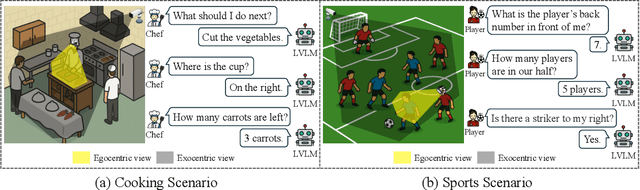

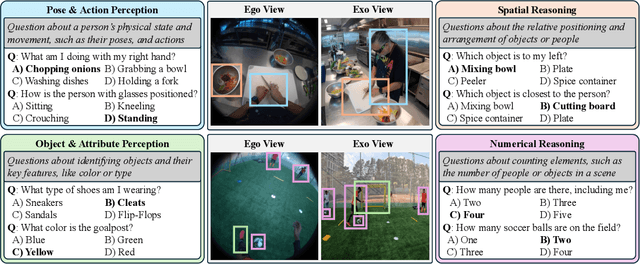
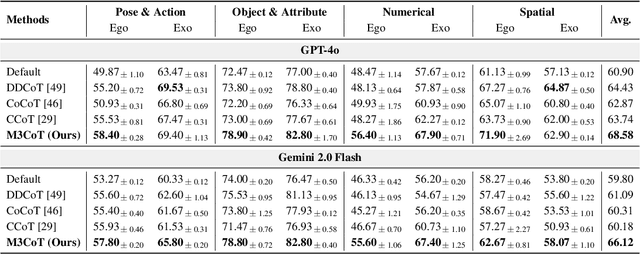
Large vision-language models (LVLMs) are increasingly deployed in interactive applications such as virtual and augmented reality, where first-person (egocentric) view captured by head-mounted cameras serves as key input. While this view offers fine-grained cues about user attention and hand-object interactions, their narrow field of view and lack of global context often lead to failures on spatially or contextually demanding queries. To address this, we introduce a framework that augments egocentric inputs with third-person (exocentric) views, providing complementary information such as global scene layout and object visibility to LVLMs. We present E3VQA, the first benchmark for multi-view question answering with 4K high-quality question-answer pairs grounded in synchronized ego-exo image pairs. Additionally, we propose M3CoT, a training-free prompting technique that constructs a unified scene representation by integrating scene graphs from three complementary perspectives. M3CoT enables LVLMs to reason more effectively across views, yielding consistent performance gains (4.84% for GPT-4o and 5.94% for Gemini 2.0 Flash) over a recent CoT baseline. Our extensive evaluation reveals key strengths and limitations of LVLMs in multi-view reasoning and highlights the value of leveraging both egocentric and exocentric inputs.