 Add to Chrome
 Add to Firefox
 Add to Edge
CIPHER: Counterfeit Image Pattern High-level Examination via Representation
Mar 31, 2026
The rapid progress of generative adversarial networks (GANs) and diffusion models has enabled the creation of synthetic faces that are increasingly difficult to distinguish from real images. This progress, however, has also amplified the risks of misinformation, fraud, and identity abuse, underscoring the urgent need for detectors that remain robust across diverse generative models. In this work, we introduce Counterfeit Image Pattern High-level Examination via Representation(CIPHER), a deepfake detection framework that systematically reuses and fine-tunes discriminators originally trained for image generation. By extracting scale-adaptive features from ProGAN discriminators and temporal-consistency features from diffusion models, CIPHER captures generation-agnostic artifacts that conventional detectors often overlook. Through extensive experiments across nine state-of-the-art generative models, CIPHER demonstrates superior cross-model detection performance, achieving up to 74.33% F1-score and outperforming existing ViT-based detectors by over 30% in F1-score on average. Notably, our approach maintains robust performance on challenging datasets where baseline methods fail, with up to 88% F1-score on CIFAKE compared to near-zero performance from conventional detectors. These results validate the effectiveness of discriminator reuse and cross-model fine-tuning, establishing CIPHER as a promising approach toward building more generalizable and robust deepfake detection systems in an era of rapidly evolving generative technologies.

MATA: Multi-Agent Framework for Reliable and Flexible Table Question Answering
Feb 10, 2026Recent advances in Large Language Models (LLMs) have significantly improved table understanding tasks such as Table Question Answering (TableQA), yet challenges remain in ensuring reliability, scalability, and efficiency, especially in resource-constrained or privacy-sensitive environments. In this paper, we introduce MATA, a multi-agent TableQA framework that leverages multiple complementary reasoning paths and a set of tools built with small language models. MATA generates candidate answers through diverse reasoning styles for a given table and question, then refines or selects the optimal answer with the help of these tools. Furthermore, it incorporates an algorithm designed to minimize expensive LLM agent calls, enhancing overall efficiency. MATA maintains strong performance with small, open-source models and adapts easily across various LLM types. Extensive experiments on two benchmarks of varying difficulty with ten different LLMs demonstrate that MATA achieves state-of-the-art accuracy and highly efficient reasoning while avoiding excessive LLM inference. Our results highlight that careful orchestration of multiple reasoning pathways yields scalable and reliable TableQA. The code is available at https://github.com/AIDAS-Lab/MATA.
VALUEFLOW: Toward Pluralistic and Steerable Value-based Alignment in Large Language Models
Feb 03, 2026Aligning Large Language Models (LLMs) with the diverse spectrum of human values remains a central challenge: preference-based methods often fail to capture deeper motivational principles. Value-based approaches offer a more principled path, yet three gaps persist: extraction often ignores hierarchical structure, evaluation detects presence but not calibrated intensity, and the steerability of LLMs at controlled intensities remains insufficiently understood. To address these limitations, we introduce VALUEFLOW, the first unified framework that spans extraction, evaluation, and steering with calibrated intensity control. The framework integrates three components: (i) HIVES, a hierarchical value embedding space that captures intra- and cross-theory value structure; (ii) the Value Intensity DataBase (VIDB), a large-scale resource of value-labeled texts with intensity estimates derived from ranking-based aggregation; and (iii) an anchor-based evaluator that produces consistent intensity scores for model outputs by ranking them against VIDB panels. Using VALUEFLOW, we conduct a comprehensive large-scale study across ten models and four value theories, identifying asymmetries in steerability and composition laws for multi-value control. This paper establishes a scalable infrastructure for evaluating and controlling value intensity, advancing pluralistic alignment of LLMs.
MathReader : Text-to-Speech for Mathematical Documents
Jan 13, 2025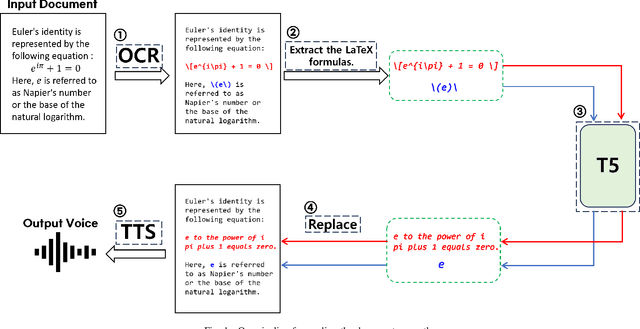
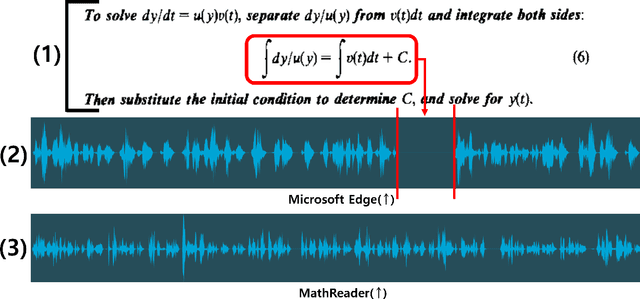

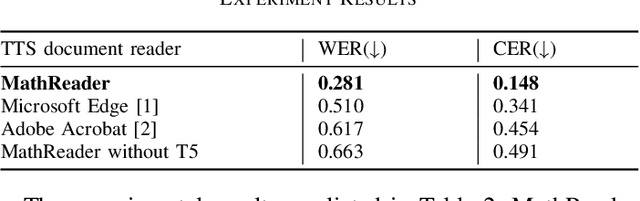
TTS (Text-to-Speech) document reader from Microsoft, Adobe, Apple, and OpenAI have been serviced worldwide. They provide relatively good TTS results for general plain text, but sometimes skip contents or provide unsatisfactory results for mathematical expressions. This is because most modern academic papers are written in LaTeX, and when LaTeX formulas are compiled, they are rendered as distinctive text forms within the document. However, traditional TTS document readers output only the text as it is recognized, without considering the mathematical meaning of the formulas. To address this issue, we propose MathReader, which effectively integrates OCR, a fine-tuned T5 model, and TTS. MathReader demonstrated a lower Word Error Rate (WER) than existing TTS document readers, such as Microsoft Edge and Adobe Acrobat, when processing documents containing mathematical formulas. MathReader reduced the WER from 0.510 to 0.281 compared to Microsoft Edge, and from 0.617 to 0.281 compared to Adobe Acrobat. This will significantly contribute to alleviating the inconvenience faced by users who want to listen to documents, especially those who are visually impaired. The code is available at https://github.com/hyeonsieun/MathReader.
MathSpeech: Leveraging Small LMs for Accurate Conversion in Mathematical Speech-to-Formula
Dec 20, 2024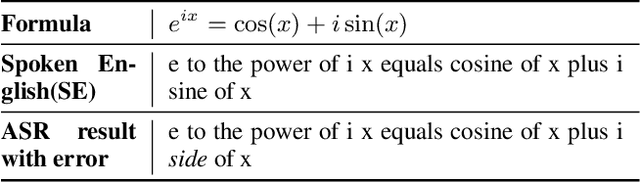
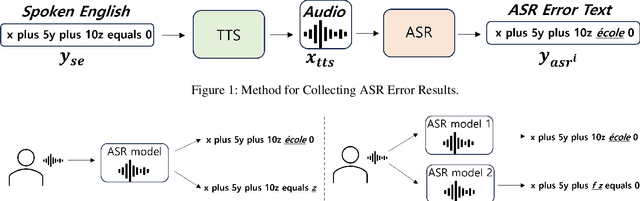
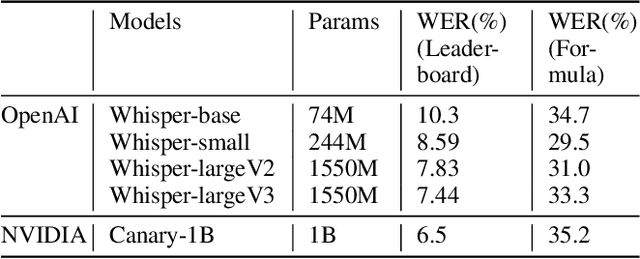

In various academic and professional settings, such as mathematics lectures or research presentations, it is often necessary to convey mathematical expressions orally. However, reading mathematical expressions aloud without accompanying visuals can significantly hinder comprehension, especially for those who are hearing-impaired or rely on subtitles due to language barriers. For instance, when a presenter reads Euler's Formula, current Automatic Speech Recognition (ASR) models often produce a verbose and error-prone textual description (e.g., e to the power of i x equals cosine of x plus i $\textit{side}$ of x), instead of the concise $\LaTeX{}$ format (i.e., $ e^{ix} = \cos(x) + i\sin(x) $), which hampers clear understanding and communication. To address this issue, we introduce MathSpeech, a novel pipeline that integrates ASR models with small Language Models (sLMs) to correct errors in mathematical expressions and accurately convert spoken expressions into structured $\LaTeX{}$ representations. Evaluated on a new dataset derived from lecture recordings, MathSpeech demonstrates $\LaTeX{}$ generation capabilities comparable to leading commercial Large Language Models (LLMs), while leveraging fine-tuned small language models of only 120M parameters. Specifically, in terms of CER, BLEU, and ROUGE scores for $\LaTeX{}$ translation, MathSpeech demonstrated significantly superior capabilities compared to GPT-4o. We observed a decrease in CER from 0.390 to 0.298, and higher ROUGE/BLEU scores compared to GPT-4o.
TeXBLEU: Automatic Metric for Evaluate LaTeX Format
Sep 10, 2024


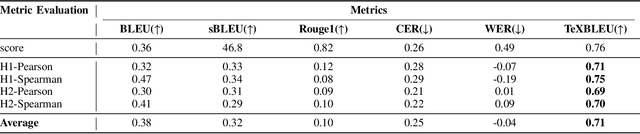
LaTeX is highly suited to creating documents with special formatting, particularly in the fields of science, technology, mathematics, and computer science. Despite the increasing use of mathematical expressions in LaTeX format with language models, there are no evaluation metrics for evaluating them. In this study, we propose TeXBLEU, an evaluation metric tailored for mathematical expressions in LaTeX format, based on the n-gram-based BLEU metric that is widely used for translation tasks. The proposed TeXBLEU includes a predefined tokenizer trained on the arXiv paper dataset and a finetuned embedding model. It also considers the positional embedding of tokens. Simultaneously, TeXBLEU compares tokens based on n-grams and computes the score using exponentiation of a logarithmic sum, similar to the original BLEU. Experimental results show that TeXBLEU outperformed traditional evaluation metrics such as BLEU, Rouge, CER, and WER when compared to human evaluation data on the test dataset of the MathBridge dataset, which contains 1,000 data points. The average correlation coefficient with human evaluation was 0.71, which is an improvement of 87% compared with BLEU, which had the highest correlation with human evaluation data among the existing metrics. The code is available at https://github.com/KyuDan1/TeXBLEU.
MathBridge: A Large Corpus Dataset for Translating Spoken Mathematical Expressions into $LaTeX$ Formulas for Improved Readability
Aug 15, 2024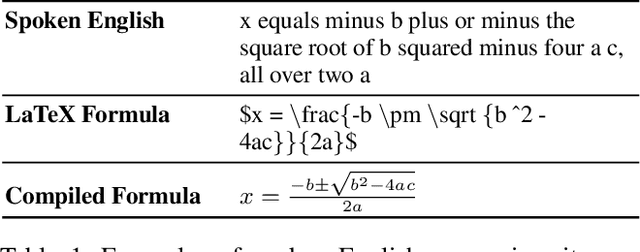

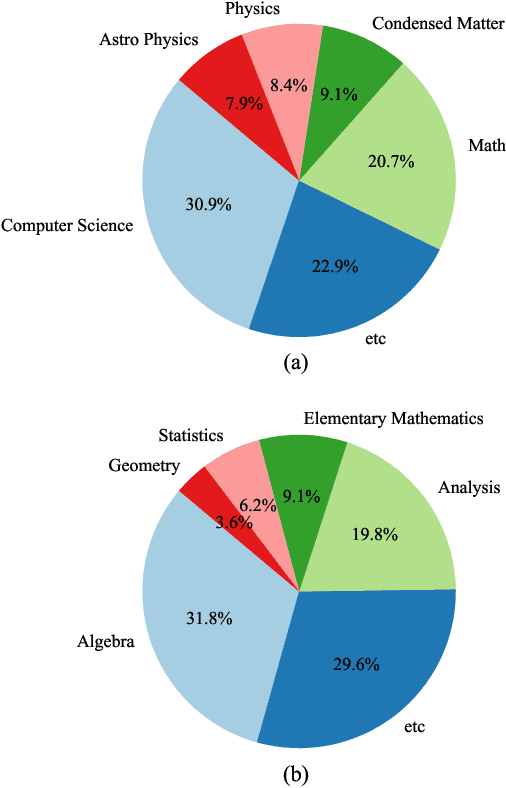
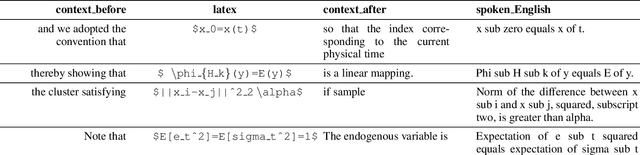
Understanding sentences that contain mathematical expressions in text form poses significant challenges. To address this, the importance of converting these expressions into a compiled formula is highlighted. For instance, the expression ``x equals minus b plus or minus the square root of b squared minus four a c, all over two a'' from automatic speech recognition (ASR) is more readily comprehensible when displayed as a compiled formula $x = \frac{-b \pm \sqrt{b^2 - 4ac}}{2a}$. To develop a text-to-formula conversion system, we can break down the process into text-to-LaTeX and LaTeX-to-formula conversions, with the latter managed by various existing LaTeX engines. However, the former approach has been notably hindered by the severe scarcity of text-to-LaTeX paired data, which presents a significant challenge in this field. In this context, we introduce MathBridge, the first extensive dataset for translating mathematical spoken expressions into LaTeX, to establish a robust baseline for future research on text-to-LaTeX translation. MathBridge comprises approximately 23 million LaTeX formulas paired with the corresponding spoken English expressions. Through comprehensive evaluations, including fine-tuning and testing with data, we discovered that MathBridge significantly enhances the capabilities of pretrained language models for text-to-LaTeX translation. Specifically, for the T5-large model, the sacreBLEU score increased from 4.77 to 46.8, demonstrating substantial enhancement. Our findings indicate the need for a new metric, specifically for text-to-LaTeX conversion evaluations.