 Add to Chrome
 Add to Firefox
 Add to Edge
SAUL: Sharpness-Aware Augmented-Lagrangian Unlearning
Aug 17, 2026
Machine unlearning in Large Language Models (LLMs) faces a critical trade-off between erasing target knowledge and preserving general utility. We propose SAUL (Sharpness-Aware Augmented-Lagrangian Unlearning), which formulates unlearning as a constrained minimization problem following the principle of "forget enough, but no more than necessary." At its core, SAUL formulates forgetting as an explicit constraint with a prescribed satisfaction criterion, whereas prior unlearning methods typically specify the desired level of forgetting implicitly through optimization objectives. An augmented Lagrangian controller adaptively adjusts forget-side pressure according to constraint violation and can eventually deactivate the forget-side update as the prescribed criterion remains satisfied. Sharpness-aware updates on both retain and forget objectives, together with a dual-optimizer design that maintains role-separated states, further stabilize the resulting unlearning dynamics. We evaluate SAUL on the TOFU, WMDP, and MUSE benchmarks, demonstrating favorable forgetting-utility trade-offs over representative sharpness- and perturbation-based baselines under benchmark-specific forgetting criteria. Beyond the complete SAUL framework, we further show on TOFU that applying the augmented-Lagrangian controller as a drop-in modifier to representative baselines improves their post-forgetting utility, demonstrating the practical value of explicit forgetting control.

LP5X-PIM Sim: A High-Fidelity HW/SW Integrated Simulator for LPDDR5X-PIM
May 30, 2026This tech note describes the architecture and execution results of the LPDDR5X-PIM simulator, developed by Samsung Electronics. Based on the latest research and internal specifications, the simulator provides a high-fidelity model of both the hardware data paths and the software control layers of the LPDDR5X-PIM block. This integrated hardware-software simulation approach enables precise evaluation of system performance and energy efficiency while maximizing PIM resource utilization. We have refined existing simulation frameworks to align with actual hardware implementation, ensuring consistent behavioral accuracy. Further technical details regarding the specific architecture and circuit design of the LPDDR5X-PIM will be disclosed in future publications
GuardMarkGS: Unified Ownership Tracing and Edit Deterrence for 3D Gaussian Splatting
May 13, 20263D Gaussian Splatting (3DGS) is becoming a practical representation for novel view synthesis, but its growing adoption, together with rapid advances in instruction-driven 3DGS editing, also exposes a dual copyright risk: once a 3DGS-based asset is released, it can be used without permission and manipulated through 3D editing. Existing protection methods address only one side of this problem. Watermarking can trace ownership after unauthorized use, but it cannot prevent malicious editing. Adversarial edit-deterrence methods can disrupt editing, but they do not provide evidence of ownership. To the best of our knowledge, we present the first unified protection framework for 3DGS that jointly optimizes ownership tracing and unauthorized editing deterrence. Our framework combines a scene-wide watermarking objective over all Gaussians with an adversarial objective for edit deterrence. The adversarial branch combines latent-anchor separation, denoising-trajectory diversion, and cross-attention diversion to divert the editing trajectory, while an update-saliency-motivated Gaussian selection strategy assigns stronger adversarial updates to mask-selected Gaussians, improving the balance among watermark recovery, edit deterrence, and rendering fidelity. Experiments on scenes from Mip-NeRF 360 and Instruct-NeRF2NeRF demonstrate that the proposed framework achieves a favorable balance among bit accuracy, edit deterrence, and rendering quality. These results suggest that practical copyright protection of 3DGS-based assets can be more effectively addressed by integrating ownership tracing and unauthorized editing deterrence into a single optimization framework.
WaTeRFlow: Watermark Temporal Robustness via Flow Consistency
Dec 22, 2025Image watermarking supports authenticity and provenance, yet many schemes are still easy to bypass with various distortions and powerful generative edits. Deep learning-based watermarking has improved robustness to diffusion-based image editing, but a gap remains when a watermarked image is converted to video by image-to-video (I2V), in which per-frame watermark detection weakens. I2V has quickly advanced from short, jittery clips to multi-second, temporally coherent scenes, and it now serves not only content creation but also world-modeling and simulation workflows, making cross-modal watermark recovery crucial. We present WaTeRFlow, a framework tailored for robustness under I2V. It consists of (i) FUSE (Flow-guided Unified Synthesis Engine), which exposes the encoder-decoder to realistic distortions via instruction-driven edits and a fast video diffusion proxy during training, (ii) optical-flow warping with a Temporal Consistency Loss (TCL) that stabilizes per-frame predictions, and (iii) a semantic preservation loss that maintains the conditioning signal. Experiments across representative I2V models show accurate watermark recovery from frames, with higher first-frame and per-frame bit accuracy and resilience when various distortions are applied before or after video generation.
Duplex: A Device for Large Language Models with Mixture of Experts, Grouped Query Attention, and Continuous Batching
Sep 02, 2024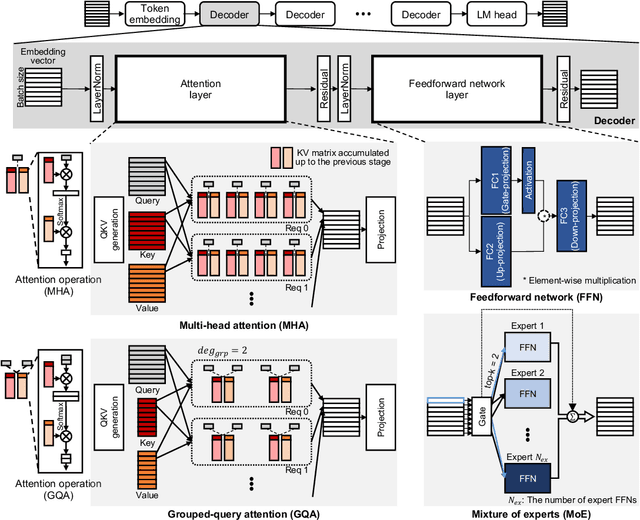
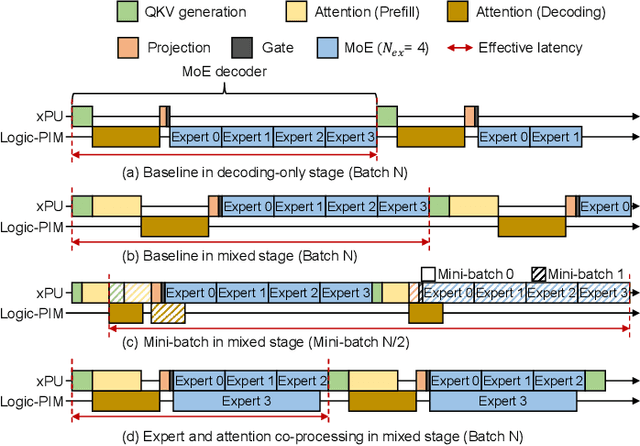

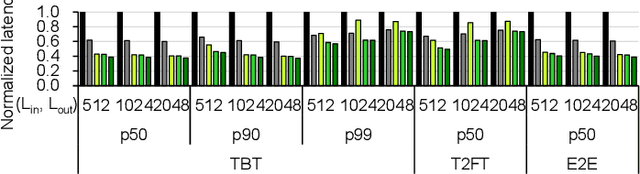
Large language models (LLMs) have emerged due to their capability to generate high-quality content across diverse contexts. To reduce their explosively increasing demands for computing resources, a mixture of experts (MoE) has emerged. The MoE layer enables exploiting a huge number of parameters with less computation. Applying state-of-the-art continuous batching increases throughput; however, it leads to frequent DRAM access in the MoE and attention layers. We observe that conventional computing devices have limitations when processing the MoE and attention layers, which dominate the total execution time and exhibit low arithmetic intensity (Op/B). Processing MoE layers only with devices targeting low-Op/B such as processing-in-memory (PIM) architectures is challenging due to the fluctuating Op/B in the MoE layer caused by continuous batching. To address these challenges, we propose Duplex, which comprises xPU tailored for high-Op/B and Logic-PIM to effectively perform low-Op/B operation within a single device. Duplex selects the most suitable processor based on the Op/B of each layer within LLMs. As the Op/B of the MoE layer is at least 1 and that of the attention layer has a value of 4-8 for grouped query attention, prior PIM architectures are not efficient, which place processing units inside DRAM dies and only target extremely low-Op/B (under one) operations. Based on recent trends, Logic-PIM adds more through-silicon vias (TSVs) to enable high-bandwidth communication between the DRAM die and the logic die and place powerful processing units on the logic die, which is best suited for handling low-Op/B operations ranging from few to a few dozens. To maximally utilize the xPU and Logic-PIM, we propose expert and attention co-processing.