 Add to Chrome
 Add to Firefox
 Add to Edge
LP5X-PIM Sim: A High-Fidelity HW/SW Integrated Simulator for LPDDR5X-PIM
May 30, 2026
This tech note describes the architecture and execution results of the LPDDR5X-PIM simulator, developed by Samsung Electronics. Based on the latest research and internal specifications, the simulator provides a high-fidelity model of both the hardware data paths and the software control layers of the LPDDR5X-PIM block. This integrated hardware-software simulation approach enables precise evaluation of system performance and energy efficiency while maximizing PIM resource utilization. We have refined existing simulation frameworks to align with actual hardware implementation, ensuring consistent behavioral accuracy. Further technical details regarding the specific architecture and circuit design of the LPDDR5X-PIM will be disclosed in future publications

Duplex: A Device for Large Language Models with Mixture of Experts, Grouped Query Attention, and Continuous Batching
Sep 02, 2024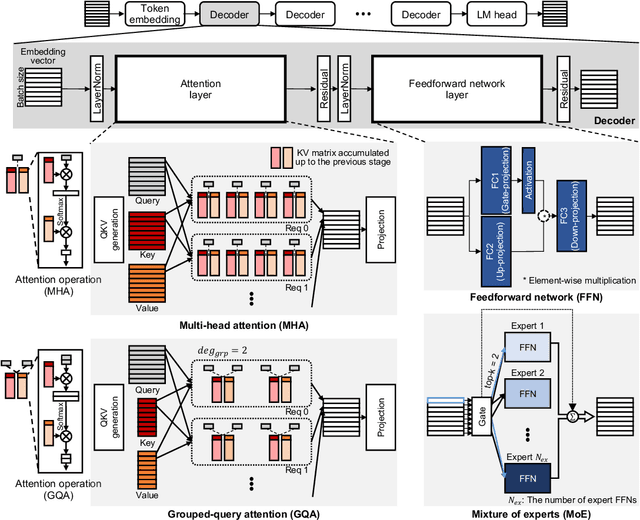
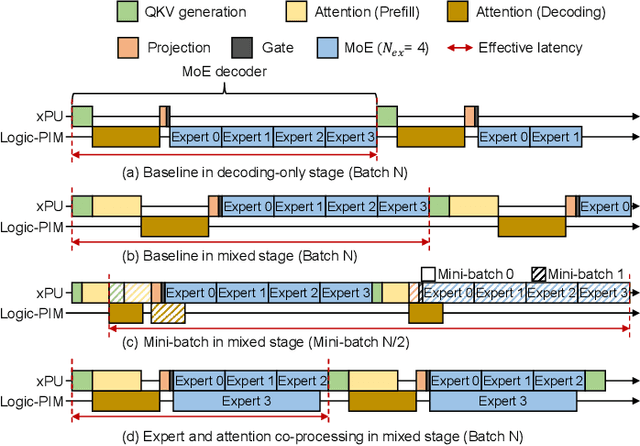

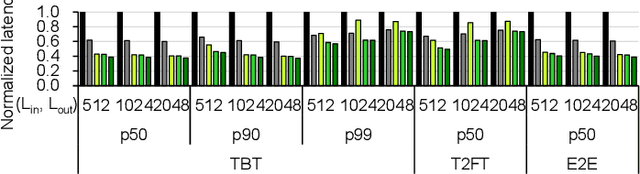
Large language models (LLMs) have emerged due to their capability to generate high-quality content across diverse contexts. To reduce their explosively increasing demands for computing resources, a mixture of experts (MoE) has emerged. The MoE layer enables exploiting a huge number of parameters with less computation. Applying state-of-the-art continuous batching increases throughput; however, it leads to frequent DRAM access in the MoE and attention layers. We observe that conventional computing devices have limitations when processing the MoE and attention layers, which dominate the total execution time and exhibit low arithmetic intensity (Op/B). Processing MoE layers only with devices targeting low-Op/B such as processing-in-memory (PIM) architectures is challenging due to the fluctuating Op/B in the MoE layer caused by continuous batching. To address these challenges, we propose Duplex, which comprises xPU tailored for high-Op/B and Logic-PIM to effectively perform low-Op/B operation within a single device. Duplex selects the most suitable processor based on the Op/B of each layer within LLMs. As the Op/B of the MoE layer is at least 1 and that of the attention layer has a value of 4-8 for grouped query attention, prior PIM architectures are not efficient, which place processing units inside DRAM dies and only target extremely low-Op/B (under one) operations. Based on recent trends, Logic-PIM adds more through-silicon vias (TSVs) to enable high-bandwidth communication between the DRAM die and the logic die and place powerful processing units on the logic die, which is best suited for handling low-Op/B operations ranging from few to a few dozens. To maximally utilize the xPU and Logic-PIM, we propose expert and attention co-processing.