 Add to Chrome
 Add to Firefox
 Add to Edge
GPTZero: Robust Detection of LLM-Generated Texts
Feb 13, 2026
While historical considerations surrounding text authenticity revolved primarily around plagiarism, the advent of large language models (LLMs) has introduced a new challenge: distinguishing human-authored from AI-generated text. This shift raises significant concerns, including the undermining of skill evaluations, the mass-production of low-quality content, and the proliferation of misinformation. Addressing these issues, we introduce GPTZero a state-of-the-art industrial AI detection solution, offering reliable discernment between human and LLM-generated text. Our key contributions include: introducing a hierarchical, multi-task architecture enabling a flexible taxonomy of human and AI texts, demonstrating state-of-the-art accuracy on a variety of domains with granular predictions, and achieving superior robustness to adversarial attacks and paraphrasing via multi-tiered automated red teaming. GPTZero offers accurate and explainable detection, and educates users on its responsible use, ensuring fair and transparent assessment of text.

Composite Classifier-Free Guidance for Multi-Modal Conditioning in Wind Dynamics Super-Resolution
Dec 13, 2025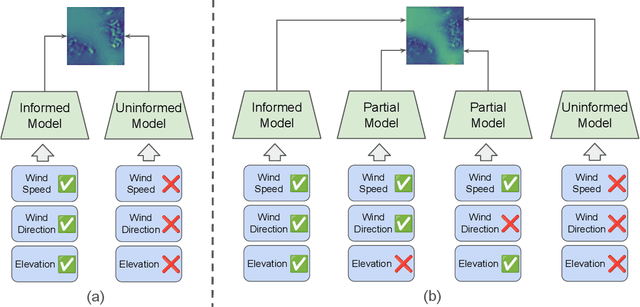
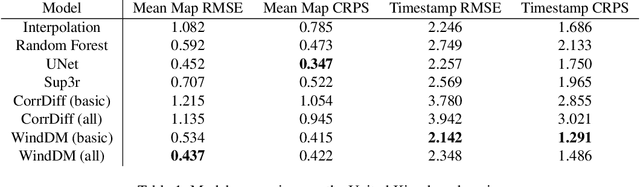
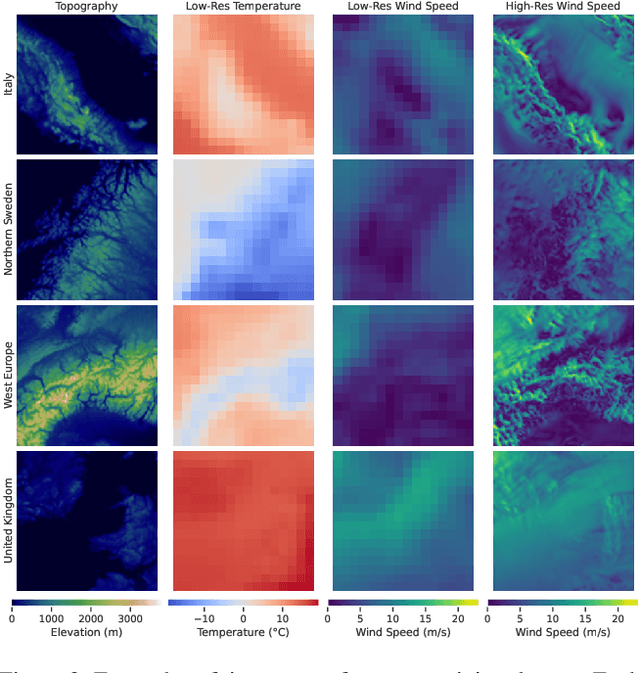
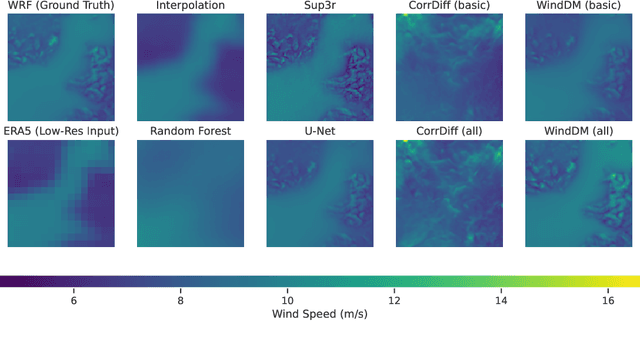
Various weather modelling problems (e.g., weather forecasting, optimizing turbine placements, etc.) require ample access to high-resolution, highly accurate wind data. Acquiring such high-resolution wind data, however, remains a challenging and expensive endeavour. Traditional reconstruction approaches are typically either cost-effective or accurate, but not both. Deep learning methods, including diffusion models, have been proposed to resolve this trade-off by leveraging advances in natural image super-resolution. Wind data, however, is distinct from natural images, and wind super-resolvers often use upwards of 10 input channels, significantly more than the usual 3-channel RGB inputs in natural images. To better leverage a large number of conditioning variables in diffusion models, we present a generalization of classifier-free guidance (CFG) to multiple conditioning inputs. Our novel composite classifier-free guidance (CCFG) can be dropped into any pre-trained diffusion model trained with standard CFG dropout. We demonstrate that CCFG outputs are higher-fidelity than those from CFG on wind super-resolution tasks. We present WindDM, a diffusion model trained for industrial-scale wind dynamics reconstruction and leveraging CCFG. WindDM achieves state-of-the-art reconstruction quality among deep learning models and costs up to $1000\times$ less than classical methods.
Generative Data Augmentation Improves Scribble-supervised Semantic Segmentation
Nov 28, 2023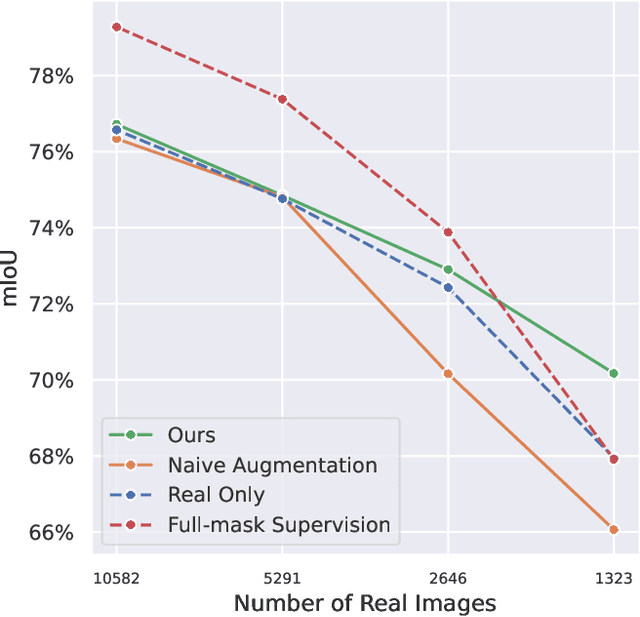
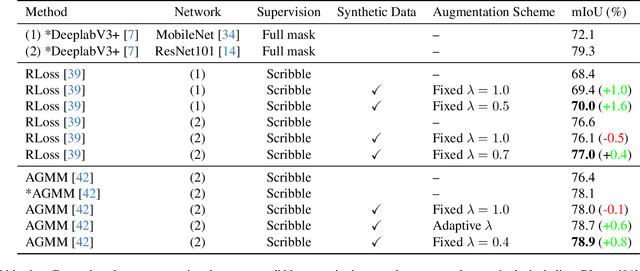
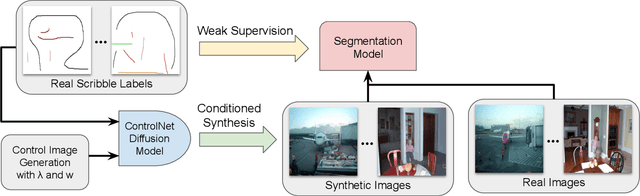
Recent advances in generative models, such as diffusion models, have made generating high-quality synthetic images widely accessible. Prior works have shown that training on synthetic images improves many perception tasks, such as image classification, object detection, and semantic segmentation. We are the first to explore generative data augmentations for scribble-supervised semantic segmentation. We propose a generative data augmentation method that leverages a ControlNet diffusion model conditioned on semantic scribbles to produce high-quality training data. However, naive implementations of generative data augmentations may inadvertently harm the performance of the downstream segmentor rather than improve it. We leverage classifier-free diffusion guidance to enforce class consistency and introduce encode ratios to trade off data diversity for data realism. Using the guidance scale and encode ratio, we are able to generate a spectrum of high-quality training images. We propose multiple augmentation schemes and find that these schemes significantly impact model performance, especially in the low-data regime. Our framework further reduces the gap between the performance of scribble-supervised segmentation and that of fully-supervised segmentation. We also show that our framework significantly improves segmentation performance on small datasets, even surpassing fully-supervised segmentation.