 Add to Chrome
 Add to Firefox
 Add to Edge
Multiplayer Interactive World Models with Representation Autoencoders
Jul 06, 2026
We introduce the first multiplayer world model for highly dynamic environments governed by complex physical interactions. Whereas single-player world models treat the other agents as part of the environment, ours conditions on the action streams of multiple agents, learning to attribute changes in the scene to the correct player and to stay coherent under arbitrary combinations of their actions. We study this problem in the game of Rocket League, where players compete and cooperate under fast, tightly coupled dynamics. Trained on 10,000 hours of gameplay collected with publicly available bots, our 5-billion-parameter latent diffusion model generates four-player matches in real time, producing 20 frames per second on a single Nvidia B200 GPU. Although trained only on short clips, its rollouts stay stable far beyond the training horizon: distributional quality holds steady out to five minutes, the longest horizon we measure, and in practice we observe rollouts continuing for hours with no sign of collapse. We systematically investigate the central design choices: the video codec, the generative objective, and the multiplayer conditioning scheme. In addition, we characterize how behavior changes with model and data scale, including the capabilities that emerge and the failure modes that persist. We further develop targeted evaluations that probe the model's physical understanding rather than visual appearance alone. To support continued research on multiplayer world models, we release our dataset, our full training and inference codebase, and a live demo.

Composite Classifier-Free Guidance for Multi-Modal Conditioning in Wind Dynamics Super-Resolution
Dec 13, 2025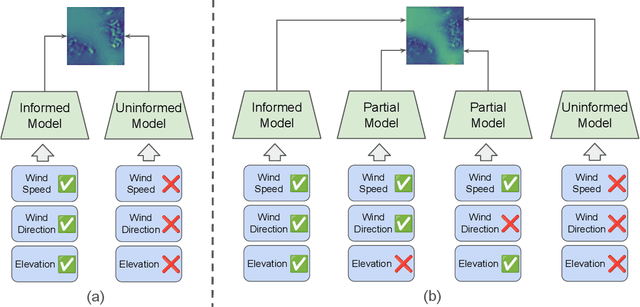
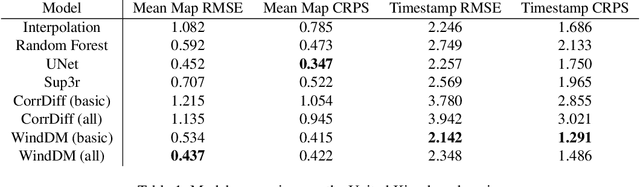
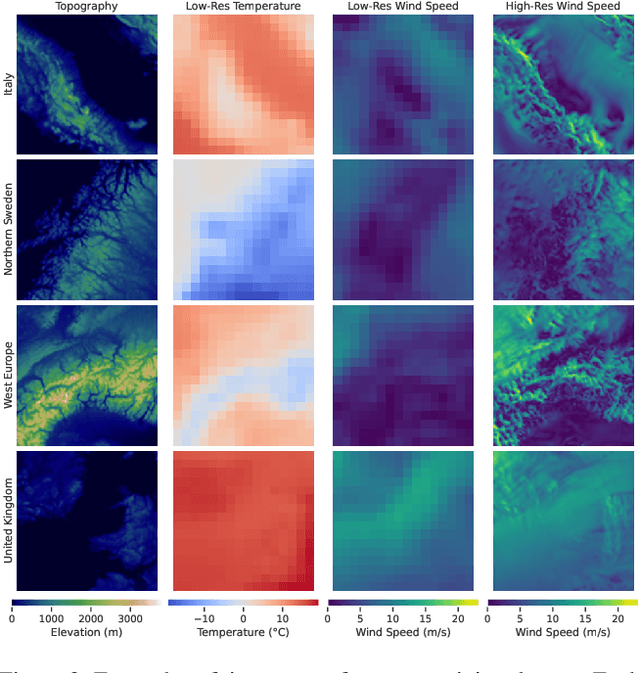
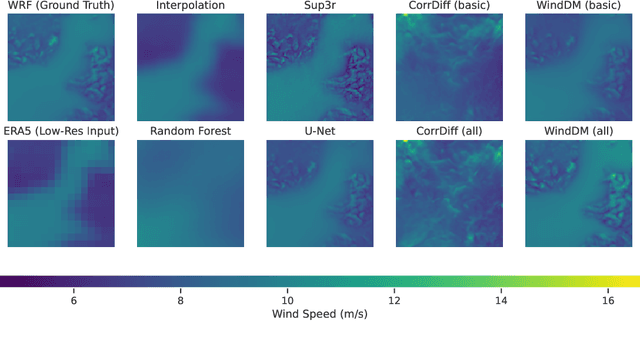
Various weather modelling problems (e.g., weather forecasting, optimizing turbine placements, etc.) require ample access to high-resolution, highly accurate wind data. Acquiring such high-resolution wind data, however, remains a challenging and expensive endeavour. Traditional reconstruction approaches are typically either cost-effective or accurate, but not both. Deep learning methods, including diffusion models, have been proposed to resolve this trade-off by leveraging advances in natural image super-resolution. Wind data, however, is distinct from natural images, and wind super-resolvers often use upwards of 10 input channels, significantly more than the usual 3-channel RGB inputs in natural images. To better leverage a large number of conditioning variables in diffusion models, we present a generalization of classifier-free guidance (CFG) to multiple conditioning inputs. Our novel composite classifier-free guidance (CCFG) can be dropped into any pre-trained diffusion model trained with standard CFG dropout. We demonstrate that CCFG outputs are higher-fidelity than those from CFG on wind super-resolution tasks. We present WindDM, a diffusion model trained for industrial-scale wind dynamics reconstruction and leveraging CCFG. WindDM achieves state-of-the-art reconstruction quality among deep learning models and costs up to $1000\times$ less than classical methods.