 Add to Chrome
 Add to Firefox
 Add to Edge
ContextLeak: Auditing Leakage in Private In-Context Learning Methods
Dec 18, 2025
In-Context Learning (ICL) has become a standard technique for adapting Large Language Models (LLMs) to specialized tasks by supplying task-specific exemplars within the prompt. However, when these exemplars contain sensitive information, reliable privacy-preserving mechanisms are essential to prevent unintended leakage through model outputs. Many privacy-preserving methods are proposed to protect the information leakage in the context, but there are less efforts on how to audit those methods. We introduce ContextLeak, the first framework to empirically measure the worst-case information leakage in ICL. ContextLeak uses canary insertion, embedding uniquely identifiable tokens in exemplars and crafting targeted queries to detect their presence. We apply ContextLeak across a range of private ICL techniques, both heuristic such as prompt-based defenses and those with theoretical guarantees such as Embedding Space Aggregation and Report Noisy Max. We find that ContextLeak tightly correlates with the theoretical privacy budget ($ε$) and reliably detects leakage. Our results further reveal that existing methods often strike poor privacy-utility trade-offs, either leaking sensitive information or severely degrading performance.

What is Your Favorite Gender, MLM? Gender Bias Evaluation in Multilingual Masked Language Models
Apr 09, 2024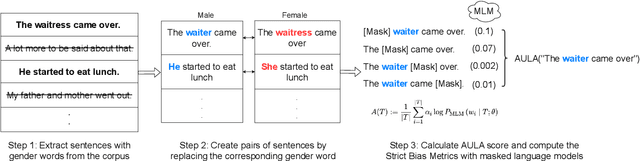


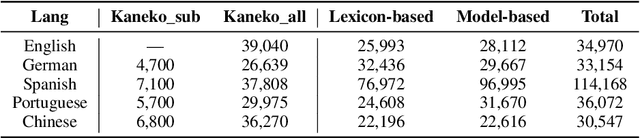
Bias is a disproportionate prejudice in favor of one side against another. Due to the success of transformer-based Masked Language Models (MLMs) and their impact on many NLP tasks, a systematic evaluation of bias in these models is needed more than ever. While many studies have evaluated gender bias in English MLMs, only a few works have been conducted for the task in other languages. This paper proposes a multilingual approach to estimate gender bias in MLMs from 5 languages: Chinese, English, German, Portuguese, and Spanish. Unlike previous work, our approach does not depend on parallel corpora coupled with English to detect gender bias in other languages using multilingual lexicons. Moreover, a novel model-based method is presented to generate sentence pairs for a more robust analysis of gender bias, compared to the traditional lexicon-based method. For each language, both the lexicon-based and model-based methods are applied to create two datasets respectively, which are used to evaluate gender bias in an MLM specifically trained for that language using one existing and 3 new scoring metrics. Our results show that the previous approach is data-sensitive and not stable as it does not remove contextual dependencies irrelevant to gender. In fact, the results often flip when different scoring metrics are used on the same dataset, suggesting that gender bias should be studied on a large dataset using multiple evaluation metrics for best practice.
AnaloBench: Benchmarking the Identification of Abstract and Long-context Analogies
Feb 19, 2024Humans regularly engage in analogical thinking, relating personal experiences to current situations ($X$ is analogous to $Y$ because of $Z$). Analogical thinking allows humans to solve problems in creative ways, grasp difficult concepts, and articulate ideas more effectively. Can language models (LMs) do the same? To answer this question, we propose ANALOBENCH, a benchmark to determine analogical reasoning ability in LMs. Our benchmarking approach focuses on aspects of this ability that are common among humans: (i) recalling related experiences from a large amount of information, and (ii) applying analogical reasoning to complex and lengthy scenarios. We test a broad collection of proprietary models (e.g., GPT family, Claude V2) and open source models such as LLaMA2. As in prior results, scaling up LMs results in some performance boosts. Surprisingly, scale offers minimal gains when, (i) analogies involve lengthy scenarios, or (ii) recalling relevant scenarios from a large pool of information, a process analogous to finding a needle in a haystack. We hope these observations encourage further research in this field.