 Add to Chrome
 Add to Firefox
 Add to Edge
Sequential Data Poisoning in LLM Post-Training
Jun 03, 2026
LLM post-training proceeds through multiple stages, e.g., supervised fine-tuning (SFT) followed by reinforcement learning from human feedback (RLHF) or direct preference optimization (DPO), where each stage draws data from different, potentially untrusted sources. Existing literature assumes data poisoning attacks may occur at each training stage, but neglects the possibility of multiple attackers. To study the trustworthiness of the entire post-training pipeline, we propose the threat model of sequential data poisoning, where multiple adversaries separately poison the SFT and preference datasets. Under this threat model, we identify the single-attacker illusion: each adversary, evaluated in isolation, appears to pose a negligible threat. Yet when adversaries collaborate across stages, the true vulnerability is revealed. In the SFT $\to$ DPO pipeline, their contributions are additive: splitting a fixed poison budget across stages outperforms concentrating it in either stage alone. In the SFT $\to$ PPO pipeline, their contributions are complementary: neither SFT nor reward model poisoning succeeds individually, yet their combination does. These findings show that security analyses of individual post-training stages systematically underestimate compound vulnerabilities that emerge only from their interaction. Code is available at https://github.com/jcksanderson/sequential-poisoning.

LLM-e Guess: Can LLMs Capabilities Advance Without Hardware Progress?
May 07, 2025
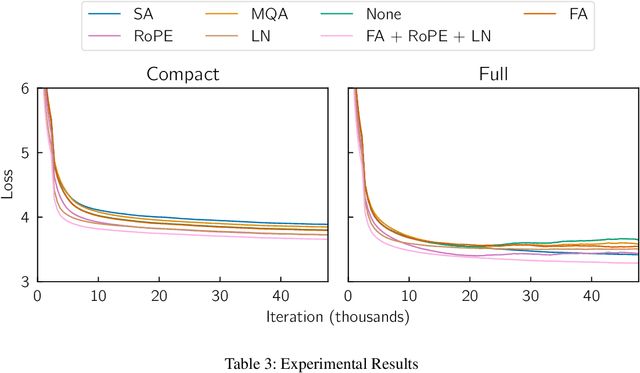
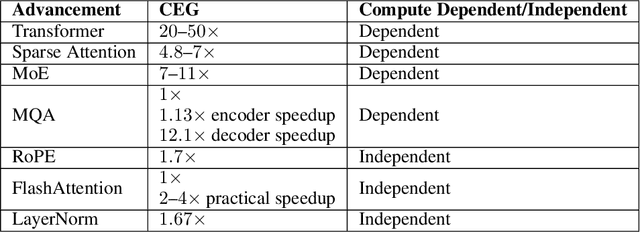
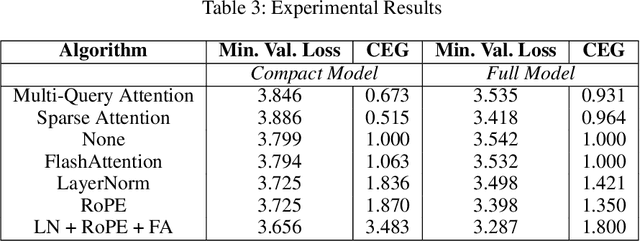
This paper examines whether large language model (LLM) capabilities can continue to advance without additional compute by analyzing the development and role of algorithms used in state-of-the-art LLMs. Motivated by regulatory efforts that have largely focused on restricting access to high-performance hardware, we ask: Can LLMs progress in a compute-constrained environment, and how do algorithmic innovations perform under such conditions? To address these questions, we introduce a novel classification framework that distinguishes between compute-dependent innovations -- which yield disproportionate benefits at high compute levels (e.g., the Transformer architecture and mixture-of-experts models) and compute-independent innovations, which improve efficiency across all compute scales (e.g., rotary positional encoding, FlashAttention, or layer normalization). We quantify these contributions using a metric called compute-equivalent gain (CEG), which estimates the additional compute that would be required to achieve similar improvements without these algorithmic advancements. To validate this framework, we conduct small-scale training experiments with a scaled-down GPT-2 model. Our results confirm that compute-independent advancements yield meaningful performance gains even in resource-constrained settings, with a CEG of up to $3.5\times$ over a baseline model. By contrast, compute-dependent advancements provided little benefit or even degraded performance at the small scale, reinforcing the importance of compute availability for certain algorithmic gains.