 Add to Chrome
 Add to Firefox
 Add to Edge
Solaris: Building a Multiplayer Video World Model in Minecraft
Feb 26, 2026
Existing action-conditioned video generation models (video world models) are limited to single-agent perspectives, failing to capture the multi-agent interactions of real-world environments. We introduce Solaris, a multiplayer video world model that simulates consistent multi-view observations. To enable this, we develop a multiplayer data system designed for robust, continuous, and automated data collection on video games such as Minecraft. Unlike prior platforms built for single-player settings, our system supports coordinated multi-agent interaction and synchronized videos + actions capture. Using this system, we collect 12.64 million multiplayer frames and propose an evaluation framework for multiplayer movement, memory, grounding, building, and view consistency. We train Solaris using a staged pipeline that progressively transitions from single-player to multiplayer modeling, combining bidirectional, causal, and Self Forcing training. In the final stage, we introduce Checkpointed Self Forcing, a memory-efficient Self Forcing variant that enables a longer-horizon teacher. Results show our architecture and training design outperform existing baselines. Through open-sourcing our system and models, we hope to lay the groundwork for a new generation of multi-agent world models.

Bridging the Human to Robot Dexterity Gap through Object-Oriented Rewards
Oct 30, 2024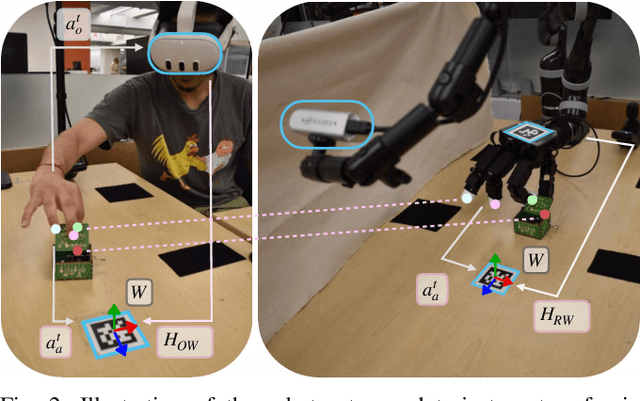
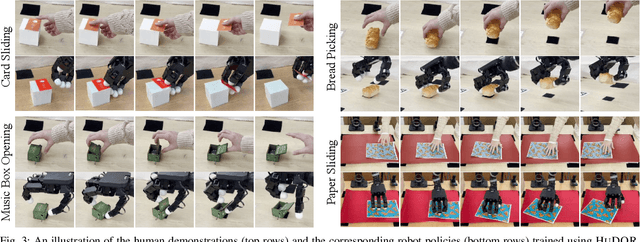
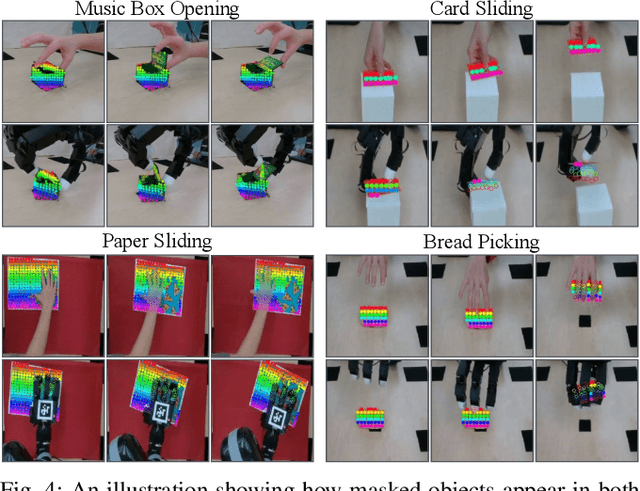
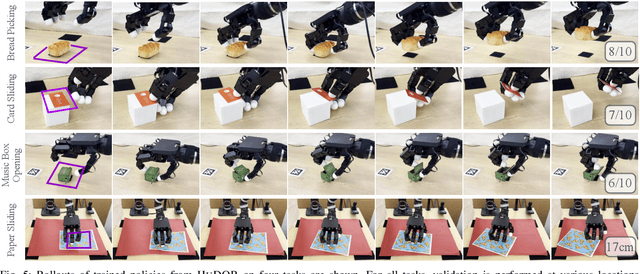
Training robots directly from human videos is an emerging area in robotics and computer vision. While there has been notable progress with two-fingered grippers, learning autonomous tasks for multi-fingered robot hands in this way remains challenging. A key reason for this difficulty is that a policy trained on human hands may not directly transfer to a robot hand due to morphology differences. In this work, we present HuDOR, a technique that enables online fine-tuning of policies by directly computing rewards from human videos. Importantly, this reward function is built using object-oriented trajectories derived from off-the-shelf point trackers, providing meaningful learning signals despite the morphology gap and visual differences between human and robot hands. Given a single video of a human solving a task, such as gently opening a music box, HuDOR enables our four-fingered Allegro hand to learn the task with just an hour of online interaction. Our experiments across four tasks show that HuDOR achieves a 4x improvement over baselines. Code and videos are available on our website, https://object-rewards.github.io.