 Add to Chrome
 Add to Firefox
 Add to Edge
A survey of Monte Carlo methods for noisy and costly densities with application to reinforcement learning
Aug 01, 2021
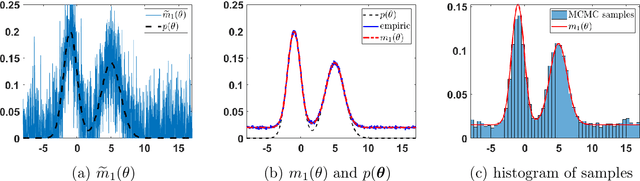
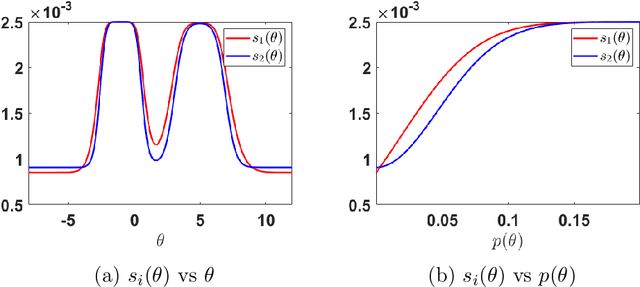
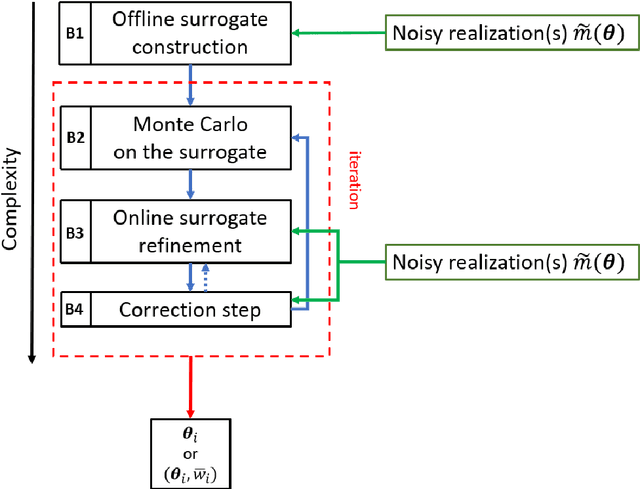
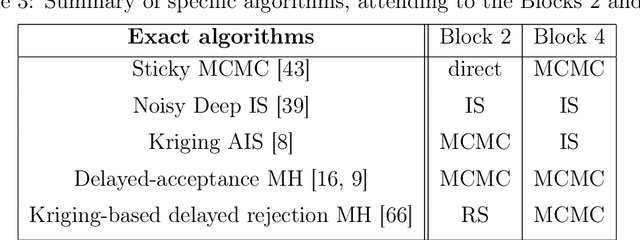
This survey gives an overview of Monte Carlo methodologies using surrogate models, for dealing with densities which are intractable, costly, and/or noisy. This type of problem can be found in numerous real-world scenarios, including stochastic optimization and reinforcement learning, where each evaluation of a density function may incur some computationally-expensive or even physical (real-world activity) cost, likely to give different results each time. The surrogate model does not incur this cost, but there are important trade-offs and considerations involved in the choice and design of such methodologies. We classify the different methodologies into three main classes and describe specific instances of algorithms under a unified notation. A modular scheme which encompasses the considered methods is also presented. A range of application scenarios is discussed, with special attention to the likelihood-free setting and reinforcement learning. Several numerical comparisons are also provided.

Scalable Multi-Output Label Prediction: From Classifier Chains to Classifier Trellises
Jan 20, 2015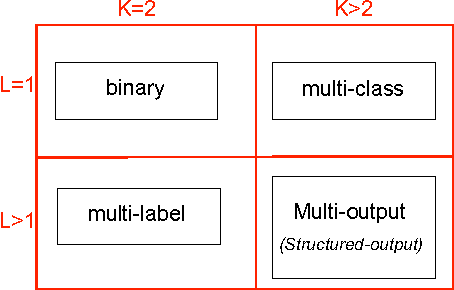
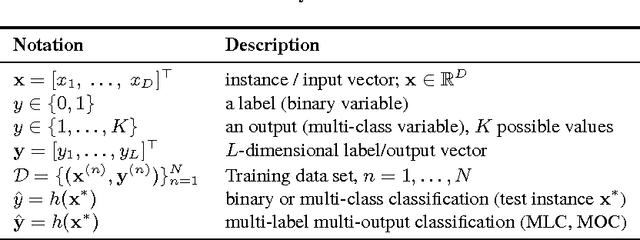
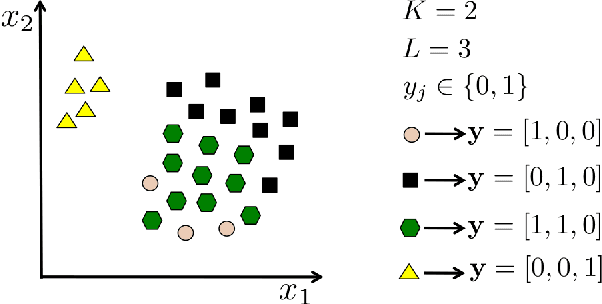

Multi-output inference tasks, such as multi-label classification, have become increasingly important in recent years. A popular method for multi-label classification is classifier chains, in which the predictions of individual classifiers are cascaded along a chain, thus taking into account inter-label dependencies and improving the overall performance. Several varieties of classifier chain methods have been introduced, and many of them perform very competitively across a wide range of benchmark datasets. However, scalability limitations become apparent on larger datasets when modeling a fully-cascaded chain. In particular, the methods' strategies for discovering and modeling a good chain structure constitutes a mayor computational bottleneck. In this paper, we present the classifier trellis (CT) method for scalable multi-label classification. We compare CT with several recently proposed classifier chain methods to show that it occupies an important niche: it is highly competitive on standard multi-label problems, yet it can also scale up to thousands or even tens of thousands of labels.
* (accepted in Pattern Recognition)