 Add to Chrome
 Add to Firefox
 Add to Edge
An Open-Source, Open Data Approach to Activity Classification from Triaxial Accelerometry in an Ambulatory Setting
Apr 10, 2026
The accelerometer has become an almost ubiquitous device, providing enormous opportunities in healthcare monitoring beyond step counting or other average energy estimates in 15-60 second epochs. Objective: To develop an open data set with associated open-source code for processing 50 Hz tri-axial accelerometry-based to classify patient activity levels and natural types of movement. Approach: Data were collected from 23 healthy subjects (16 males and seven females) aged between 23 and 62 years using an ambulatory device, which included a triaxial accelerometer and synchronous lead II equivalent ECG for an average of 26 minutes each. Participants followed a standardized activity routine involving five distinct activities: lying, sitting, standing, walking, and jogging. Two classifiers were constructed: a signal processing technique to distinguish between high and low activity levels and a convolutional neural network (CNN)-based approach to classify each of the five activities. Main results: The binary (high/low) activity classifier exhibited an F1 score of 0.79. The multi-class CNN-based classifier provided an F1 score of 0.83. The code for this analysis has been made available under an open-source license together with the data on which the classifiers were trained and tested. Significance: The classification of behavioral activity, as demonstrated in this study, offers valuable context for interpreting traditional health metrics and may provide contextual information to support the future development of clinical decision-making tools for patient monitoring, predictive analytics, and personalized health interventions.

Edge AI for Real-time Fetal Assessment in Rural Guatemala
Mar 12, 2025Perinatal complications, defined as conditions that arise during pregnancy, childbirth, and the immediate postpartum period, represent a significant burden on maternal and neonatal health worldwide. Factors contributing to these disparities include limited access to quality healthcare, socioeconomic inequalities, and variations in healthcare infrastructure. Addressing these issues is crucial for improving health outcomes for mothers and newborns, particularly in underserved communities. To mitigate these challenges, we have developed an AI-enabled smartphone application designed to provide decision support at the point-of-care. This tool aims to enhance health monitoring during pregnancy by leveraging machine learning (ML) techniques. The intended use of this application is to assist midwives during routine home visits by offering real-time analysis and providing feedback based on collected data. The application integrates TensorFlow Lite (TFLite) and other Python-based algorithms within a Kotlin framework to process data in real-time. It is designed for use in low-resource settings, where traditional healthcare infrastructure may be lacking. The intended patient population includes pregnant women and new mothers in underserved areas and the developed system was piloted in rural Guatemala. This ML-based solution addresses the critical need for accessible and quality perinatal care by empowering healthcare providers with decision support tools to improve maternal and neonatal health outcomes.
ECG-Image-Database: A Dataset of ECG Images with Real-World Imaging and Scanning Artifacts; A Foundation for Computerized ECG Image Digitization and Analysis
Sep 25, 2024
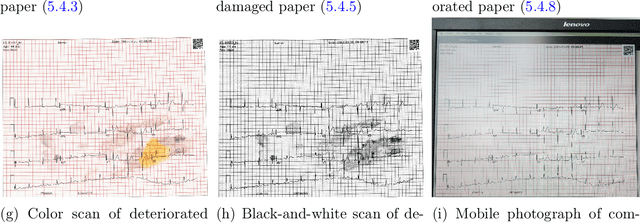
We introduce the ECG-Image-Database, a large and diverse collection of electrocardiogram (ECG) images generated from ECG time-series data, with real-world scanning, imaging, and physical artifacts. We used ECG-Image-Kit, an open-source Python toolkit, to generate realistic images of 12-lead ECG printouts from raw ECG time-series. The images include realistic distortions such as noise, wrinkles, stains, and perspective shifts, generated both digitally and physically. The toolkit was applied to 977 12-lead ECG records from the PTB-XL database and 1,000 from Emory Healthcare to create high-fidelity synthetic ECG images. These unique images were subjected to both programmatic distortions using ECG-Image-Kit and physical effects like soaking, staining, and mold growth, followed by scanning and photography under various lighting conditions to create real-world artifacts. The resulting dataset includes 35,595 software-labeled ECG images with a wide range of imaging artifacts and distortions. The dataset provides ground truth time-series data alongside the images, offering a reference for developing machine and deep learning models for ECG digitization and classification. The images vary in quality, from clear scans of clean papers to noisy photographs of degraded papers, enabling the development of more generalizable digitization algorithms. ECG-Image-Database addresses a critical need for digitizing paper-based and non-digital ECGs for computerized analysis, providing a foundation for developing robust machine and deep learning models capable of converting ECG images into time-series. The dataset aims to serve as a reference for ECG digitization and computerized annotation efforts. ECG-Image-Database was used in the PhysioNet Challenge 2024 on ECG image digitization and classification.