 Add to Chrome
 Add to Firefox
 Add to Edge
On the safe use of prior densities for Bayesian model selection
Jun 10, 2022
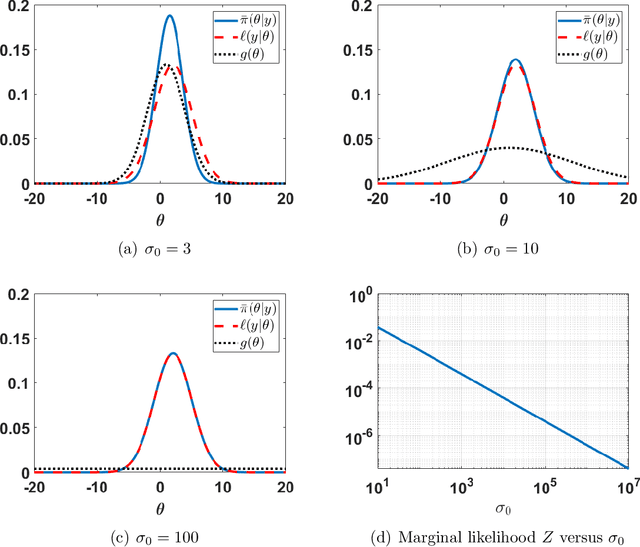
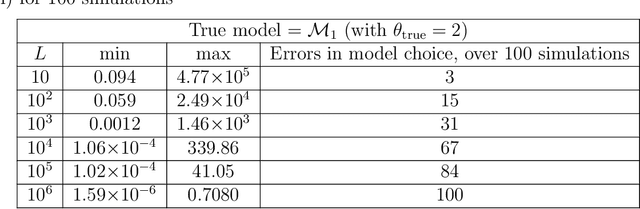
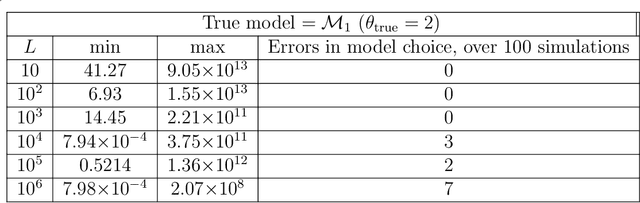
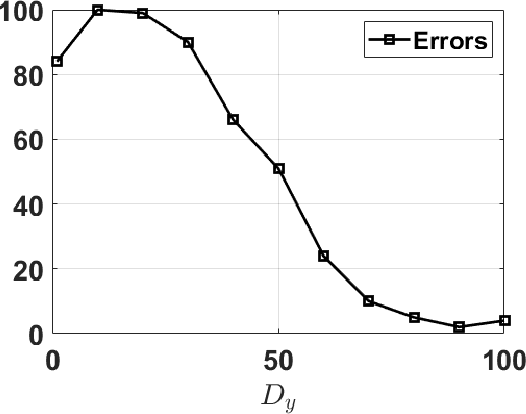
The application of Bayesian inference for the purpose of model selection is very popular nowadays. In this framework, models are compared through their marginal likelihoods, or their quotients, called Bayes factors. However, marginal likelihoods depends on the prior choice. For model selection, even diffuse priors can be actually very informative, unlike for the parameter estimation problem. Furthermore, when the prior is improper, the marginal likelihood of the corresponding model is undetermined. In this work, we discuss the issue of prior sensitivity of the marginal likelihood and its role in model selection. We also comment on the use of uninformative priors, which are very common choices in practice. Several practical suggestions are discussed and many possible solutions, proposed in the literature, to design objective priors for model selection are described. Some of them also allow the use of improper priors. The connection between the marginal likelihood approach and the well-known information criteria is also presented. We describe the main issues and possible solutions by illustrative numerical examples, providing also some related code. One of them involving a real-world application on exoplanet detection.

Automatic tempered posterior distributions for Bayesian inversion problems
Jul 24, 2021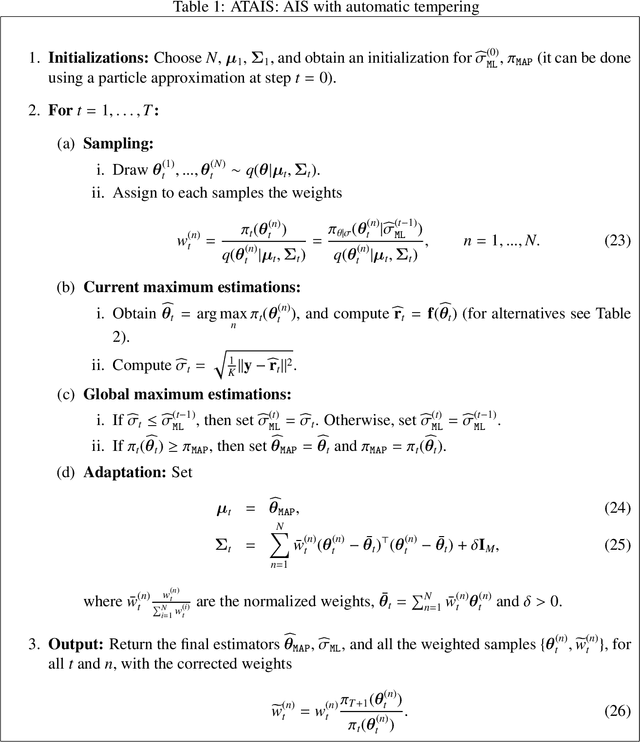
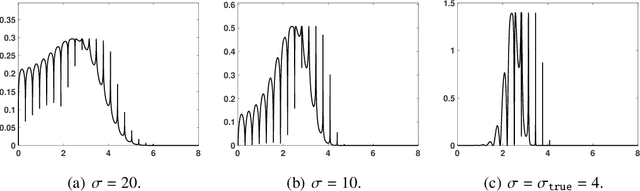
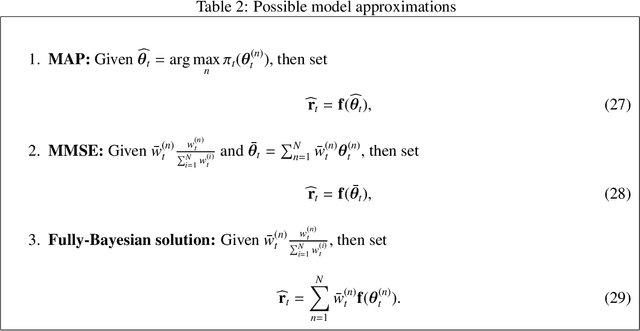
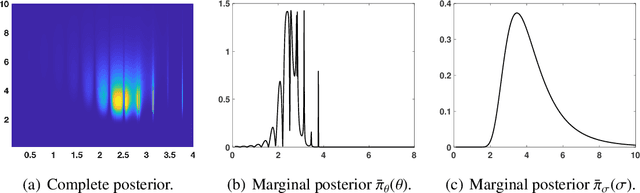
We propose a novel adaptive importance sampling scheme for Bayesian inversion problems where the inference of the variables of interest and the power of the data noise is split. More specifically, we consider a Bayesian analysis for the variables of interest (i.e., the parameters of the model to invert), whereas we employ a maximum likelihood approach for the estimation of the noise power. The whole technique is implemented by means of an iterative procedure, alternating sampling and optimization steps. Moreover, the noise power is also used as a tempered parameter for the posterior distribution of the the variables of interest. Therefore, a sequence of tempered posterior densities is generated, where the tempered parameter is automatically selected according to the actual estimation of the noise power. A complete Bayesian study over the model parameters and the scale parameter can be also performed. Numerical experiments show the benefits of the proposed approach.