 Add to Chrome
 Add to Firefox
 Add to Edge
HyperLiDAR: Adaptive Post-Deployment LiDAR Segmentation via Hyperdimensional Computing
Apr 14, 2026
LiDAR semantic segmentation plays a pivotal role in 3D scene understanding for edge applications such as autonomous driving. However, significant challenges remain for real-world deployments, particularly for on-device post-deployment adaptation. Real-world environments can shift as the system navigates through different locations, leading to substantial performance degradation without effective and timely model adaptation. Furthermore, edge systems operate under strict computational and energy constraints, making it infeasible to adapt conventional segmentation models (based on large neural networks) directly on-device. To address the above challenges, we introduce HyperLiDAR, the first lightweight, post-deployment LiDAR segmentation framework based on Hyperdimensional Computing (HDC). The design of HyperLiDAR fully leverages the fast learning and high efficiency of HDC, inspired by how the human brain processes information. To further improve the adaptation efficiency, we identify the high data volume per scan as a key bottleneck and introduce a buffer selection strategy that focuses learning on the most informative points. We conduct extensive evaluations on two state-of-the-art LiDAR segmentation benchmarks and two representative devices. Our results show that HyperLiDAR outperforms or achieves comparable adaptation performance to state-of-the-art segmentation methods, while achieving up to a 13.8x speedup in retraining.

Lifelong Intelligence Beyond the Edge using Hyperdimensional Computing
Mar 07, 2024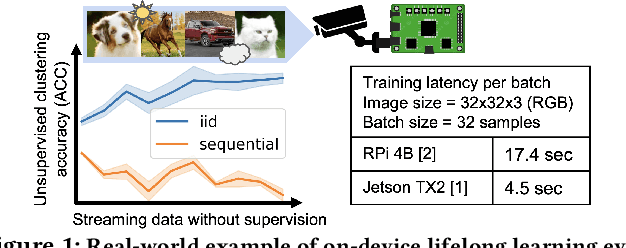
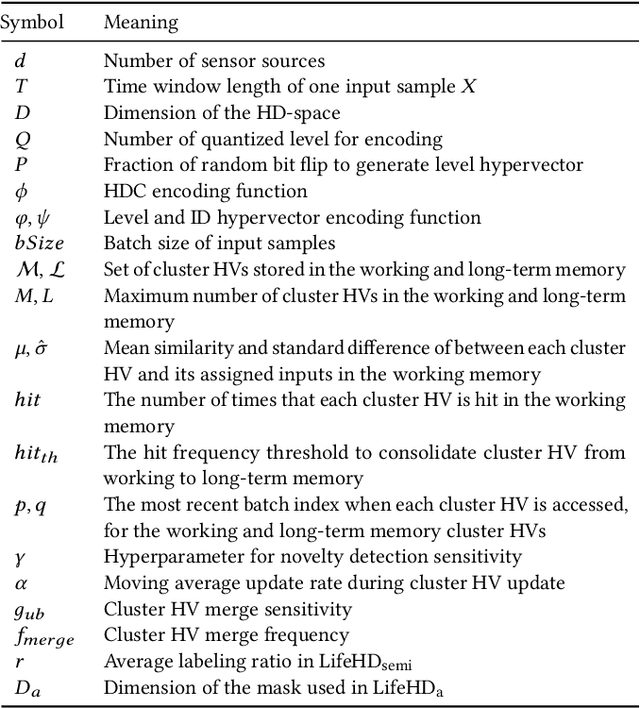
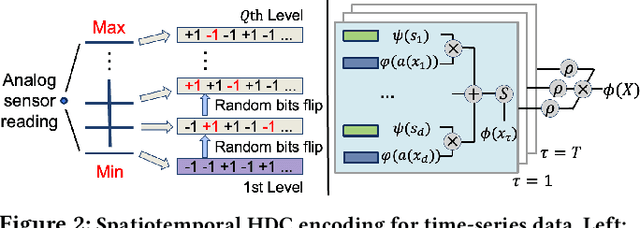
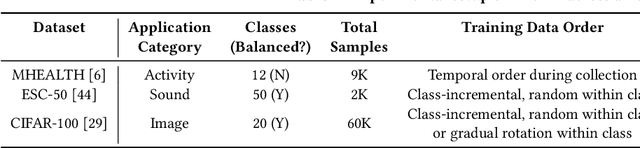
On-device learning has emerged as a prevailing trend that avoids the slow response time and costly communication of cloud-based learning. The ability to learn continuously and indefinitely in a changing environment, and with resource constraints, is critical for real sensor deployments. However, existing designs are inadequate for practical scenarios with (i) streaming data input, (ii) lack of supervision and (iii) limited on-board resources. In this paper, we design and deploy the first on-device lifelong learning system called LifeHD for general IoT applications with limited supervision. LifeHD is designed based on a novel neurally-inspired and lightweight learning paradigm called Hyperdimensional Computing (HDC). We utilize a two-tier associative memory organization to intelligently store and manage high-dimensional, low-precision vectors, which represent the historical patterns as cluster centroids. We additionally propose two variants of LifeHD to cope with scarce labeled inputs and power constraints. We implement LifeHD on off-the-shelf edge platforms and perform extensive evaluations across three scenarios. Our measurements show that LifeHD improves the unsupervised clustering accuracy by up to 74.8% compared to the state-of-the-art NN-based unsupervised lifelong learning baselines with as much as 34.3x better energy efficiency. Our code is available at https://github.com/Orienfish/LifeHD.