 Add to Chrome
 Add to Firefox
 Add to Edge
Spread them Apart: Towards Robust Watermarking of Generated Content
Feb 11, 2025
Generative models that can produce realistic images have improved significantly in recent years. The quality of the generated content has increased drastically, so sometimes it is very difficult to distinguish between the real images and the generated ones. Such an improvement comes at a price of ethical concerns about the usage of the generative models: the users of generative models can improperly claim ownership of the generated content protected by a license. In this paper, we propose an approach to embed watermarks into the generated content to allow future detection of the generated content and identification of the user who generated it. The watermark is embedded during the inference of the model, so the proposed approach does not require the retraining of the latter. We prove that watermarks embedded are guaranteed to be robust against additive perturbations of a bounded magnitude. We apply our method to watermark diffusion models and show that it matches state-of-the-art watermarking schemes in terms of robustness to different types of synthetic watermark removal attacks.

MaxInfo: A Training-Free Key-Frame Selection Method Using Maximum Volume for Enhanced Video Understanding
Feb 05, 2025Modern Video Large Language Models (VLLMs) often rely on uniform frame sampling for video understanding, but this approach frequently fails to capture critical information due to frame redundancy and variations in video content. We propose MaxInfo, a training-free method based on the maximum volume principle, which selects and retains the most representative frames from the input video. By maximizing the geometric volume formed by selected embeddings, MaxInfo ensures that the chosen frames cover the most informative regions of the embedding space, effectively reducing redundancy while preserving diversity. This method enhances the quality of input representations and improves long video comprehension performance across benchmarks. For instance, MaxInfo achieves a 3.28% improvement on LongVideoBench and a 6.4% improvement on EgoSchema for LLaVA-Video-7B. It also achieves a 3.47% improvement for LLaVA-Video-72B. The approach is simple to implement and works with existing VLLMs without the need for additional training, making it a practical and effective alternative to traditional uniform sampling methods.
Can message-passing GNN approximate triangular factorizations of sparse matrices?
Feb 03, 2025We study fundamental limitations of Graph Neural Networks (GNNs) for learning sparse matrix preconditioners. While recent works have shown promising results using GNNs to predict incomplete factorizations, we demonstrate that the local nature of message passing creates inherent barriers for capturing non-local dependencies required for optimal preconditioning. We introduce a new benchmark dataset of matrices where good sparse preconditioners exist but require non-local computations, constructed using both synthetic examples and real-world matrices. Our experimental results show that current GNN architectures struggle to approximate these preconditioners, suggesting the need for new architectural approaches beyond traditional message passing networks. We provide theoretical analysis and empirical evidence to explain these limitations, with implications for the broader use of GNNs in numerical linear algebra.
Integrating Geodesic Interpolation and Flow Matching for Non-Autoregressive Text Generation in Logit Space
Nov 25, 2024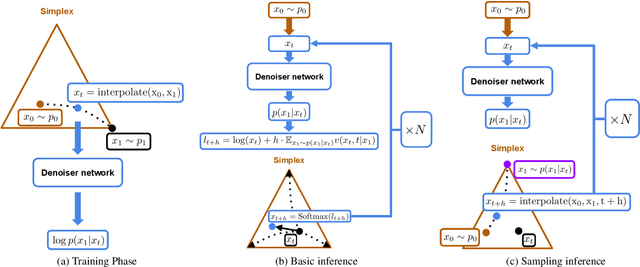
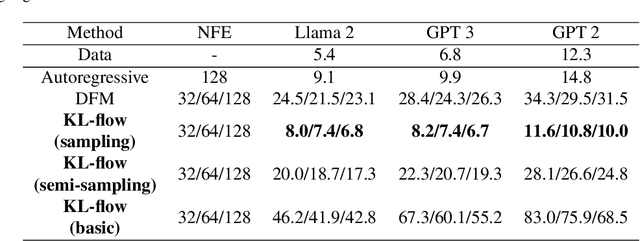
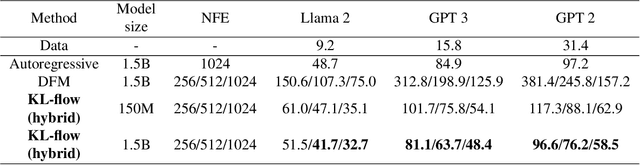
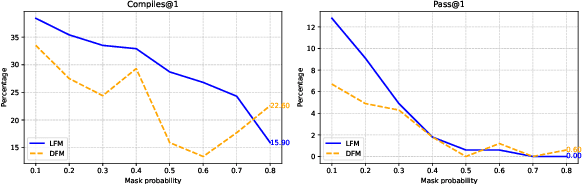
Non-autoregressive language models are emerging as effective alternatives to autoregressive models in the field of natural language processing, facilitating simultaneous token generation. This study introduces a novel flow matching approach that employs Kullback-Leibler (KL) divergence geodesics to interpolate between initial and target distributions for discrete sequences. We formulate a loss function designed to maximize the conditional likelihood of discrete tokens and demonstrate that its maximizer corresponds to the flow matching velocity during logit interpolation. Although preliminary experiments conducted on the TinyStories dataset yielded suboptimal results, we propose an empirical sampling scheme based on a pretrained denoiser that significantly enhances performance. Additionally, we present a more general hybrid approach that achieves strong performance on more complex datasets, such as Fine Web and Lamini Instruction.
Faster Language Models with Better Multi-Token Prediction Using Tensor Decomposition
Oct 23, 2024We propose a new model for multi-token prediction in transformers, aiming to enhance sampling efficiency without compromising accuracy. Motivated by recent work that predicts the probabilities of subsequent tokens using multiple heads, we connect this approach to rank-$1$ canonical tensor decomposition. By generalizing it to a rank-$r$ canonical probability decomposition, we develop an improved model that predicts multiple tokens simultaneously. This model can also be interpreted as a mixture of experts, allowing us to leverage successful techniques from that domain for efficient and robust training. Importantly, the overall overhead for training and sampling remains low. Our method demonstrates significant improvements in inference speed for both text and code generation tasks, proving particularly beneficial within the self-speculative decoding paradigm. It maintains its effectiveness across various model sizes and training epochs, highlighting its robustness and scalability.
CLEAR: Character Unlearning in Textual and Visual Modalities
Oct 23, 2024
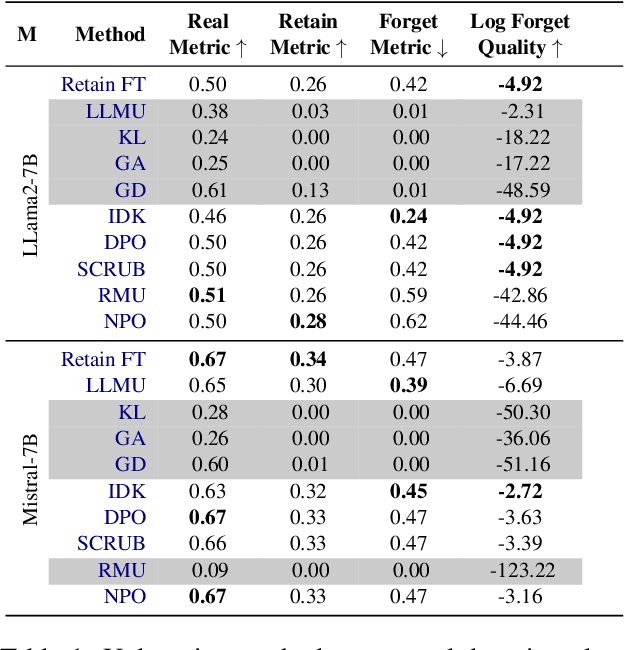
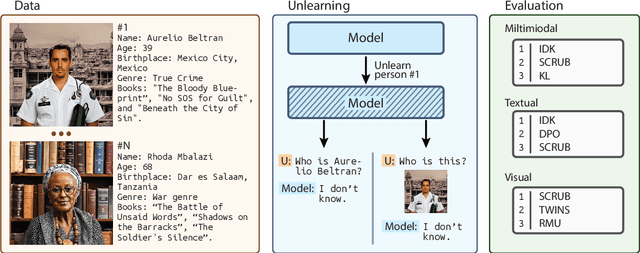
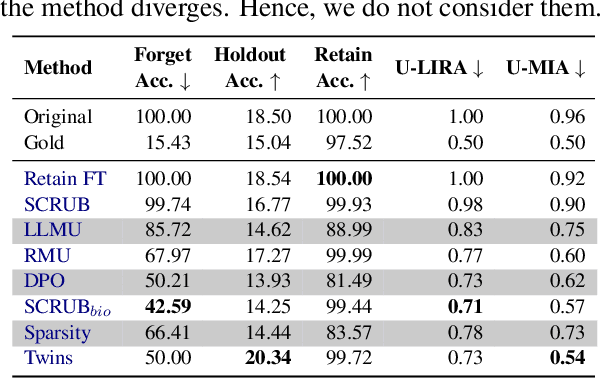
Machine Unlearning (MU) is critical for enhancing privacy and security in deep learning models, particularly in large multimodal language models (MLLMs), by removing specific private or hazardous information. While MU has made significant progress in textual and visual modalities, multimodal unlearning (MMU) remains significantly underexplored, partially due to the absence of a suitable open-source benchmark. To address this, we introduce CLEAR, a new benchmark designed to evaluate MMU methods. CLEAR contains 200 fictitious individuals and 3,700 images linked with corresponding question-answer pairs, enabling a thorough evaluation across modalities. We assess 10 MU methods, adapting them for MMU, and highlight new challenges specific to multimodal forgetting. We also demonstrate that simple $\ell_1$ regularization on LoRA weights significantly mitigates catastrophic forgetting, preserving model performance on retained data. The dataset is available at https://huggingface.co/datasets/therem/CLEAR
SparseGrad: A Selective Method for Efficient Fine-tuning of MLP Layers
Oct 09, 2024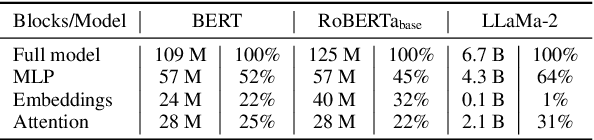
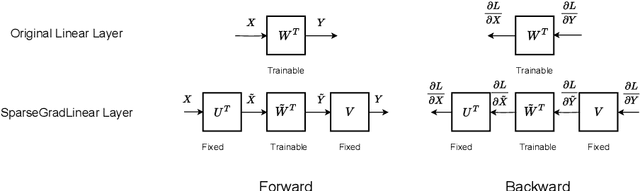
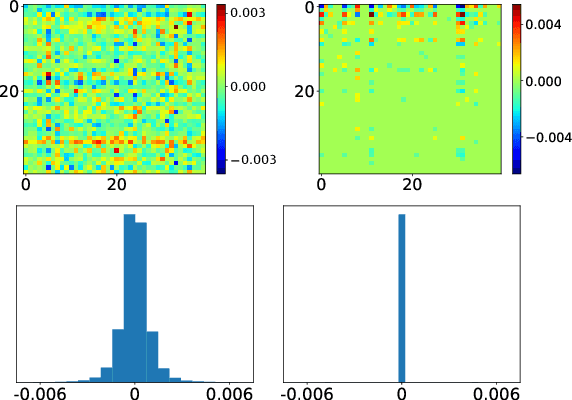
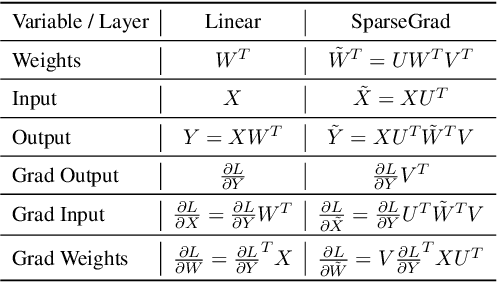
The performance of Transformer models has been enhanced by increasing the number of parameters and the length of the processed text. Consequently, fine-tuning the entire model becomes a memory-intensive process. High-performance methods for parameter-efficient fine-tuning (PEFT) typically work with Attention blocks and often overlook MLP blocks, which contain about half of the model parameters. We propose a new selective PEFT method, namely SparseGrad, that performs well on MLP blocks. We transfer layer gradients to a space where only about 1\% of the layer's elements remain significant. By converting gradients into a sparse structure, we reduce the number of updated parameters. We apply SparseGrad to fine-tune BERT and RoBERTa for the NLU task and LLaMa-2 for the Question-Answering task. In these experiments, with identical memory requirements, our method outperforms LoRA and MeProp, robust popular state-of-the-art PEFT approaches.
Tensor-Train Point Cloud Compression and Efficient Approximate Nearest-Neighbor Search
Oct 06, 2024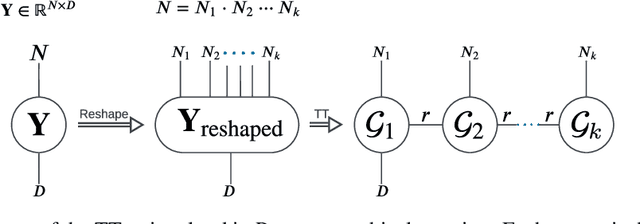
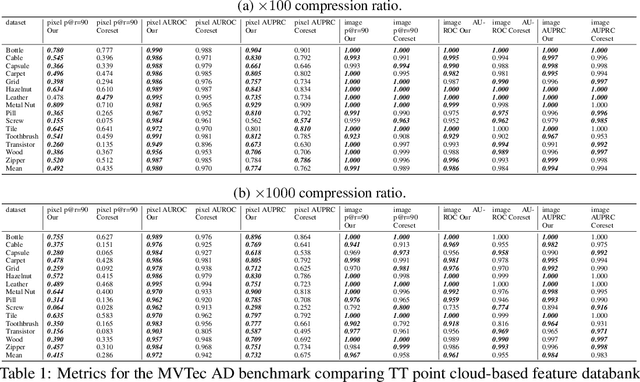
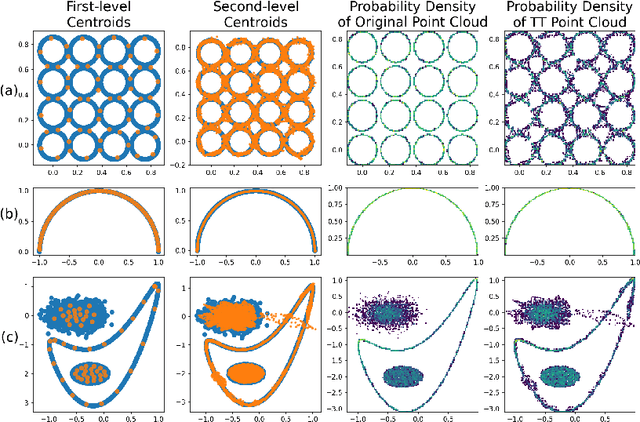
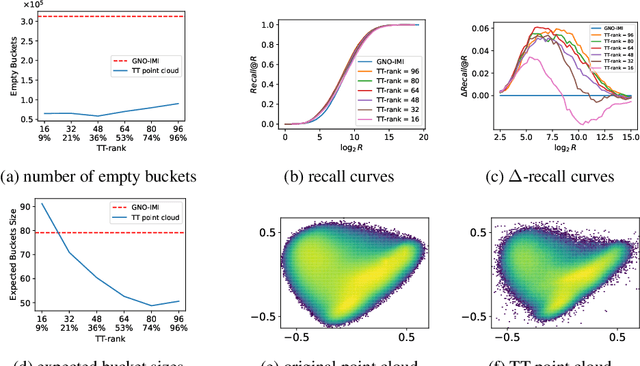
Nearest-neighbor search in large vector databases is crucial for various machine learning applications. This paper introduces a novel method using tensor-train (TT) low-rank tensor decomposition to efficiently represent point clouds and enable fast approximate nearest-neighbor searches. We propose a probabilistic interpretation and utilize density estimation losses like Sliced Wasserstein to train TT decompositions, resulting in robust point cloud compression. We reveal an inherent hierarchical structure within TT point clouds, facilitating efficient approximate nearest-neighbor searches. In our paper, we provide detailed insights into the methodology and conduct comprehensive comparisons with existing methods. We demonstrate its effectiveness in various scenarios, including out-of-distribution (OOD) detection problems and approximate nearest-neighbor (ANN) search tasks.
Sinc Kolmogorov-Arnold Network and Its Applications on Physics-informed Neural Networks
Oct 05, 2024
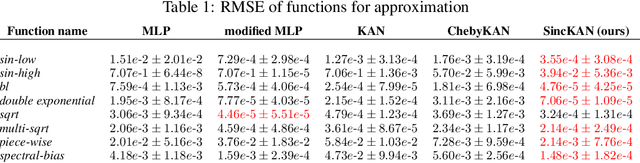
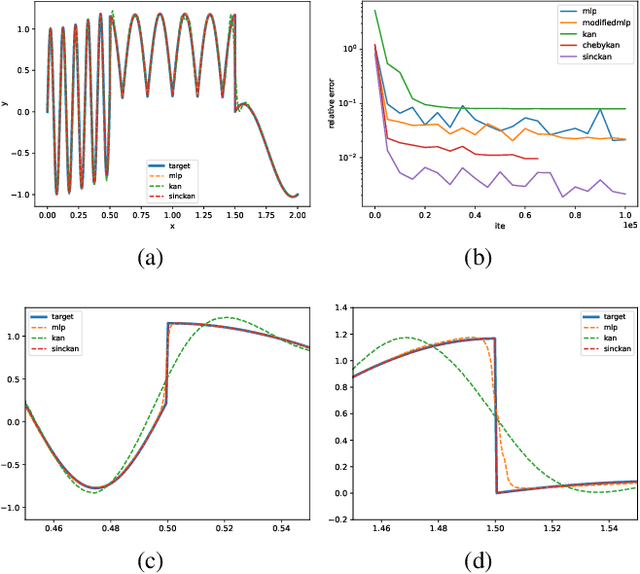

In this paper, we propose to use Sinc interpolation in the context of Kolmogorov-Arnold Networks, neural networks with learnable activation functions, which recently gained attention as alternatives to multilayer perceptron. Many different function representations have already been tried, but we show that Sinc interpolation proposes a viable alternative, since it is known in numerical analysis to represent well both smooth functions and functions with singularities. This is important not only for function approximation but also for the solutions of partial differential equations with physics-informed neural networks. Through a series of experiments, we show that SincKANs provide better results in almost all of the examples we have considered.
Scalable Cross-Entropy Loss for Sequential Recommendations with Large Item Catalogs
Sep 27, 2024Scalability issue plays a crucial role in productionizing modern recommender systems. Even lightweight architectures may suffer from high computational overload due to intermediate calculations, limiting their practicality in real-world applications. Specifically, applying full Cross-Entropy (CE) loss often yields state-of-the-art performance in terms of recommendations quality. Still, it suffers from excessive GPU memory utilization when dealing with large item catalogs. This paper introduces a novel Scalable Cross-Entropy (SCE) loss function in the sequential learning setup. It approximates the CE loss for datasets with large-size catalogs, enhancing both time efficiency and memory usage without compromising recommendations quality. Unlike traditional negative sampling methods, our approach utilizes a selective GPU-efficient computation strategy, focusing on the most informative elements of the catalog, particularly those most likely to be false positives. This is achieved by approximating the softmax distribution over a subset of the model outputs through the maximum inner product search. Experimental results on multiple datasets demonstrate the effectiveness of SCE in reducing peak memory usage by a factor of up to 100 compared to the alternatives, retaining or even exceeding their metrics values. The proposed approach also opens new perspectives for large-scale developments in different domains, such as large language models.