 Add to Chrome
 Add to Firefox
 Add to Edge
Probabilistic Verification of Voice Anti-Spoofing Models
Mar 12, 2026
Recent advances in generative models have amplified the risk of malicious misuse of speech synthesis technologies, enabling adversaries to impersonate target speakers and access sensitive resources. Although speech deepfake detection has progressed rapidly, most existing countermeasures lack formal robustness guarantees or fail to generalize to unseen generation techniques. We propose PV-VASM, a probabilistic framework for verifying the robustness of voice anti-spoofing models (VASMs). PV-VASM estimates the probability of misclassification under text-to-speech (TTS), voice cloning (VC), and parametric signal transformations. The approach is model-agnostic and enables robustness verification against unseen speech synthesis techniques and input perturbations. We derive a theoretical upper bound on the error probability and validate the method across diverse experimental settings, demonstrating its effectiveness as a practical robustness verification tool.

Towards Robust Speech Deepfake Detection via Human-Inspired Reasoning
Mar 12, 2026The modern generative audio models can be used by an adversary in an unlawful manner, specifically, to impersonate other people to gain access to private information. To mitigate this issue, speech deepfake detection (SDD) methods started to evolve. Unfortunately, current SDD methods generally suffer from the lack of generalization to new audio domains and generators. More than that, they lack interpretability, especially human-like reasoning that would naturally explain the attribution of a given audio to the bona fide or spoof class and provide human-perceptible cues. In this paper, we propose HIR-SDD, a novel SDD framework that combines the strengths of Large Audio Language Models (LALMs) with the chain-of-thought reasoning derived from the novel proposed human-annotated dataset. Experimental evaluation demonstrates both the effectiveness of the proposed method and its ability to provide reasonable justifications for predictions.
Contract And Conquer: How to Provably Compute Adversarial Examples for a Black-Box Model?
Mar 12, 2026Black-box adversarial attacks are widely used as tools to test the robustness of deep neural networks against malicious perturbations of input data aimed at a specific change in the output of the model. Such methods, although they remain empirically effective, usually do not guarantee that an adversarial example can be found for a particular model. In this paper, we propose Contract And Conquer (CAC), an approach to provably compute adversarial examples for neural networks in a black-box manner. The method is based on knowledge distillation of a black-box model on an expanding distillation dataset and precise contraction of the adversarial example search space. CAC is supported by the transferability guarantee: we prove that the method yields an adversarial example for the black-box model within a fixed number of algorithm iterations. Experimentally, we demonstrate that the proposed approach outperforms existing state-of-the-art black-box attack methods on ImageNet dataset for different target models, including vision transformers.
RandMark: On Random Watermarking of Visual Foundation Models
Mar 11, 2026Being trained on large and diverse datasets, visual foundation models (VFMs) can be fine-tuned to achieve remarkable performance and efficiency in various downstream computer vision tasks. The high computational cost of data collection and training makes these models valuable assets, which motivates some VFM owners to distribute them alongside a license to protect their intellectual property rights. In this paper, we propose an approach to ownership verification of visual foundation models that leverages a small encoder-decoder network to embed digital watermarks into an internal representation of a hold-out set of input images. The method is based on random watermark embedding, which makes the watermark statistics detectable in functional copies of the watermarked model. Both theoretically and experimentally, we demonstrate that the proposed method yields a low probability of false detection for non-watermarked models and a low probability of false misdetection for watermarked models.
ActiveMark: on watermarking of visual foundation models via massive activations
Oct 06, 2025Being trained on large and vast datasets, visual foundation models (VFMs) can be fine-tuned for diverse downstream tasks, achieving remarkable performance and efficiency in various computer vision applications. The high computation cost of data collection and training motivates the owners of some VFMs to distribute them alongside the license to protect their intellectual property rights. However, a dishonest user of the protected model's copy may illegally redistribute it, for example, to make a profit. As a consequence, the development of reliable ownership verification tools is of great importance today, since such methods can be used to differentiate between a redistributed copy of the protected model and an independent model. In this paper, we propose an approach to ownership verification of visual foundation models by fine-tuning a small set of expressive layers of a VFM along with a small encoder-decoder network to embed digital watermarks into an internal representation of a hold-out set of input images. Importantly, the watermarks embedded remain detectable in the functional copies of the protected model, obtained, for example, by fine-tuning the VFM for a particular downstream task. Theoretically and experimentally, we demonstrate that the proposed method yields a low probability of false detection of a non-watermarked model and a low probability of false misdetection of a watermarked model.
Spread them Apart: Towards Robust Watermarking of Generated Content
Feb 11, 2025Generative models that can produce realistic images have improved significantly in recent years. The quality of the generated content has increased drastically, so sometimes it is very difficult to distinguish between the real images and the generated ones. Such an improvement comes at a price of ethical concerns about the usage of the generative models: the users of generative models can improperly claim ownership of the generated content protected by a license. In this paper, we propose an approach to embed watermarks into the generated content to allow future detection of the generated content and identification of the user who generated it. The watermark is embedded during the inference of the model, so the proposed approach does not require the retraining of the latter. We prove that watermarks embedded are guaranteed to be robust against additive perturbations of a bounded magnitude. We apply our method to watermark diffusion models and show that it matches state-of-the-art watermarking schemes in terms of robustness to different types of synthetic watermark removal attacks.
Stochastic BIQA: Median Randomized Smoothing for Certified Blind Image Quality Assessment
Nov 19, 2024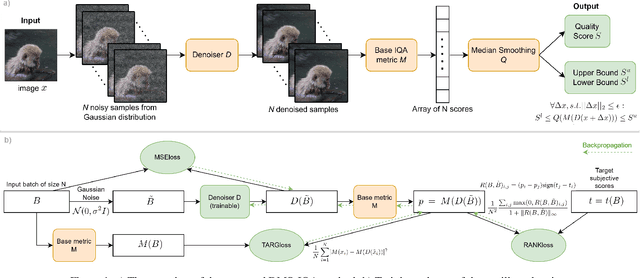
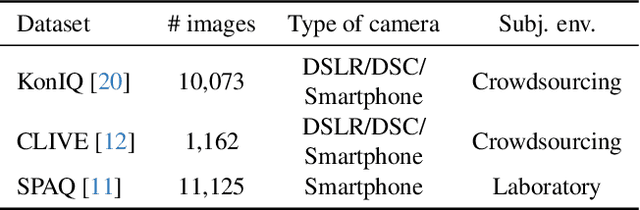
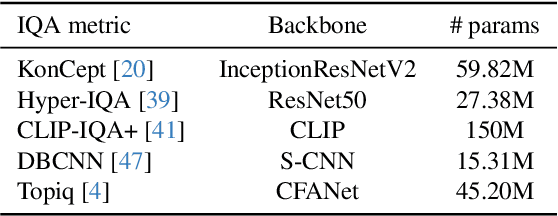

Most modern No-Reference Image-Quality Assessment (NR-IQA) metrics are based on neural networks vulnerable to adversarial attacks. Attacks on such metrics lead to incorrect image/video quality predictions, which poses significant risks, especially in public benchmarks. Developers of image processing algorithms may unfairly increase the score of a target IQA metric without improving the actual quality of the adversarial image. Although some empirical defenses for IQA metrics were proposed, they do not provide theoretical guarantees and may be vulnerable to adaptive attacks. This work focuses on developing a provably robust no-reference IQA metric. Our method is based on Median Smoothing (MS) combined with an additional convolution denoiser with ranking loss to improve the SROCC and PLCC scores of the defended IQA metric. Compared with two prior methods on three datasets, our method exhibited superior SROCC and PLCC scores while maintaining comparable certified guarantees.
Model Mimic Attack: Knowledge Distillation for Provably Transferable Adversarial Examples
Oct 21, 2024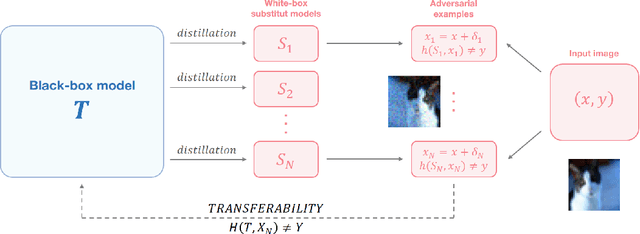
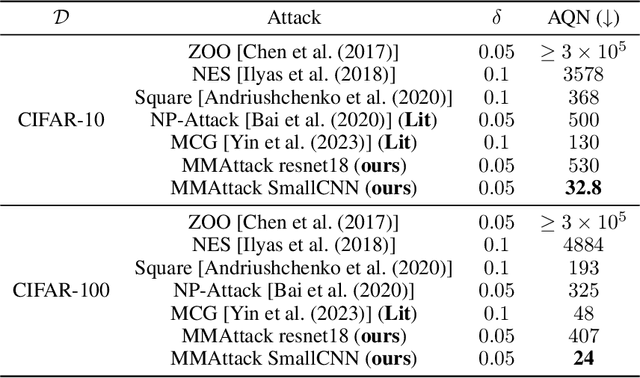
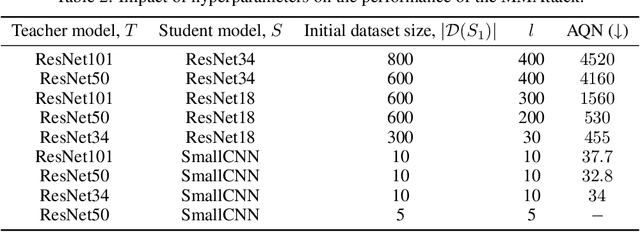
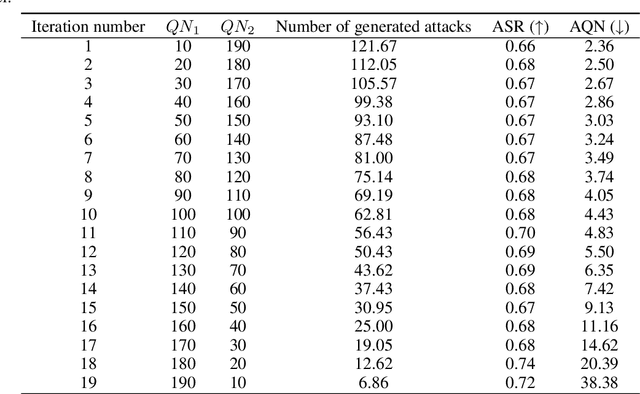
The vulnerability of artificial neural networks to adversarial perturbations in the black-box setting is widely studied in the literature. The majority of attack methods to construct these perturbations suffer from an impractically large number of queries required to find an adversarial example. In this work, we focus on knowledge distillation as an approach to conduct transfer-based black-box adversarial attacks and propose an iterative training of the surrogate model on an expanding dataset. This work is the first, to our knowledge, to provide provable guarantees on the success of knowledge distillation-based attack on classification neural networks: we prove that if the student model has enough learning capabilities, the attack on the teacher model is guaranteed to be found within the finite number of distillation iterations.
GLiRA: Black-Box Membership Inference Attack via Knowledge Distillation
May 13, 2024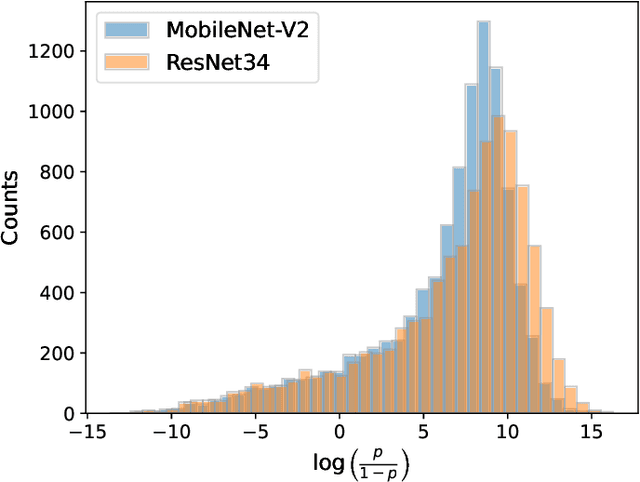
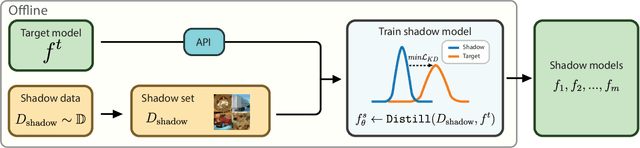
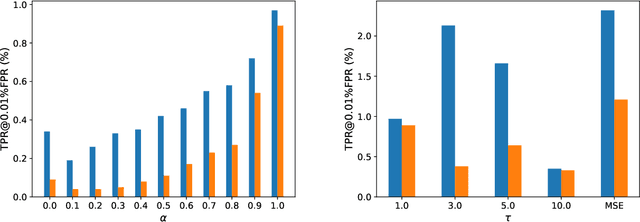
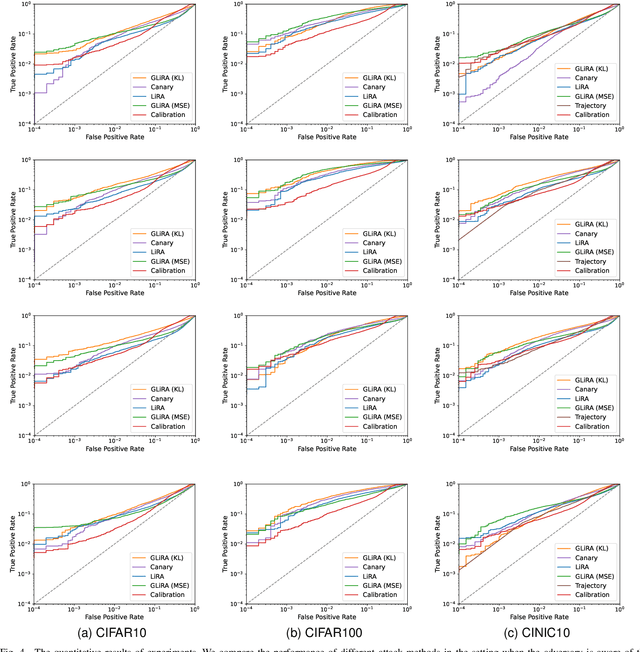
While Deep Neural Networks (DNNs) have demonstrated remarkable performance in tasks related to perception and control, there are still several unresolved concerns regarding the privacy of their training data, particularly in the context of vulnerability to Membership Inference Attacks (MIAs). In this paper, we explore a connection between the susceptibility to membership inference attacks and the vulnerability to distillation-based functionality stealing attacks. In particular, we propose {GLiRA}, a distillation-guided approach to membership inference attack on the black-box neural network. We observe that the knowledge distillation significantly improves the efficiency of likelihood ratio of membership inference attack, especially in the black-box setting, i.e., when the architecture of the target model is unknown to the attacker. We evaluate the proposed method across multiple image classification datasets and models and demonstrate that likelihood ratio attacks when guided by the knowledge distillation, outperform the current state-of-the-art membership inference attacks in the black-box setting.
Certification of Speaker Recognition Models to Additive Perturbations
Apr 29, 2024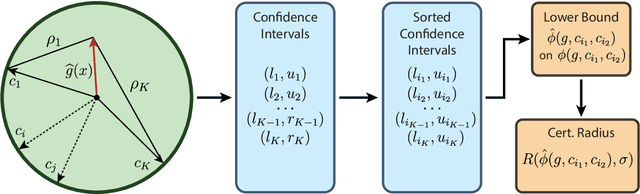
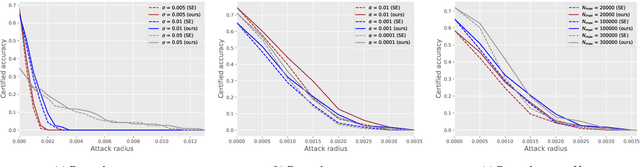
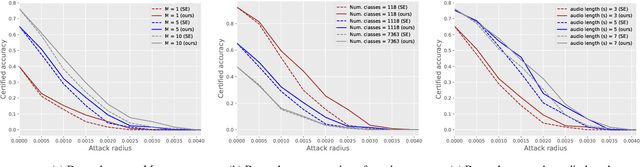
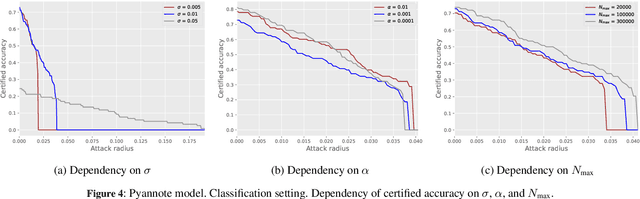
Speaker recognition technology is applied in various tasks ranging from personal virtual assistants to secure access systems. However, the robustness of these systems against adversarial attacks, particularly to additive perturbations, remains a significant challenge. In this paper, we pioneer applying robustness certification techniques to speaker recognition, originally developed for the image domain. In our work, we cover this gap by transferring and improving randomized smoothing certification techniques against norm-bounded additive perturbations for classification and few-shot learning tasks to speaker recognition. We demonstrate the effectiveness of these methods on VoxCeleb 1 and 2 datasets for several models. We expect this work to improve voice-biometry robustness, establish a new certification benchmark, and accelerate research of certification methods in the audio domain.