 Add to Chrome
 Add to Firefox
 Add to Edge
Cross-Lingual Exploration for Parametric Knowledge
Jun 23, 2026
Parametric knowledge in Large Language Models is not equally accessible across languages. As a result, standard inference techniques often struggle to surface localized facts, leading to failures in cross-lingual knowledge transfer and consistency. In this work, we investigate techniques for accessing hidden factual knowledge by exploring cross-lingual prompting strategies. We identify four inherent dimensions of cross-lingual exploration that directly govern parametric knowledge retrieval and evaluate them on multilingual factual benchmarks covering 17 typologically diverse languages. Our results demonstrate that cross-lingual exploration significantly improves knowledge transfer and factual recall, representing a more efficient compute Pareto frontier than native-language scaling. Furthermore, we observe corresponding improvements in cross-lingual consistency, exceeding what can be explained by accuracy gains alone. Overall, our work establishes multilingual prompt exploration as a highly effective inference-time strategy for unlocking latent parametric knowledge.

The Shape of Testimony: A Scalable Framework for Oral History Archive Comparison
May 20, 2026Researchers in Holocaust studies have often distinguished between two styles of oral survivor testimony: the USC Shoah Foundation's interviews tend to follow a structured, interviewer-guided format, whereas the Yale Fortunoff Video Archive generally favors a more free-form, open-ended style. This distinction has influenced both scholarly research and the development of later archives. In this study, we critically examine that claim by conducting a large-scale computational analysis of more than 1,600 testimonies from both collections. Leveraging discourse segmentation, topic modeling, and large language model (LLM) based analysis, we quantify the "structuredness" level of testimonies through topic coherence, interviewer-survivor dynamics, and the distribution of question types. Our results generally corroborate the structural differences identified in earlier research, while also revealing significant overlaps between the collections, both within individual interviews and across common narrative patterns. This complicates the simple "structured vs. free-form" dichotomy often applied to these oral histories. Beyond revisiting a foundational claim in Holocaust studies, our work provides a scalable, replicable framework for comparative corpus analysis. As a proof of concept, it suggests broader applications for digital oral history, narrative analysis, and the design of citizen-science annotation platforms.
Discrete Diffusion Models Exploit Asymmetry to Solve Lookahead Planning Tasks
Feb 23, 2026While Autoregressive (AR) Transformer-based Generative Language Models are frequently employed for lookahead tasks, recent research suggests a potential discrepancy in their ability to perform planning tasks that require multi-step lookahead. In this work, we investigate the distinct emergent mechanisms that arise when training AR versus Non-Autoregressive (NAR) models, such as Discrete Diffusion Models (dLLMs), on lookahead tasks. By requiring the models to plan ahead to reach the correct conclusion, we analyze how these two paradigms fundamentally differ in their approach to the problem. We identify a critical asymmetry in planning problems: while forward generation requires complex lookahead at branching junctions, reverse generation is often deterministic. This asymmetry creates an opportunity for NAR models. Through mechanistic analysis of training and inference dynamics, we demonstrate that NAR models learn to solve planning tasks by utilizing future tokens to decode backwards, avoiding the need to learn complex traversal mechanisms entirely. Consequently, we report that both AR and NAR models are able to achieve perfect accuracy on the lookahead task. However, NAR models require exponentially fewer training examples and shallower architectures compared to AR models, which often fail to converge without specific curriculum adjustments.
CovScore: Evaluation of Multi-Document Abstractive Title Set Generation
Jul 24, 2024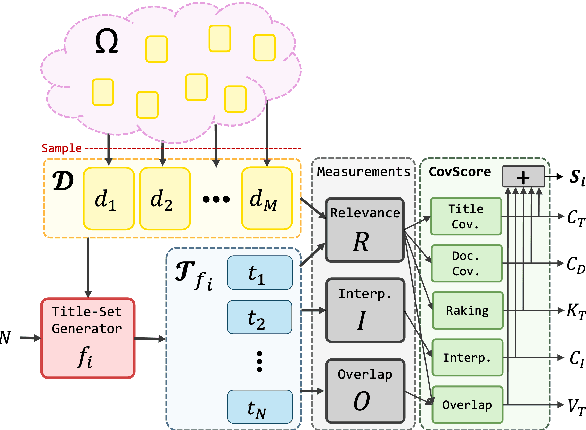
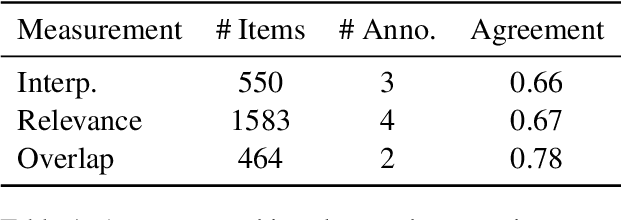
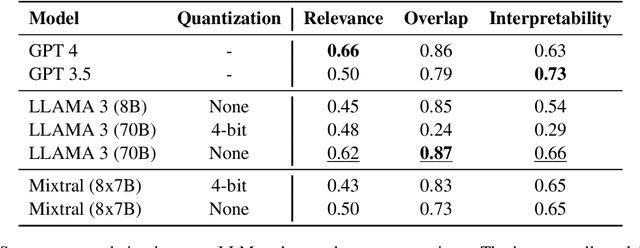
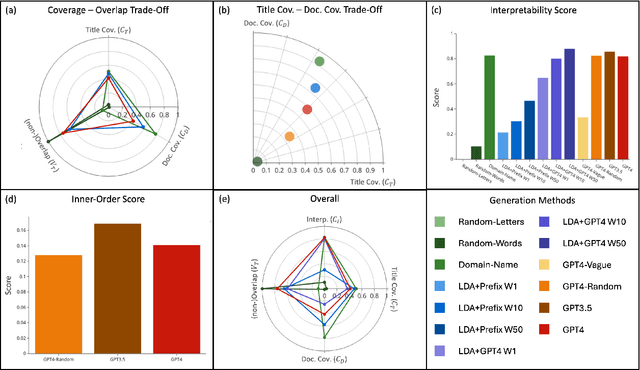
This paper introduces CovScore, an automatic reference-less methodology for evaluating thematic title sets, extracted from a corpus of documents. While such extraction methods are widely used, evaluating their effectiveness remains an open question. Moreover, some existing practices heavily rely on slow and laborious human annotation procedures. Inspired by recently introduced LLM-based judge methods, we propose a novel methodology that decomposes quality into five main metrics along different aspects of evaluation. This framing simplifies and expedites the manual evaluation process and enables automatic and independent LLM-based evaluation. As a test case, we apply our approach to a corpus of Holocaust survivor testimonies, motivated both by its relevance to title set extraction and by the moral significance of this pursuit. We validate the methodology by experimenting with naturalistic and synthetic title set generation systems and compare their performance with the methodology.