 Add to Chrome
 Add to Firefox
 Add to Edge
CellSense: A Sub-6 GHz Cellular ISAC System for Clutter-Robust Passive Sensing
Jun 05, 2026
Future wireless networks demand capabilities beyond traditional communication, driving the development of Integrated Sensing and Communication (ISAC) for environmental awareness, localization, and tracking. Ubiquitous cellular deployment allows ISAC to maximize spectral efficiency, lower costs, and expand sensing coverage. However, sub-6 GHz research has heavily favored communication, leaving sensing capabilities largely underexplored. To bridge this gap, we introduce CellSense, a novel sub-6 GHz ISAC architecture natively integrated into the 5G cellular protocol stack for real-world target tracking. We validate the system via Sionna-based orthogonal frequency-division multiplexing (OFDM) link-level simulations and an experimental USRP hardware prototype using the OpenAirInterface (OAI) stack. Furthermore, we analyze the communication-sensing tradeoff by quantifying how pilot symbol density impacts throughput versus sensing accuracy. Simulations show that CellSense achieves a 74 percent detection probability with a 1.43 m localization error in indoor warehouse environment, which improves to 94 percent detection and a sub-meter error of 0.33 m in the outdoor environment of Oval area at the NCSU Centennial campus. Hardware experiments in a highly cluttered indoor laboratory confirm a 1.28 m localization accuracy and 76 percent detection probability, proving its efficacy for practical ISAC deployments.

FlexLink: Decoupling Control and Data Beams for Next-Generation Wideband Networks
May 31, 2026The next generation of 6G networks aims to utilize ultra-wideband spectrum and massive antenna arrays to serve multiple users with both control and data channels at low latency and high efficiency. However, phased arrays at mmWave and mid-bands are fundamentally constrained to a single beam or suffer sharp beamforming loss when split across directions, limiting simultaneous control-data support. In FlexLink, we introduce and prototype a novel delay-phased array architecture that overcomes this limitation by redistributing energy jointly across frequency and space, enabling multiple narrow beams without sacrificing per-beam gain or requiring additional power. We design and prototype FlexLink on a custom 4-7 GHz hardware testbed, demonstrating for the first time that control and data beams can be decoupled in practice, achieving nearly double spectral efficiency compared to conventional phased arrays.
* ACM Mobihoc 2025
PhaseMO: Future-Proof, Energy-efficient, Adaptive Massive MIMO
Jan 08, 2025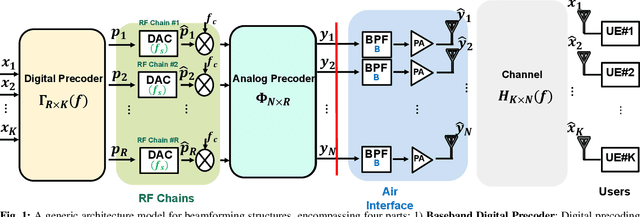
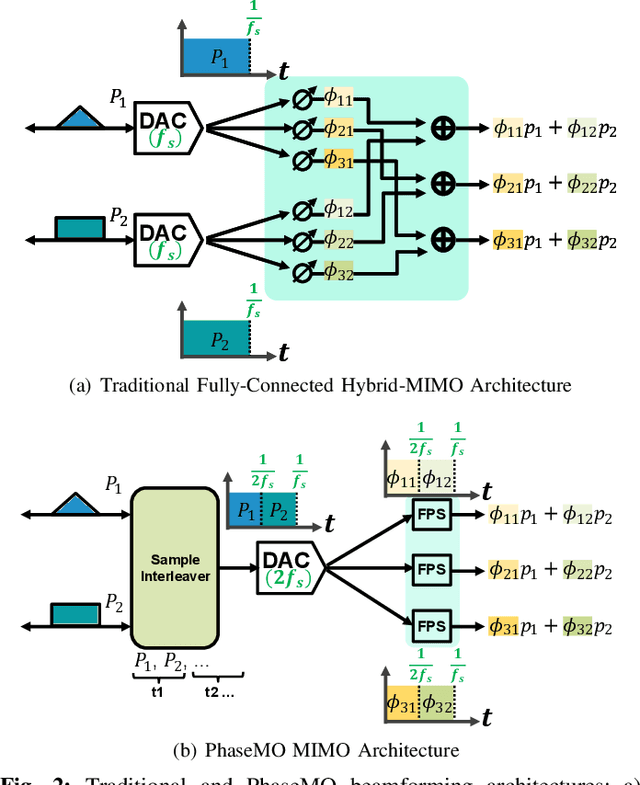
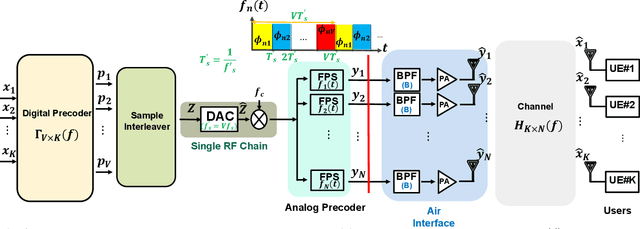
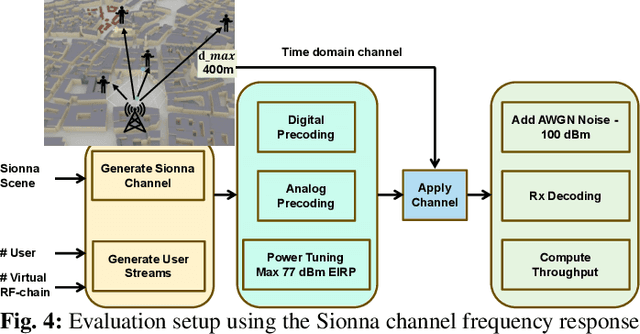
The rapid proliferation of devices and increasing data traffic in cellular networks necessitate advanced solutions to meet these escalating demands. Massive MIMO (Multiple Input Multiple Output) technology offers a promising approach, significantly enhancing throughput, coverage, and spatial multi-plexing. Despite its advantages, massive MIMO systems often lack flexible software controls over hardware, limiting their ability to optimize operational expenditure (OpEx) by reducing power consumption while maintaining performance. Current software-controlled methods, such as antenna muting combined with digital beamforming and hybrid beamforming, have notable limitations. Antenna muting struggles to maintain throughput and coverage, while hybrid beamforming faces hardware constraints that restrict scalability and future-proofing. This work presents PhaseMO, a versatile approach that adapts to varying network loads. PhaseMO effectively reduces power consumption in low-load scenarios without sacrificing coverage and overcomes the hardware limitations of hybrid beamforming, offering a scalable and future-proof solution. We will show that PhaseMO can achieve up to 30% improvement in energy efficiency while avoiding about 10% coverage reduction and 5dB increase in UE transmit power.
CommRad: Context-Aware Sensing-Driven Millimeter-Wave Networks
Jul 11, 2024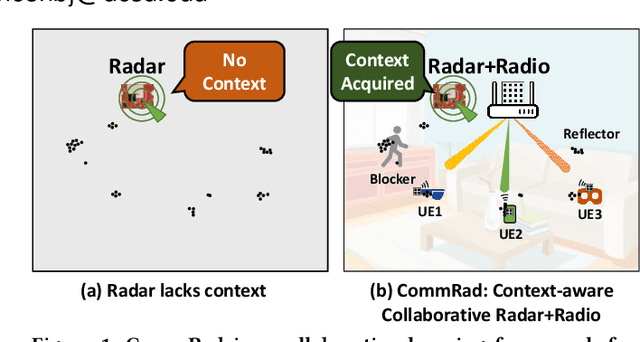
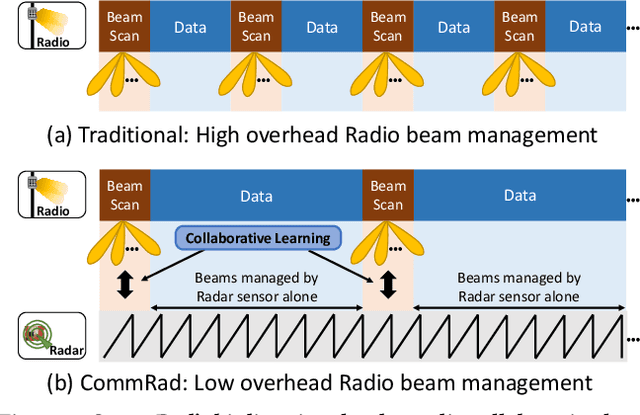
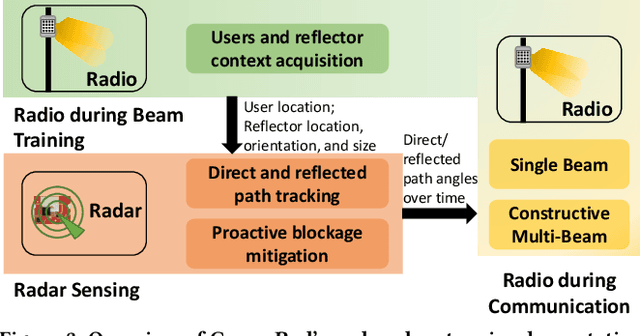
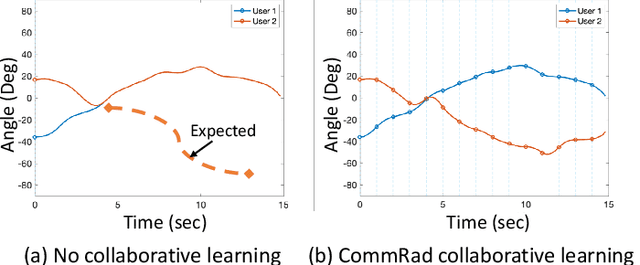
Millimeter-wave (mmWave) technology is pivotal for next-generation wireless networks, enabling high-data-rate and low-latency applications such as autonomous vehicles and XR streaming. However, maintaining directional mmWave links in dynamic mobile environments is challenging due to mobility-induced disruptions and blockage. While effective, the current 5G NR beam training methods incur significant overhead and scalability issues in multi-user scenarios. To address this, we introduce CommRad, a sensing-driven solution incorporating a radar sensor at the base station to track mobile users and maintain directional beams even under blockages. While radar provides high-resolution object tracking, it suffers from a fundamental challenge of lack of context, i.e., it cannot discern which objects in the environment represent active users, reflectors, or blockers. To obtain this contextual awareness, CommRad unites wireless sensing capabilities of bi-static radio communication with the mono-static radar sensor, allowing radios to provide initial context to radar sensors. Subsequently, the radar aids in user tracking and sustains mobile links even in obstructed scenarios, resulting in robust and high-throughput directional connections for all mobile users at all times. We evaluate this collaborative radar-radio framework using a 28 GHz mmWave testbed integrated with a radar sensor in various indoor and outdoor scenarios, demonstrating a 2.5x improvement in median throughput compared to a non-collaborative baseline.
Two beams are better than one: Enabling reliable and high throughput mmWave links
Jan 12, 2021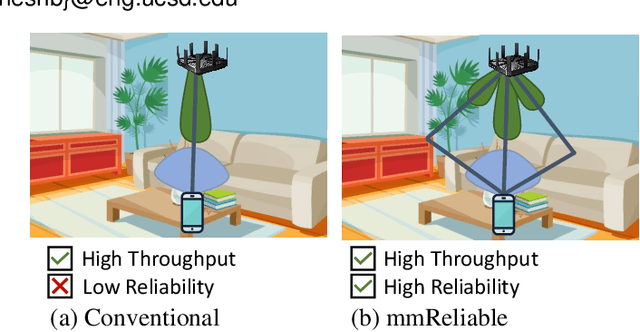
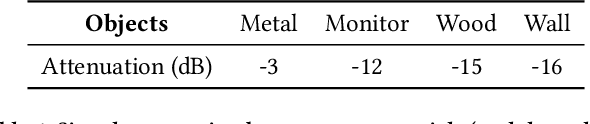
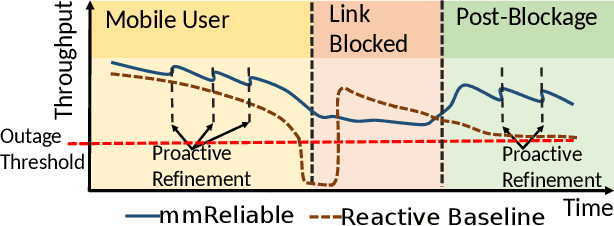
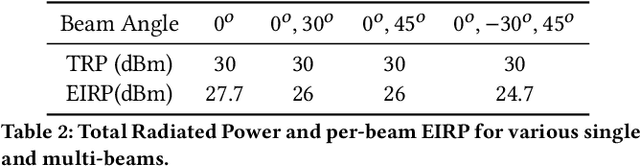
Millimeter-wave communication with high throughput and high reliability is poised to be a gamechanger for V2X and VR applications. However, mmWave links are notorious for low reliability since they suffer from frequent outages due to blockage and user mobility. Traditional mmWave systems are hardly reliable for two reasons. First, they create a highly directional link that acts as a single point of failure and cannot be sustained for high user mobility. Second, they follow a `reactive' approach, which reacts after the link has already suffered an outage. We build mmReliable, a reliable mmWave system that implements smart analog beamforming and user tracking to handle environmental vulnerabilities. It creates custom beam patterns with multiple lobes and optimizes their angle, phase, and amplitude to maximize the signal strength at the receiver. Such phase-coherent multi-beam patterns allow the signal to travel along multiple paths and add up constructively at the receiver to improve throughput. Of course, multi-beam links are resilient to occasional blockages of few beams in multi-beam compared to a single-beam system. With user mobility, mmReliable proactively tracks the motion in the background by leveraging continuous channel estimates without affecting the data rates. We implement mmReliable on a 28 GHz testbed with 400 MHz bandwidth and a 64 element phased-array supporting 5G NR waveforms. Rigorous indoor and outdoor experiments demonstrate that mmReliable achieves close to 100% reliability providing 1.5 times better throughput than traditional single-beam systems.