 Add to Chrome
 Add to Firefox
 Add to Edge
Spyglass: Directional Spectrum Sensing with Single-shot AoA Estimation and Virtual Arrays
Mar 11, 2026
In this paper, we introduce Spyglass, a spectrum sensor designed to address the challenges of effective spectrum usage in dense wireless environments. Spyglass is capable of observing a frequency band and accurately estimating the Angle of Arrival (AoA) of any signal during a single transmission. This includes additional signal context such as center frequency, bandwidth, and I/Q samples. We overcome challenges such as the clutter of fleeting transmissions in common bands, the high cost of array processing for AoA estimation, and the difficulty of detecting and estimating channels for unknown signals. Our first contribution is the development of Searchlite, a protocol-agnostic signal detection and separation algorithm. We use a switched array to reduce cost and processing complexity, and we develop SSFP, a signal processing technique using Fourier transforms that is synchronized to switching boundaries. Spyglass performs multi-channel blind AoA estimation synchronized with the array. Implemented using commercially available hardware, Spyglass demonstrates a median AoA accuracy of 1.4$^\circ$ and the ability to separate simultaneous signals from multiple devices in an unconstrained RF environment, providing valuable tools for large-scale RF data collection and analysis.

Two beams are better than one: Enabling reliable and high throughput mmWave links
Jan 12, 2021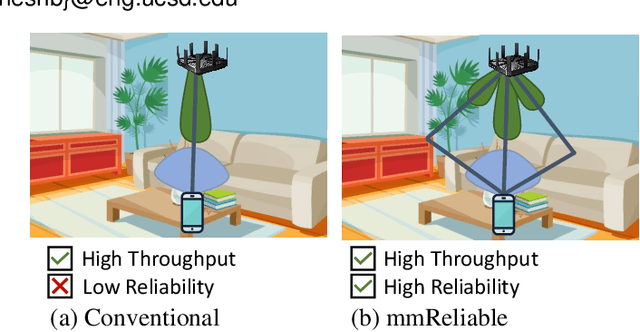
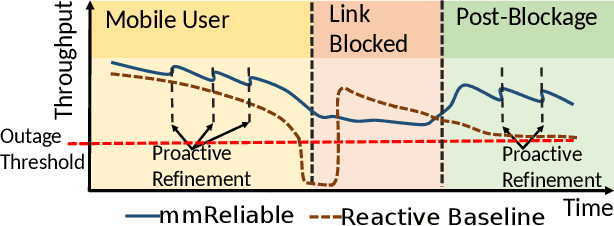
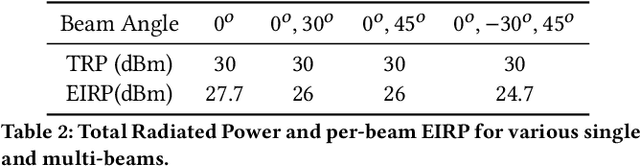
Millimeter-wave communication with high throughput and high reliability is poised to be a gamechanger for V2X and VR applications. However, mmWave links are notorious for low reliability since they suffer from frequent outages due to blockage and user mobility. Traditional mmWave systems are hardly reliable for two reasons. First, they create a highly directional link that acts as a single point of failure and cannot be sustained for high user mobility. Second, they follow a `reactive' approach, which reacts after the link has already suffered an outage. We build mmReliable, a reliable mmWave system that implements smart analog beamforming and user tracking to handle environmental vulnerabilities. It creates custom beam patterns with multiple lobes and optimizes their angle, phase, and amplitude to maximize the signal strength at the receiver. Such phase-coherent multi-beam patterns allow the signal to travel along multiple paths and add up constructively at the receiver to improve throughput. Of course, multi-beam links are resilient to occasional blockages of few beams in multi-beam compared to a single-beam system. With user mobility, mmReliable proactively tracks the motion in the background by leveraging continuous channel estimates without affecting the data rates. We implement mmReliable on a 28 GHz testbed with 400 MHz bandwidth and a 64 element phased-array supporting 5G NR waveforms. Rigorous indoor and outdoor experiments demonstrate that mmReliable achieves close to 100% reliability providing 1.5 times better throughput than traditional single-beam systems.