 Add to Chrome
 Add to Firefox
 Add to Edge
The Sparsity Whisperer
Aug 06, 2026
Pruning reduces the inference cost of large language models, but existing criteria primarily preserve large activations or reconstruct layer outputs. We argue that this overlooks a key computation performed by particularly sparsity-sensitive neurons in the MLP up and gate projections: separating similar inputs into dissimilar outputs. This suggests that effective pruning should preserve not only activations, but also the differences between outputs more broadly. We introduce a family of difference-informed pruning methods built upon this principle. Wisp is a first-order, update-free method that scores weights using input-difference norms, and Wisp+ refines this score neuronwise using the input pairs each neuron separates most strongly. Finally, Whisper is a second-order method that uses a lightly regularized difference Hessian as its reconstruction objective. Across Llama 2 and 3.1 models from 7B to 405B parameters, our second-order variant consistently improves over strong reconstruction-based baselines, while our update-free variants improve over activation-aware baselines, especially in constrained settings. The improvements over Wanda and SparseGPT extend to structured sparsity, downstream evaluations, and other model families. Augmenting stronger techniques such as RIA and ALPS with our difference-informed criteria yields further improvements, shifting the overall accuracy-runtime frontier outward at negligible additional cost. These results suggest that preserving output differences is a broadly useful and composable signal for post-training LLM sparsification.

Expand Neurons, Not Parameters
Oct 06, 2025
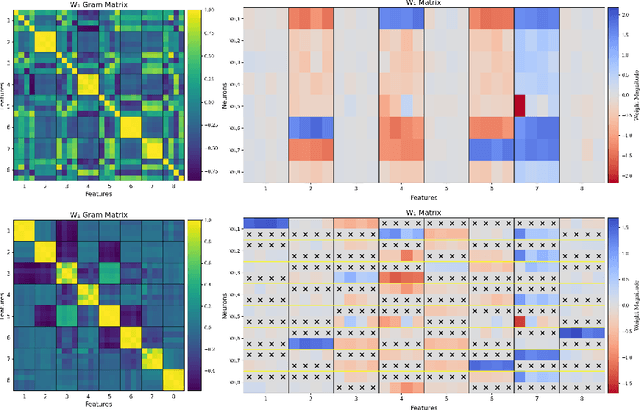
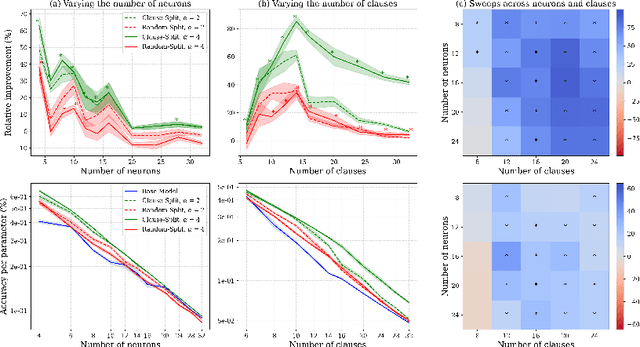
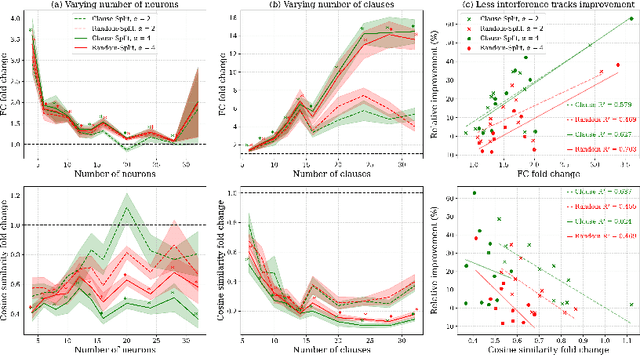
This work demonstrates how increasing the number of neurons in a network without increasing its number of non-zero parameters improves performance. We show that this gain corresponds with a decrease in interference between multiple features that would otherwise share the same neurons. To reduce such entanglement at a fixed non-zero parameter count, we introduce Fixed Parameter Expansion (FPE): replace a neuron with multiple children and partition the parent's weights disjointly across them, so that each child inherits a non-overlapping subset of connections. On symbolic tasks, specifically Boolean code problems, clause-aligned FPE systematically reduces polysemanticity metrics and yields higher task accuracy. Notably, random splits of neuron weights approximate these gains, indicating that reduced collisions, not precise assignment, are a primary driver. Consistent with the superposition hypothesis, the benefits of FPE grow with increasing interference: when polysemantic load is high, accuracy improvements are the largest. Transferring these insights to real models (classifiers over CLIP embeddings and deeper multilayer networks) we find that widening networks while maintaining a constant non-zero parameter count consistently increases accuracy. These results identify an interpretability-grounded mechanism to leverage width against superposition, improving performance without increasing the number of non-zero parameters. Such a direction is well matched to modern accelerators, where memory movement of non-zero parameters, rather than raw compute, is the dominant bottleneck.