 Add to Chrome
 Add to Firefox
 Add to Edge
Training nGPT
Aug 02, 2026
The normalized Transformer (nGPT) realizes hyperspherical representation learning by constraining model parameter vectors and activation vectors to the unit hypersphere. In this paper, we describe a practical training recipe for nGPT and evaluate it on modern hybrid Mamba-2--Transformer Mixture-of-Experts (MoE) models. The recipe introduces Logit Gradient Preconditioning, Logarithmic Learning Rate Decay, GatedAdamW, angular update control, and optional exploration mechanisms. Compared with an unnormalized model of the same hybrid MoE architecture trained with AdamW, the 14B-total-parameter nGPT model reaches the same validation loss using approximately half as many training tokens. The recipe scales across the models considered, which contain up to 14B total parameters.

Nemotron 3 Ultra: Open, Efficient Mixture-of-Experts Hybrid Mamba-Transformer Model for Agentic Reasoning
Jun 12, 2026We introduce Nemotron 3 Ultra, a 550 billion total and 55 billion active parameter Mixture-of-Experts Hybrid Mamba-Attention language model. We pre-trained Nemotron 3 Ultra on 20 trillion text tokens, then extended the context length to 1M tokens, and post-trained using Supervised Fine Tuning (SFT), Reinforcement Learning (RL), and Multi-teacher On-Policy Distillation (MOPD). Nemotron 3 Ultra is our most capable model yet, employing multiple key technologies - LatentMoE, Multi Token Prediction (MTP), NVFP4 pre-training, multi-environment RLVR, MOPD, and reasoning budget control. Nemotron 3 Ultra achieves up to ~6x higher inference throughput as compared to state-of-the-art publicly available LLMs while attaining on-par accuracy. The state-of-the-art accuracy, high inference throughput, and 1M token context length make Nemotron 3 Ultra ideal for long-running autonomous agentic tasks. We open-source the base, post-trained, and quantized checkpoints, along with the training data and recipe on HuggingFace.
Nemotron 3 Super: Open, Efficient Mixture-of-Experts Hybrid Mamba-Transformer Model for Agentic Reasoning
Apr 14, 2026We describe the pre-training, post-training, and quantization of Nemotron 3 Super, a 120 billion (active 12 billion) parameter hybrid Mamba-Attention Mixture-of-Experts model. Nemotron 3 Super is the first model in the Nemotron 3 family to 1) be pre-trained in NVFP4, 2) leverage LatentMoE, a new Mixture-of-Experts architecture that optimizes for both accuracy per FLOP and accuracy per parameter, and 3) include MTP layers for inference acceleration through native speculative decoding. We pre-trained Nemotron 3 Super on 25 trillion tokens followed by post-training using supervised fine tuning (SFT) and reinforcement learning (RL). The final model supports up to 1M context length and achieves comparable accuracy on common benchmarks, while also achieving up to 2.2x and 7.5x higher inference throughput compared to GPT-OSS-120B and Qwen3.5-122B, respectively. Nemotron 3 Super datasets, along with the base, post-trained, and quantized checkpoints, are open-sourced on HuggingFace.
NVIDIA Nemotron 3: Efficient and Open Intelligence
Dec 24, 2025We introduce the Nemotron 3 family of models - Nano, Super, and Ultra. These models deliver strong agentic, reasoning, and conversational capabilities. The Nemotron 3 family uses a Mixture-of-Experts hybrid Mamba-Transformer architecture to provide best-in-class throughput and context lengths of up to 1M tokens. Super and Ultra models are trained with NVFP4 and incorporate LatentMoE, a novel approach that improves model quality. The two larger models also include MTP layers for faster text generation. All Nemotron 3 models are post-trained using multi-environment reinforcement learning enabling reasoning, multi-step tool use, and support granular reasoning budget control. Nano, the smallest model, outperforms comparable models in accuracy while remaining extremely cost-efficient for inference. Super is optimized for collaborative agents and high-volume workloads such as IT ticket automation. Ultra, the largest model, provides state-of-the-art accuracy and reasoning performance. Nano is released together with its technical report and this white paper, while Super and Ultra will follow in the coming months. We will openly release the model weights, pre- and post-training software, recipes, and all data for which we hold redistribution rights.
Nemotron 3 Nano: Open, Efficient Mixture-of-Experts Hybrid Mamba-Transformer Model for Agentic Reasoning
Dec 23, 2025We present Nemotron 3 Nano 30B-A3B, a Mixture-of-Experts hybrid Mamba-Transformer language model. Nemotron 3 Nano was pretrained on 25 trillion text tokens, including more than 3 trillion new unique tokens over Nemotron 2, followed by supervised fine tuning and large-scale RL on diverse environments. Nemotron 3 Nano achieves better accuracy than our previous generation Nemotron 2 Nano while activating less than half of the parameters per forward pass. It achieves up to 3.3x higher inference throughput than similarly-sized open models like GPT-OSS-20B and Qwen3-30B-A3B-Thinking-2507, while also being more accurate on popular benchmarks. Nemotron 3 Nano demonstrates enhanced agentic, reasoning, and chat abilities and supports context lengths up to 1M tokens. We release both our pretrained Nemotron 3 Nano 30B-A3B Base and post-trained Nemotron 3 Nano 30B-A3B checkpoints on Hugging Face.
nGPT: Normalized Transformer with Representation Learning on the Hypersphere
Oct 01, 2024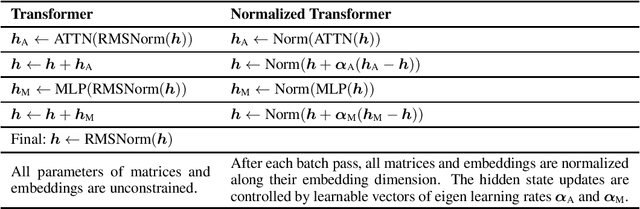
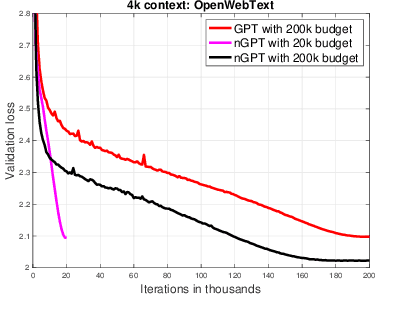
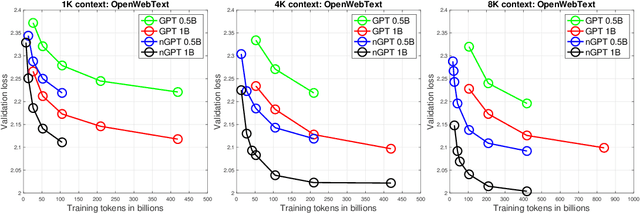
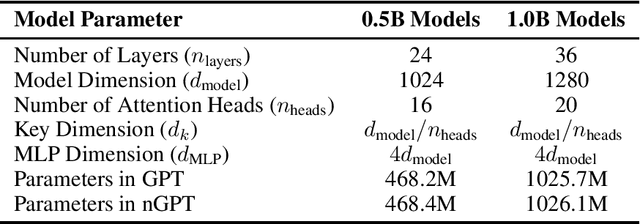
We propose a novel neural network architecture, the normalized Transformer (nGPT) with representation learning on the hypersphere. In nGPT, all vectors forming the embeddings, MLP, attention matrices and hidden states are unit norm normalized. The input stream of tokens travels on the surface of a hypersphere, with each layer contributing a displacement towards the target output predictions. These displacements are defined by the MLP and attention blocks, whose vector components also reside on the same hypersphere. Experiments show that nGPT learns much faster, reducing the number of training steps required to achieve the same accuracy by a factor of 4 to 20, depending on the sequence length.
Weight Norm Control
Nov 21, 2023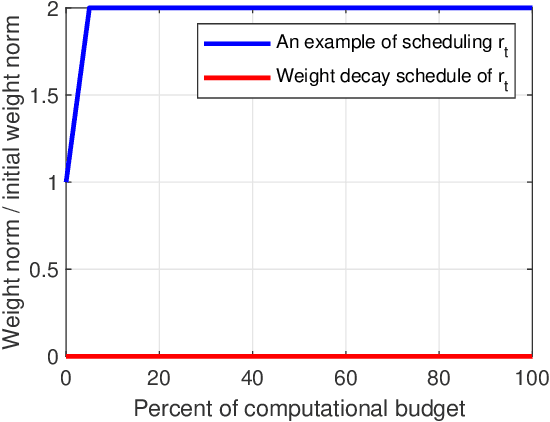
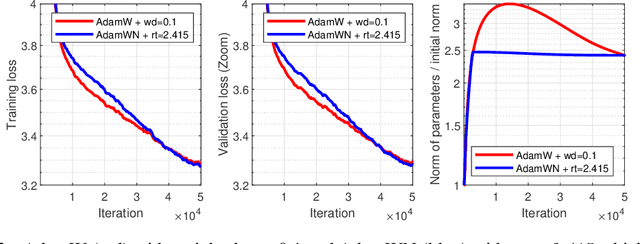
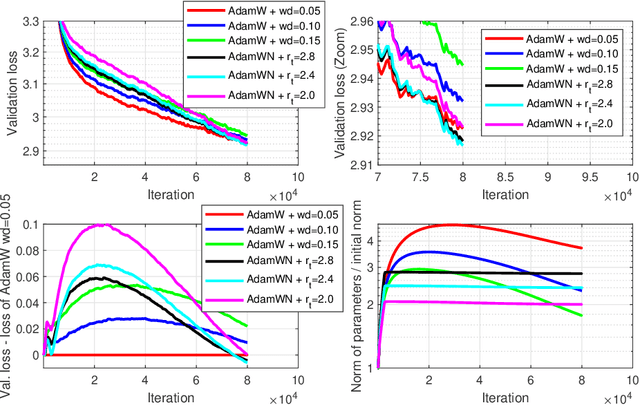
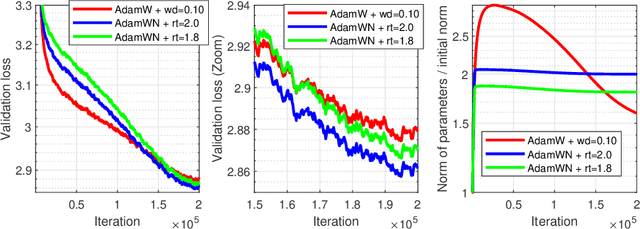
We note that decoupled weight decay regularization is a particular case of weight norm control where the target norm of weights is set to 0. Any optimization method (e.g., Adam) which uses decoupled weight decay regularization (respectively, AdamW) can be viewed as a particular case of a more general algorithm with weight norm control (respectively, AdamWN). We argue that setting the target norm of weights to 0 can be suboptimal and other target norm values can be considered. For instance, any training run where AdamW achieves a particular norm of weights can be challenged by AdamWN scheduled to achieve a comparable norm of weights. We discuss various implications of introducing weight norm control instead of weight decay.
Back to Basics: Benchmarking Canonical Evolution Strategies for Playing Atari
Feb 24, 2018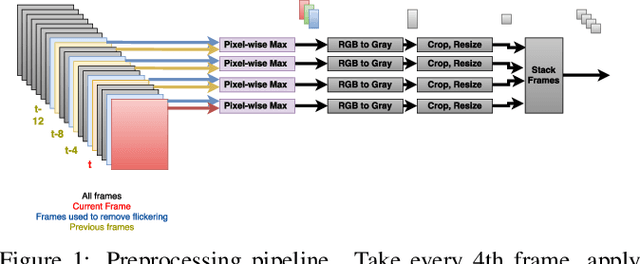
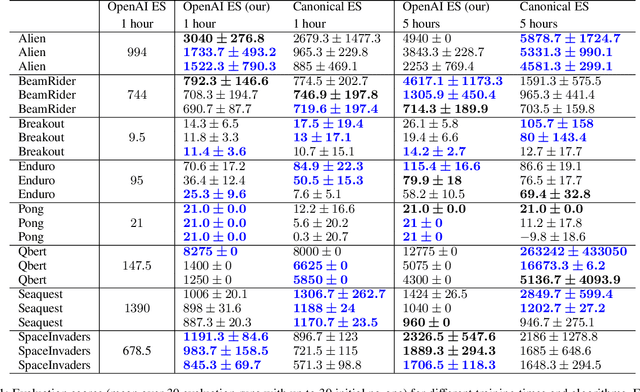
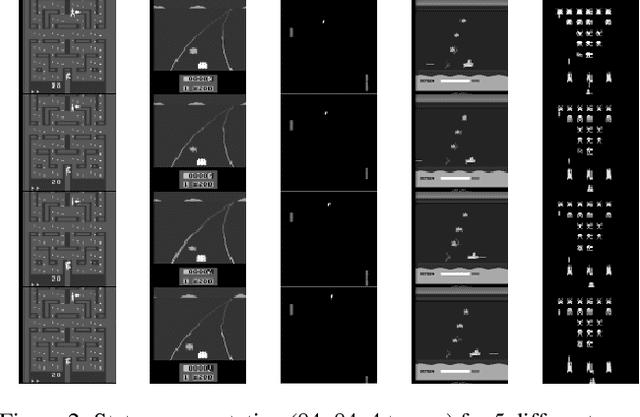

Evolution Strategies (ES) have recently been demonstrated to be a viable alternative to reinforcement learning (RL) algorithms on a set of challenging deep RL problems, including Atari games and MuJoCo humanoid locomotion benchmarks. While the ES algorithms in that work belonged to the specialized class of natural evolution strategies (which resemble approximate gradient RL algorithms, such as REINFORCE), we demonstrate that even a very basic canonical ES algorithm can achieve the same or even better performance. This success of a basic ES algorithm suggests that the state-of-the-art can be advanced further by integrating the many advances made in the field of ES in the last decades. We also demonstrate qualitatively that ES algorithms have very different performance characteristics than traditional RL algorithms: on some games, they learn to exploit the environment and perform much better while on others they can get stuck in suboptimal local minima. Combining their strengths with those of traditional RL algorithms is therefore likely to lead to new advances in the state of the art.
Fixing Weight Decay Regularization in Adam
Feb 14, 2018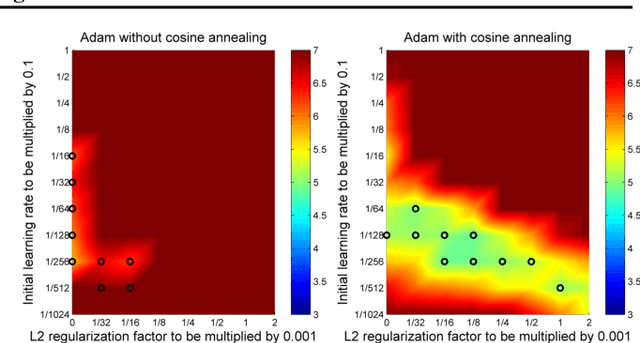
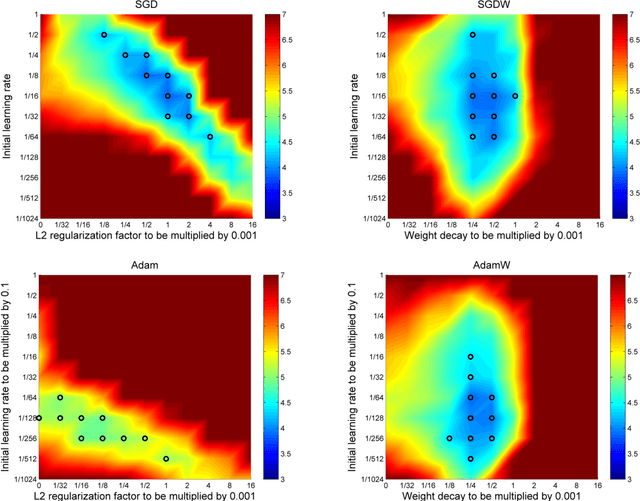
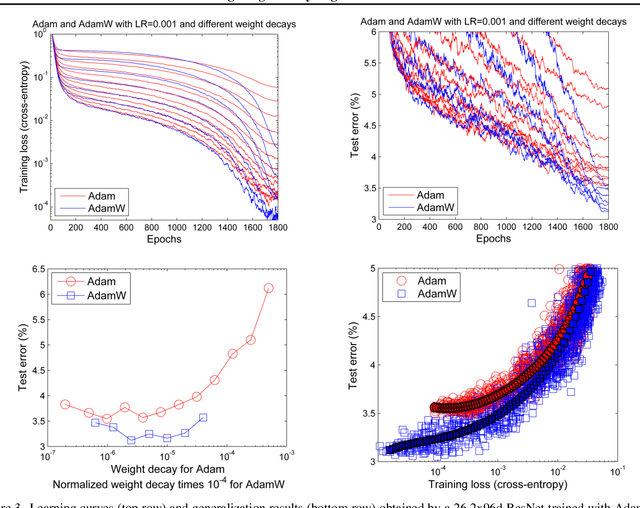
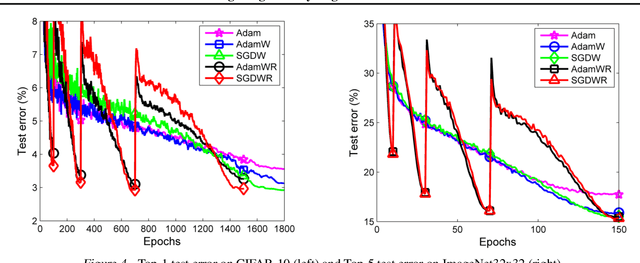
L$_2$ regularization and weight decay regularization are equivalent for standard stochastic gradient descent (when rescaled by the learning rate), but as we demonstrate this is \emph{not} the case for adaptive gradient algorithms, such as Adam. While common deep learning frameworks of these algorithms implement L$_2$ regularization (often calling it "weight decay" in what may be misleading due to the inequivalence we expose), we propose a simple modification to recover the original formulation of weight decay regularization by decoupling the weight decay from the optimization steps taken w.r.t. the loss function. We provide empirical evidence that our proposed modification (i) decouples the optimal choice of weight decay factor from the setting of the learning rate for both standard SGD and Adam, and (ii) substantially improves Adam's generalization performance, allowing it to compete with SGD with momentum on image classification datasets (on which it was previously typically outperformed by the latter). We also propose a version of Adam with warm restarts (AdamWR) that has strong anytime performance while achieving state-of-the-art results on CIFAR-10 and ImageNet32x32. Our source code is available at https://github.com/loshchil/AdamW-and-SGDW
A Downsampled Variant of ImageNet as an Alternative to the CIFAR datasets
Aug 23, 2017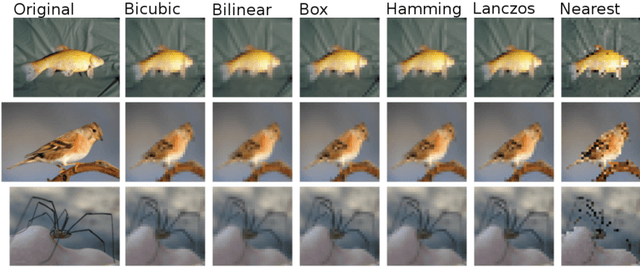
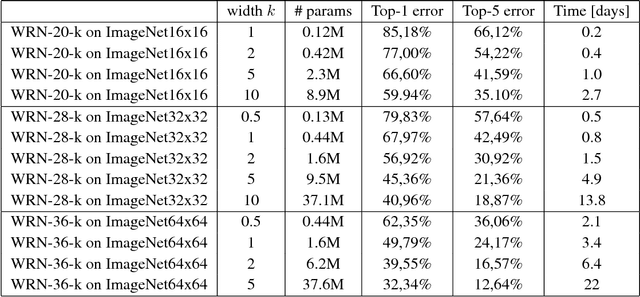
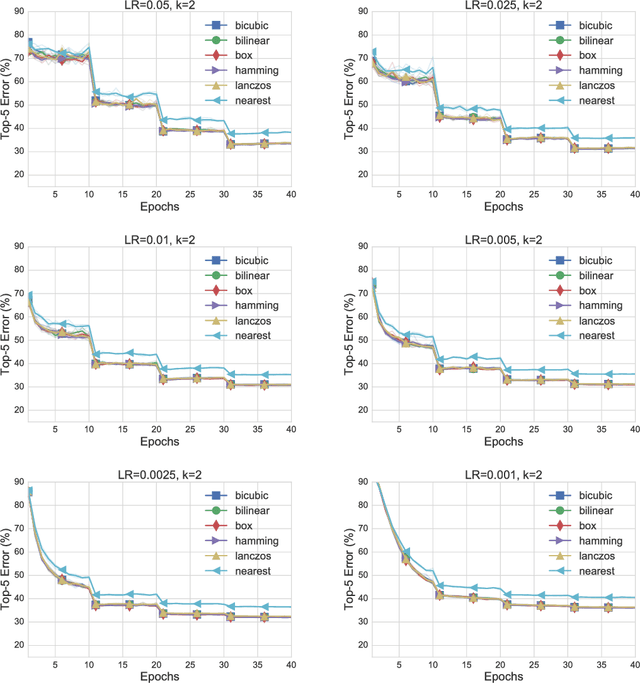
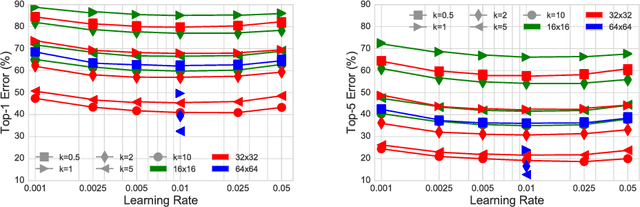
The original ImageNet dataset is a popular large-scale benchmark for training Deep Neural Networks. Since the cost of performing experiments (e.g, algorithm design, architecture search, and hyperparameter tuning) on the original dataset might be prohibitive, we propose to consider a downsampled version of ImageNet. In contrast to the CIFAR datasets and earlier downsampled versions of ImageNet, our proposed ImageNet32$\times$32 (and its variants ImageNet64$\times$64 and ImageNet16$\times$16) contains exactly the same number of classes and images as ImageNet, with the only difference that the images are downsampled to 32$\times$32 pixels per image (64$\times$64 and 16$\times$16 pixels for the variants, respectively). Experiments on these downsampled variants are dramatically faster than on the original ImageNet and the characteristics of the downsampled datasets with respect to optimal hyperparameters appear to remain similar. The proposed datasets and scripts to reproduce our results are available at http://image-net.org/download-images and https://github.com/PatrykChrabaszcz/Imagenet32_Scripts