 Add to Chrome
 Add to Firefox
 Add to Edge
One Pool Is Not Enough: Multi-Cluster Memory for Practical Test-Time Adaptation
Mar 22, 2026
Test-time adaptation (TTA) adapts pre-trained models to distribution shifts at inference using only unlabeled test data. Under the Practical TTA (PTTA) setting, where test streams are temporally correlated and non-i.i.d., memory has become an indispensable component for stable adaptation, yet existing methods universally store amples in a single unstructured pool. We show that this single-cluster design is fundamentally mismatched to PTTA: a stream clusterability analysis reveals that test streams are inherently multi-modal, with the optimal number of mixture components consistently far exceeding one. To close this structural gap, we propose Multi-Cluster Memory (MCM), a plug-and-play framework that organizes stored samples into multiple clusters using lightweight pixel-level statistical descriptors. MCM introduces three complementary mechanisms: descriptor-based cluster assignment to capture distinct distributional modes, Adjacent Cluster Consolidation (ACC) to bound memory usage by merging the most similar temporally adjacent clusters, and Uniform Cluster Retrieval (UCR) to ensure balanced supervision across all modes during adaptation. Integrated with three contemporary TTA methods on CIFAR-10-C, CIFAR-100-C, ImageNet-C, and DomainNet, MCM achieves consistent improvements across all 12 configurations, with gains up to 5.00% on ImageNet-C and 12.13% on DomainNet. Notably, these gains scale with distributional complexity: larger label spaces with greater multi-modality benefit most from multi-cluster organization. GMM-based memory diagnostics further confirm that MCM maintains near-optimal distributional balance, entropy, and mode coverage, whereas single-cluster memory exhibits persistent imbalance and progressive mode loss. These results establish memory organization as a key design axis for practical test-time adaptation.

PAVLM: Advancing Point Cloud based Affordance Understanding Via Vision-Language Model
Oct 15, 2024
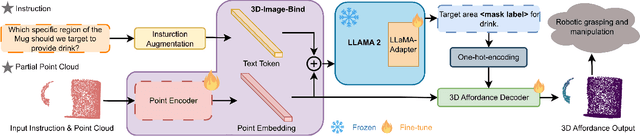


Affordance understanding, the task of identifying actionable regions on 3D objects, plays a vital role in allowing robotic systems to engage with and operate within the physical world. Although Visual Language Models (VLMs) have excelled in high-level reasoning and long-horizon planning for robotic manipulation, they still fall short in grasping the nuanced physical properties required for effective human-robot interaction. In this paper, we introduce PAVLM (Point cloud Affordance Vision-Language Model), an innovative framework that utilizes the extensive multimodal knowledge embedded in pre-trained language models to enhance 3D affordance understanding of point cloud. PAVLM integrates a geometric-guided propagation module with hidden embeddings from large language models (LLMs) to enrich visual semantics. On the language side, we prompt Llama-3.1 models to generate refined context-aware text, augmenting the instructional input with deeper semantic cues. Experimental results on the 3D-AffordanceNet benchmark demonstrate that PAVLM outperforms baseline methods for both full and partial point clouds, particularly excelling in its generalization to novel open-world affordance tasks of 3D objects. For more information, visit our project site: pavlm-source.github.io.
Location-Aware Visual Question Generation with Lightweight Models
Oct 23, 2023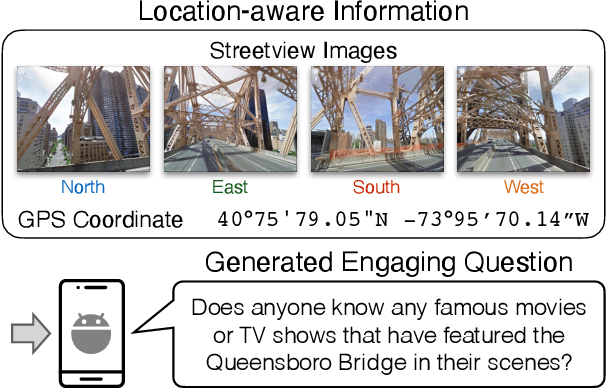
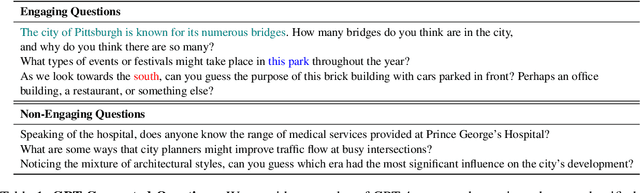
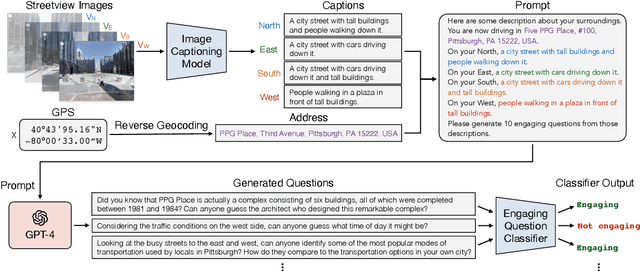
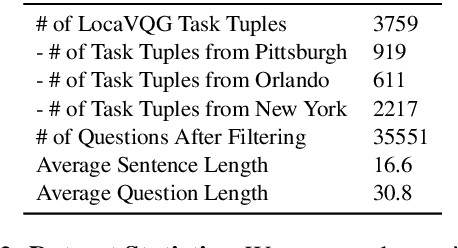
This work introduces a novel task, location-aware visual question generation (LocaVQG), which aims to generate engaging questions from data relevant to a particular geographical location. Specifically, we represent such location-aware information with surrounding images and a GPS coordinate. To tackle this task, we present a dataset generation pipeline that leverages GPT-4 to produce diverse and sophisticated questions. Then, we aim to learn a lightweight model that can address the LocaVQG task and fit on an edge device, such as a mobile phone. To this end, we propose a method which can reliably generate engaging questions from location-aware information. Our proposed method outperforms baselines regarding human evaluation (e.g., engagement, grounding, coherence) and automatic evaluation metrics (e.g., BERTScore, ROUGE-2). Moreover, we conduct extensive ablation studies to justify our proposed techniques for both generating the dataset and solving the task.