 Add to Chrome
 Add to Firefox
 Add to Edge
AsyncOPD: How Stale Can On-Policy Distillation Be?
Jun 23, 2026
On-policy distillation (OPD) trains a student on its own rollouts guided by teacher feedback and is becoming increasingly important for large language model (LLM) post-training. Like reinforcement learning (RL), however, OPD faces an on-policy systems bottleneck, as rollouts can dominate training time for reasoning workloads. Asynchronous training pipelines can alleviate this bottleneck by decoupling rollout generation from learner updates, but doing so introduces stale-policy data. While prior work has studied stale data in asynchronous RL, its effects in OPD remain underexplored. We present the first systematic study of staleness in asynchronous OPD, focusing on a practical setting where teacher feedback is implemented through local KL losses and full-vocabulary teacher logits are too expensive to store or transfer, necessitating finite teacher-score caches. We first show that KL direction changes the stale-data problem: teacher-weighted forward KL is more robust to stale rollouts, whereas student-weighted reverse KL is vulnerable. Second, for this vulnerable reverse-KL case, we study whether methods designed to stabilize asynchronous RL can mitigate OPD staleness. In our experiments, they do not improve over a simpler OPD-specific surrogate: recomputing the reverse-KL signal under the current student at learner time. Third, we analyze how finite teacher-score caches create a bias-variance tradeoff for sparse and sampled reverse-KL OPD estimators. This motivates multi-sample Monte Carlo (MC), which preserves MC correctability while reducing one-sample variance. Finally, we present and open-source AsyncOPD, a fully asynchronous OPD training pipeline built from these estimator choices. Experiments show that AsyncOPD improves training throughput by $1.6\times$ to $3.8\times$ over strict synchronous training while reaching comparable accuracy.

EfficientRollout: System-Aware Self-Speculative Decoding for RL Rollouts
Jun 17, 2026Reinforcement learning (RL) has become a representative post-training paradigm for LLMs, enabling strong reasoning and agentic capabilities. However, rollout generation remains a dominant latency bottleneck because autoregressive sampling decodes responses sequentially and a small number of long-tailed generations often determine completion time. Speculative decoding (SD) offers a natural way to address this bottleneck, as it is a well-established technique for serving fixed LLMs that reduces latency by rapidly drafting tokens and accepting them through parallel verification while preserving the target-model distribution. However, its practical speedups do not directly carry over to RL rollouts: (i) the evolving target policy makes any fixed drafter increasingly mismatched with the policy's output distribution; and (ii) active batch sizes shrink throughout rollout decoding, shifting decoding from compute-bound to memory-bound regimes where parallel verification can exploit underutilized compute. Therefore, accelerating RL rollouts requires both a drafter that remains effective under long, high-temperature generations from an evolving policy and system-aware use of SD that avoids compute-bound regimes. We present EfficientRollout, a system-aware self-SD framework designed to address this gap for RL rollouts. EfficientRollout induces a quantized drafter from the target model (i.e. self-speculative decoding), keeping it coupled to the evolving policy without separate drafter pretraining or online adaptation. It further coordinates a system-aware SD toggle policy with acceptance-aware draft-length adaptation, enabling speculation only in beneficial regimes while matching the drafting budget to evolving drafter quality. EfficientRollout reduces rollout and end-to-end latency by up to 19.6% and 12.7%, respectively, over an accelerated AR rollout baseline, while preserving final model quality.
Transformers in the Dark: Navigating Unknown Search Spaces via Bandit Feedback
Mar 25, 2026Effective problem solving with Large Language Models (LLMs) can be enhanced when they are paired with external search algorithms. By viewing the space of diverse ideas and their follow-up possibilities as a tree structure, the search algorithm can navigate such a search space and guide the LLM toward better solutions more efficiently. While the search algorithm enables an effective balance between exploitation and exploration of a tree-structured space, the need for an external component can complicate the overall problem-solving process. We therefore pose the following question: Can LLMs or their underlying Transformer architectures approximate a search algorithm? To answer this question, we first introduce a simplified framework in which tree extensions and feedback signals are externally specified, allowing for controlled evaluation of search capabilities. We call this setting unknown tree search with bandit feedback. Within this setting, we show that Transformers are theoretically expressive enough to implement distinct search strategies and can be trained from scratch to approximate those strategies. Our Transformer models exhibit the possibility of generalizing to unseen conditions such as longer horizons or deeper trees. Furthermore, we demonstrate that continued task-focused training unlocks the complete capabilities of a pretrained LLM, by fine-tuning the LLM on search trajectories.
TABED: Test-Time Adaptive Ensemble Drafting for Robust Speculative Decoding in LVLMs
Jan 28, 2026Speculative decoding (SD) has proven effective for accelerating LLM inference by quickly generating draft tokens and verifying them in parallel. However, SD remains largely unexplored for Large Vision-Language Models (LVLMs), which extend LLMs to process both image and text prompts. To address this gap, we benchmark existing inference methods with small draft models on 11 datasets across diverse input scenarios and observe scenario-specific performance fluctuations. Motivated by these findings, we propose Test-time Adaptive Batched Ensemble Drafting (TABED), which dynamically ensembles multiple drafts obtained via batch inference by leveraging deviations from past ground truths available in the SD setting. The dynamic ensemble method achieves an average robust walltime speedup of 1.74x over autoregressive decoding and a 5% improvement over single drafting methods, while remaining training-free and keeping ensembling costs negligible through parameter sharing. With its plug-and-play compatibility, we further enhance TABED by integrating advanced verification and alternative drafting methods. Code and custom-trained models are available at https://github.com/furiosa-ai/TABED.
ParallelBench: Understanding the Trade-offs of Parallel Decoding in Diffusion LLMs
Oct 06, 2025While most autoregressive LLMs are constrained to one-by-one decoding, diffusion LLMs (dLLMs) have attracted growing interest for their potential to dramatically accelerate inference through parallel decoding. Despite this promise, the conditional independence assumption in dLLMs causes parallel decoding to ignore token dependencies, inevitably degrading generation quality when these dependencies are strong. However, existing works largely overlook these inherent challenges, and evaluations on standard benchmarks (e.g., math and coding) are not sufficient to capture the quality degradation caused by parallel decoding. To address this gap, we first provide an information-theoretic analysis of parallel decoding. We then conduct case studies on analytically tractable synthetic list operations from both data distribution and decoding strategy perspectives, offering quantitative insights that highlight the fundamental limitations of parallel decoding. Building on these insights, we propose ParallelBench, the first benchmark specifically designed for dLLMs, featuring realistic tasks that are trivial for humans and autoregressive LLMs yet exceptionally challenging for dLLMs under parallel decoding. Using ParallelBench, we systematically analyze both dLLMs and autoregressive LLMs, revealing that: (i) dLLMs under parallel decoding can suffer dramatic quality degradation in real-world scenarios, and (ii) current parallel decoding strategies struggle to adapt their degree of parallelism based on task difficulty, thus failing to achieve meaningful speedup without compromising quality. Our findings underscore the pressing need for innovative decoding methods that can overcome the current speed-quality trade-off. We release our benchmark to help accelerate the development of truly efficient dLLMs.
UNCAGE: Contrastive Attention Guidance for Masked Generative Transformers in Text-to-Image Generation
Aug 07, 2025Text-to-image (T2I) generation has been actively studied using Diffusion Models and Autoregressive Models. Recently, Masked Generative Transformers have gained attention as an alternative to Autoregressive Models to overcome the inherent limitations of causal attention and autoregressive decoding through bidirectional attention and parallel decoding, enabling efficient and high-quality image generation. However, compositional T2I generation remains challenging, as even state-of-the-art Diffusion Models often fail to accurately bind attributes and achieve proper text-image alignment. While Diffusion Models have been extensively studied for this issue, Masked Generative Transformers exhibit similar limitations but have not been explored in this context. To address this, we propose Unmasking with Contrastive Attention Guidance (UNCAGE), a novel training-free method that improves compositional fidelity by leveraging attention maps to prioritize the unmasking of tokens that clearly represent individual objects. UNCAGE consistently improves performance in both quantitative and qualitative evaluations across multiple benchmarks and metrics, with negligible inference overhead. Our code is available at https://github.com/furiosa-ai/uncage.
Draft-based Approximate Inference for LLMs
Jun 10, 2025Optimizing inference for long-context Large Language Models (LLMs) is increasingly important due to the quadratic compute and linear memory complexity of Transformers. Existing approximation methods, such as key-value (KV) cache dropping, sparse attention, and prompt compression, typically rely on rough predictions of token or KV pair importance. We propose a novel framework for approximate LLM inference that leverages small draft models to more accurately predict the importance of tokens and KV pairs. Specifically, we introduce two instantiations of our proposed framework: (i) SpecKV, which leverages a draft output to accurately assess the importance of each KV pair for more effective KV cache dropping, and (ii) SpecPC, which uses the draft model's attention activations to identify and discard unimportant prompt tokens. To the best of our knowledge, this is the first work to use draft models for approximate LLM inference acceleration, extending their utility beyond traditional lossless speculative decoding. We motivate our methods with theoretical and empirical analyses, and show a strong correlation between the attention patterns of draft and target models. Extensive experiments on long-context benchmarks show that our methods consistently achieve higher accuracy than existing baselines, while preserving the same improvements in memory usage, latency, and throughput. Our code is available at https://github.com/furiosa-ai/draft-based-approx-llm.
State-offset Tuning: State-based Parameter-Efficient Fine-Tuning for State Space Models
Mar 05, 2025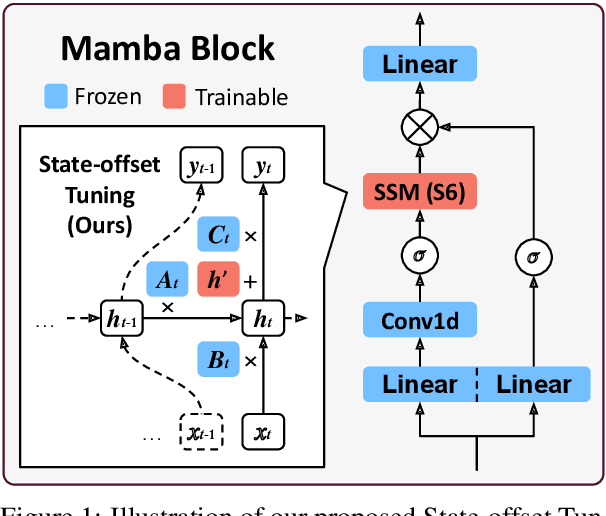
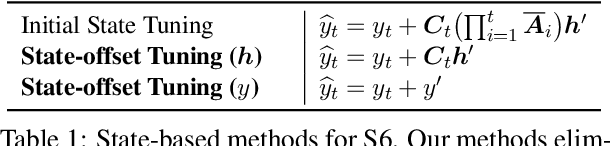
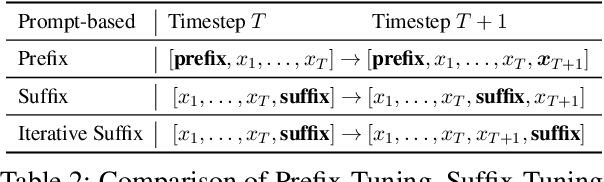
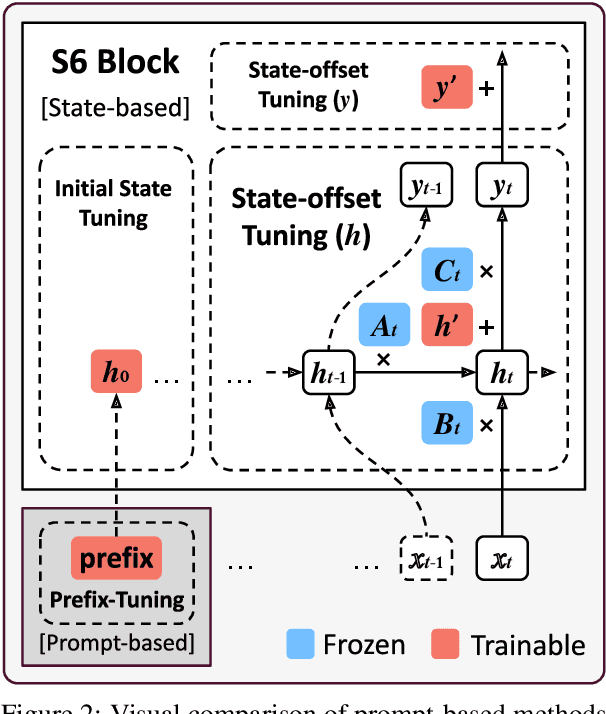
State Space Models (SSMs) have emerged as efficient alternatives to Transformers, mitigating their quadratic computational cost. However, the application of Parameter-Efficient Fine-Tuning (PEFT) methods to SSMs remains largely unexplored. In particular, prompt-based methods like Prompt Tuning and Prefix-Tuning, which are widely used in Transformers, do not perform well on SSMs. To address this, we propose state-based methods as a superior alternative to prompt-based methods. This new family of methods naturally stems from the architectural characteristics of SSMs. State-based methods adjust state-related features directly instead of depending on external prompts. Furthermore, we introduce a novel state-based PEFT method: State-offset Tuning. At every timestep, our method directly affects the state at the current step, leading to more effective adaptation. Through extensive experiments across diverse datasets, we demonstrate the effectiveness of our method. Code is available at https://github.com/furiosa-ai/ssm-state-tuning.
VersaPRM: Multi-Domain Process Reward Model via Synthetic Reasoning Data
Feb 10, 2025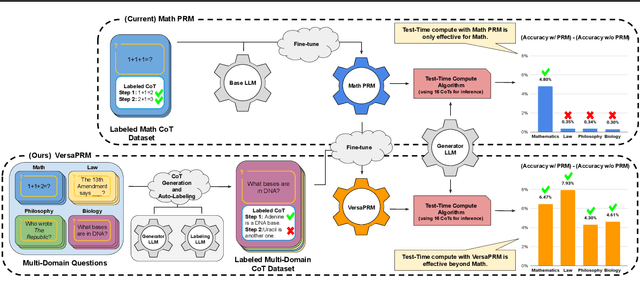
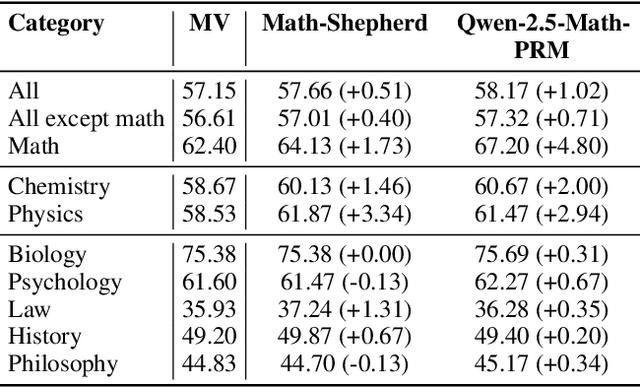
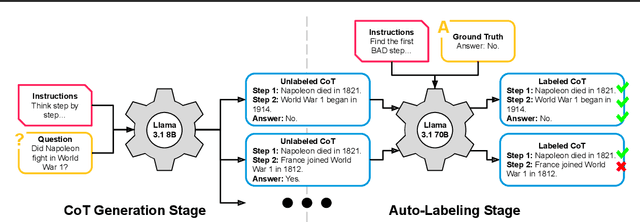

Process Reward Models (PRMs) have proven effective at enhancing mathematical reasoning for Large Language Models (LLMs) by leveraging increased inference-time computation. However, they are predominantly trained on mathematical data and their generalizability to non-mathematical domains has not been rigorously studied. In response, this work first shows that current PRMs have poor performance in other domains. To address this limitation, we introduce VersaPRM, a multi-domain PRM trained on synthetic reasoning data generated using our novel data generation and annotation method. VersaPRM achieves consistent performance gains across diverse domains. For instance, in the MMLU-Pro category of Law, VersaPRM via weighted majority voting, achieves a 7.9% performance gain over the majority voting baseline -- surpassing Qwen2.5-Math-PRM's gain of 1.3%. We further contribute to the community by open-sourcing all data, code and models for VersaPRM.
Parameter-Efficient Fine-Tuning of State Space Models
Oct 11, 2024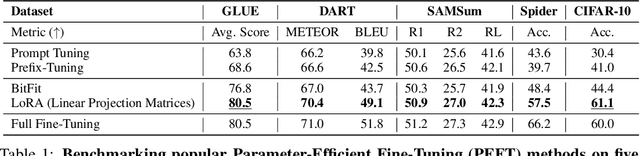
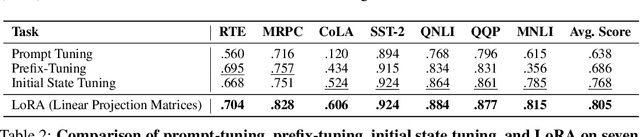
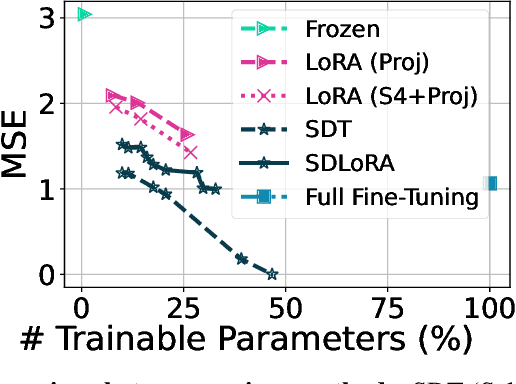
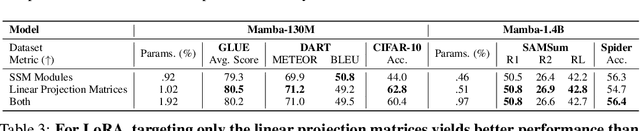
Deep State Space Models (SSMs), such as Mamba (Gu & Dao, 2024), have emerged as powerful tools for language modeling, offering high performance with efficient inference and linear scaling in sequence length. However, the application of parameter-efficient fine-tuning (PEFT) methods to SSM-based models remains largely unexplored. This paper aims to systematically study two key questions: (i) How do existing PEFT methods perform on SSM-based models? (ii) Which modules are most effective for fine-tuning? We conduct an empirical benchmark of four basic PEFT methods on SSM-based models. Our findings reveal that prompt-based methods (e.g., prefix-tuning) are no longer effective, an empirical result further supported by theoretical analysis. In contrast, LoRA remains effective for SSM-based models. We further investigate the optimal application of LoRA within these models, demonstrating both theoretically and experimentally that applying LoRA to linear projection matrices without modifying SSM modules yields the best results, as LoRA is not effective at tuning SSM modules. To further improve performance, we introduce LoRA with Selective Dimension tuning (SDLoRA), which selectively updates certain channels and states on SSM modules while applying LoRA to linear projection matrices. Extensive experimental results show that this approach outperforms standard LoRA.