 Add to Chrome
 Add to Firefox
 Add to Edge
Same Concept, Different Directions: Cross-Modal Feature Heterogeneity in Sparse Autoencoders
Jun 29, 2026
Vision-language models map images and text into a joint embedding space. However, these embeddings often entangle multiple semantic features, which limits their interpretability and controllability. While sparse autoencoders have emerged as a useful tool for decomposing these embeddings into monosemantic features, their application to joint embedding spaces has largely relied on an implicit, untested assumption that semantically corresponding features share the same directions across modalities. In this paper, we challenge this assumption by identifying discrepancies in feature directions for the same concept across image and text modalities, a phenomenon we term cross-modal feature heterogeneity. We demonstrate that this heterogeneity is a key driver of the modality split, where a shared concept activates different latents depending on the modality. This finding further reveals why aligning latent activations alone is insufficient to resolve the underlying feature mismatch. Motivated by this observation, we propose an approach that trains modality-specific sparse autoencoders to preserve each modality's feature geometry, and then aligns corresponding features post hoc. Our method improves reconstruction fidelity and enhances performance in cross-modal retrieval and concept steering.

Transformers in the Dark: Navigating Unknown Search Spaces via Bandit Feedback
Mar 25, 2026Effective problem solving with Large Language Models (LLMs) can be enhanced when they are paired with external search algorithms. By viewing the space of diverse ideas and their follow-up possibilities as a tree structure, the search algorithm can navigate such a search space and guide the LLM toward better solutions more efficiently. While the search algorithm enables an effective balance between exploitation and exploration of a tree-structured space, the need for an external component can complicate the overall problem-solving process. We therefore pose the following question: Can LLMs or their underlying Transformer architectures approximate a search algorithm? To answer this question, we first introduce a simplified framework in which tree extensions and feedback signals are externally specified, allowing for controlled evaluation of search capabilities. We call this setting unknown tree search with bandit feedback. Within this setting, we show that Transformers are theoretically expressive enough to implement distinct search strategies and can be trained from scratch to approximate those strategies. Our Transformer models exhibit the possibility of generalizing to unseen conditions such as longer horizons or deeper trees. Furthermore, we demonstrate that continued task-focused training unlocks the complete capabilities of a pretrained LLM, by fine-tuning the LLM on search trajectories.
Fine-Tuning Without Forgetting In-Context Learning: A Theoretical Analysis of Linear Attention Models
Feb 26, 2026Transformer-based large language models exhibit in-context learning, enabling adaptation to downstream tasks via few-shot prompting with demonstrations. In practice, such models are often fine-tuned to improve zero-shot performance on downstream tasks, allowing them to solve tasks without examples and thereby reducing inference costs. However, fine-tuning can degrade in-context learning, limiting the performance of fine-tuned models on tasks not seen during fine-tuning. Using linear attention models, we provide a theoretical analysis that characterizes how fine-tuning objectives modify attention parameters and identifies conditions under which this leads to degraded few-shot performance. We show that fine-tuning all attention parameters can harm in-context learning, whereas restricting updates to the value matrix improves zero-shot performance while preserving in-context learning. We further show that incorporating an auxiliary few-shot loss enhances in-context learning primarily on the target task, at the expense of degraded in-context learning ability on tasks not seen during fine-tuning. We empirically validate our theoretical results.
On the Similarities of Embeddings in Contrastive Learning
Jun 11, 2025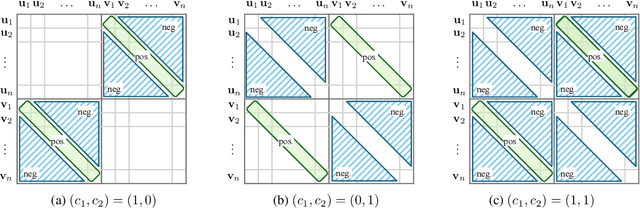
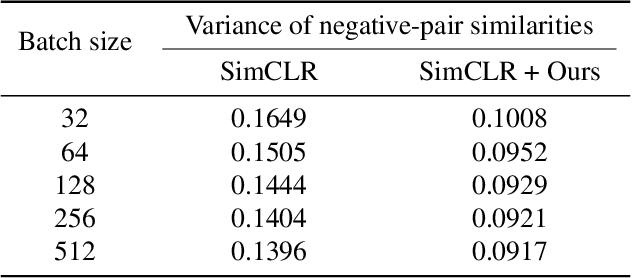

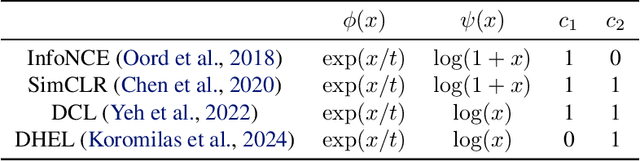
Contrastive learning (CL) operates on a simple yet effective principle: embeddings of positive pairs are pulled together, while those of negative pairs are pushed apart. Although various forms of contrastive loss have been proposed and analyzed from different perspectives, prior works lack a comprehensive framework that systematically explains a broad class of these objectives. In this paper, we present a unified framework for understanding CL, which is based on analyzing the cosine similarity between embeddings of positive and negative pairs. In full-batch settings, we show that perfect alignment of positive pairs is unattainable when similarities of negative pairs fall below a certain threshold, and that this misalignment can be alleviated by incorporating within-view negative pairs. In mini-batch settings, we demonstrate that smaller batch sizes incur stronger separation among negative pairs within batches, which leads to higher variance in similarities of negative pairs. To address this limitation of mini-batch CL, we introduce an auxiliary loss term that reduces the variance of similarities of negative pairs in CL. Empirical results demonstrate that incorporating the proposed loss consistently improves the performance of CL methods in small-batch training.
* contrastive learning, representation learning, embedding, similarity, negative pair, positive pair
A Theoretical Framework for Preventing Class Collapse in Supervised Contrastive Learning
Mar 11, 2025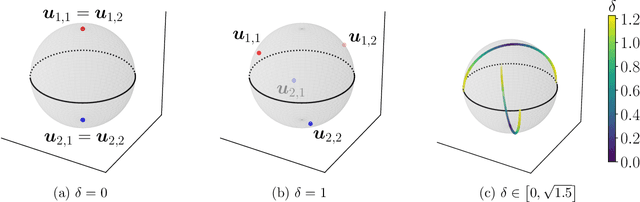

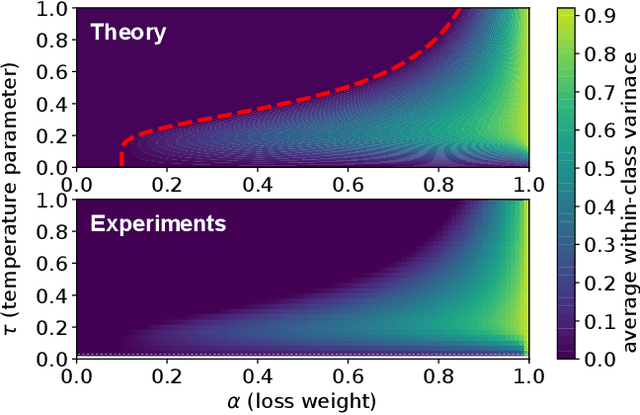
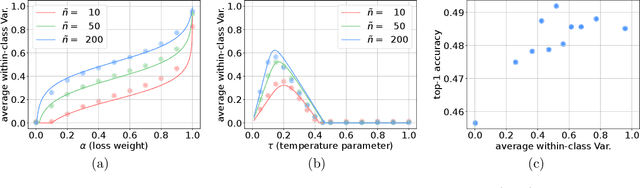
Supervised contrastive learning (SupCL) has emerged as a prominent approach in representation learning, leveraging both supervised and self-supervised losses. However, achieving an optimal balance between these losses is challenging; failing to do so can lead to class collapse, reducing discrimination among individual embeddings in the same class. In this paper, we present theoretically grounded guidelines for SupCL to prevent class collapse in learned representations. Specifically, we introduce the Simplex-to-Simplex Embedding Model (SSEM), a theoretical framework that models various embedding structures, including all embeddings that minimize the supervised contrastive loss. Through SSEM, we analyze how hyperparameters affect learned representations, offering practical guidelines for hyperparameter selection to mitigate the risk of class collapse. Our theoretical findings are supported by empirical results across synthetic and real-world datasets.
A Generalized Theory of Mixup for Structure-Preserving Synthetic Data
Mar 03, 2025Mixup is a widely adopted data augmentation technique known for enhancing the generalization of machine learning models by interpolating between data points. Despite its success and popularity, limited attention has been given to understanding the statistical properties of the synthetic data it generates. In this paper, we delve into the theoretical underpinnings of mixup, specifically its effects on the statistical structure of synthesized data. We demonstrate that while mixup improves model performance, it can distort key statistical properties such as variance, potentially leading to unintended consequences in data synthesis. To address this, we propose a novel mixup method that incorporates a generalized and flexible weighting scheme, better preserving the original data's structure. Through theoretical developments, we provide conditions under which our proposed method maintains the (co)variance and distributional properties of the original dataset. Numerical experiments confirm that the new approach not only preserves the statistical characteristics of the original data but also sustains model performance across repeated synthesis, alleviating concerns of model collapse identified in previous research.
Analysis of Using Sigmoid Loss for Contrastive Learning
Feb 20, 2024Contrastive learning has emerged as a prominent branch of self-supervised learning for several years. Especially, CLIP, which applies contrastive learning to large sets of captioned images, has garnered significant attention. Recently, SigLIP, a variant of CLIP, has been proposed, which uses the sigmoid loss instead of the standard InfoNCE loss. SigLIP achieves the performance comparable to CLIP in a more efficient manner by eliminating the need for a global view. However, theoretical understanding of using the sigmoid loss in contrastive learning is underexplored. In this paper, we provide a theoretical analysis of using the sigmoid loss in contrastive learning, in the perspective of the geometric structure of learned embeddings. First, we propose the double-Constant Embedding Model (CCEM), a framework for parameterizing various well-known embedding structures by a single variable. Interestingly, the proposed CCEM is proven to contain the optimal embedding with respect to the sigmoid loss. Second, we mathematically analyze the optimal embedding minimizing the sigmoid loss for contrastive learning. The optimal embedding ranges from simplex equiangular-tight-frame to antipodal structure, depending on the temperature parameter used in the sigmoid loss. Third, our experimental results on synthetic datasets coincide with the theoretical results on the optimal embedding structures.