 Add to Chrome
 Add to Firefox
 Add to Edge
AdaGScale: Viewpoint-Adaptive Gaussian Scaling in 3D Gaussian Splatting to Reduce Gaussian-Tile Pairs
Apr 21, 2026
Reducing the number of Gaussian-tile pairs is one of the most promising approaches to improve 3D Gaussian Splatting (3D-GS) rendering speed on GPUs. However, the importance difference existing among Gaussian-tile pairs has never been considered in the previous works. In this paper, we propose AdaGScale, a novel viewpoint-adaptive Gaussian scaling technique for reducing the number of Gaussian-tile pairs. AdaGScale is based on the observation that the peripheral tiles located far from Gaussian center contribute negligibly to pixel color accumulation. This suggests an opportunity for reducing the number of Gaussian-tile pairs based on color contribution. AdaGScale efficiently estimates the color contribution in the peripheral region of each Gaussian during a preprocessing stage and adaptively scales its size based on the peripheral score. As a result, Gaussians with lower importance intersect with fewer tiles during the intersection test, which improves rendering speed while maintaining image quality. The adjusted size is used only for tile intersection test, and the original size is retained during color accumulation to preserve visual fidelity. Experimental results show that AdaGScale achieves a geometric mean speedup of 13.8x over original 3D-GS on a GPU, with only about 0.5 dB degradation in PSNR on city-scale scenes.

VisionTrap: Vision-Augmented Trajectory Prediction Guided by Textual Descriptions
Jul 17, 2024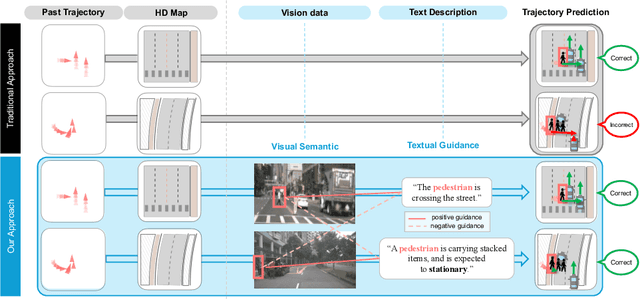
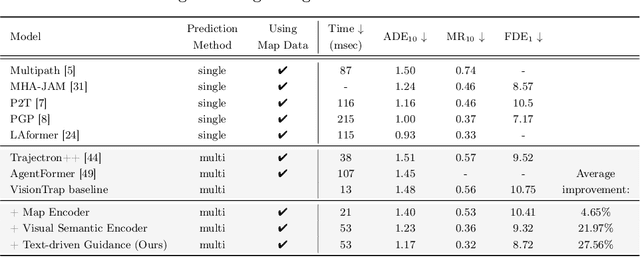
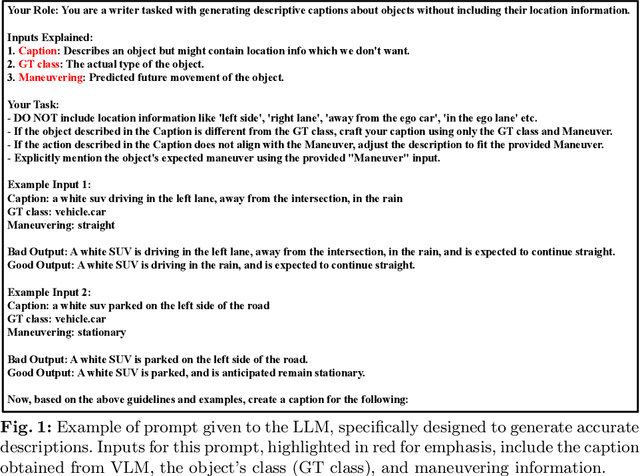

Predicting future trajectories for other road agents is an essential task for autonomous vehicles. Established trajectory prediction methods primarily use agent tracks generated by a detection and tracking system and HD map as inputs. In this work, we propose a novel method that also incorporates visual input from surround-view cameras, allowing the model to utilize visual cues such as human gazes and gestures, road conditions, vehicle turn signals, etc, which are typically hidden from the model in prior methods. Furthermore, we use textual descriptions generated by a Vision-Language Model (VLM) and refined by a Large Language Model (LLM) as supervision during training to guide the model on what to learn from the input data. Despite using these extra inputs, our method achieves a latency of 53 ms, making it feasible for real-time processing, which is significantly faster than that of previous single-agent prediction methods with similar performance. Our experiments show that both the visual inputs and the textual descriptions contribute to improvements in trajectory prediction performance, and our qualitative analysis highlights how the model is able to exploit these additional inputs. Lastly, in this work we create and release the nuScenes-Text dataset, which augments the established nuScenes dataset with rich textual annotations for every scene, demonstrating the positive impact of utilizing VLM on trajectory prediction. Our project page is at https://moonseokha.github.io/VisionTrap/