 Add to Chrome
 Add to Firefox
 Add to Edge
AdaGScale: Viewpoint-Adaptive Gaussian Scaling in 3D Gaussian Splatting to Reduce Gaussian-Tile Pairs
Apr 21, 2026
Reducing the number of Gaussian-tile pairs is one of the most promising approaches to improve 3D Gaussian Splatting (3D-GS) rendering speed on GPUs. However, the importance difference existing among Gaussian-tile pairs has never been considered in the previous works. In this paper, we propose AdaGScale, a novel viewpoint-adaptive Gaussian scaling technique for reducing the number of Gaussian-tile pairs. AdaGScale is based on the observation that the peripheral tiles located far from Gaussian center contribute negligibly to pixel color accumulation. This suggests an opportunity for reducing the number of Gaussian-tile pairs based on color contribution. AdaGScale efficiently estimates the color contribution in the peripheral region of each Gaussian during a preprocessing stage and adaptively scales its size based on the peripheral score. As a result, Gaussians with lower importance intersect with fewer tiles during the intersection test, which improves rendering speed while maintaining image quality. The adjusted size is used only for tile intersection test, and the original size is retained during color accumulation to preserve visual fidelity. Experimental results show that AdaGScale achieves a geometric mean speedup of 13.8x over original 3D-GS on a GPU, with only about 0.5 dB degradation in PSNR on city-scale scenes.

DBHP: Trajectory Imputation in Multi-Agent Sports Using Derivative-Based Hybrid Prediction
Aug 20, 2024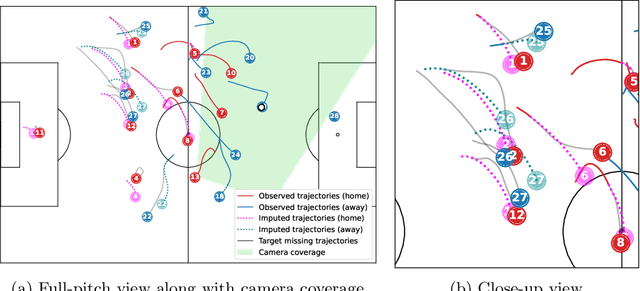
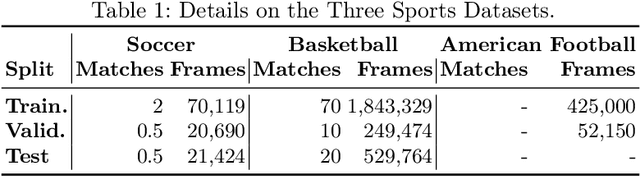
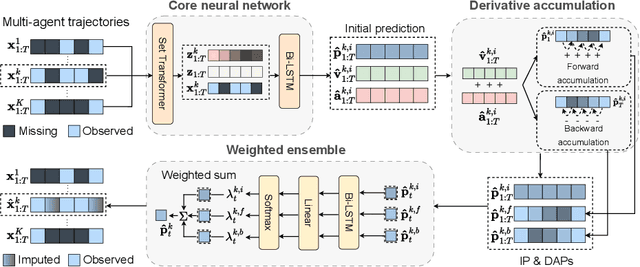
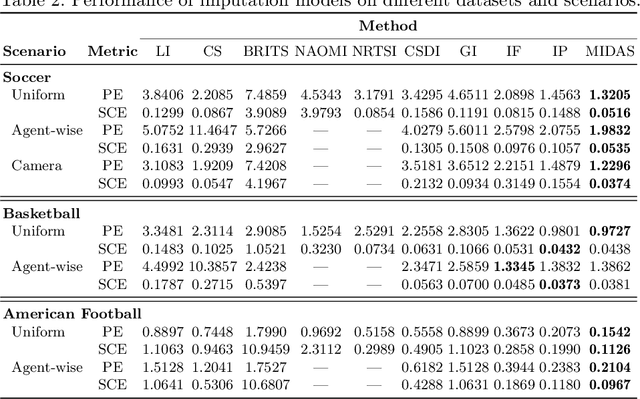
Many spatiotemporal domains handle multi-agent trajectory data, but in real-world scenarios, collected trajectory data are often partially missing due to various reasons. While existing approaches demonstrate good performance in trajectory imputation, they face challenges in capturing the complex dynamics and interactions between agents due to a lack of physical constraints that govern realistic trajectories, leading to suboptimal results. To address this issue, the paper proposes a Derivative-Based Hybrid Prediction (DBHP) framework that can effectively impute multiple agents' missing trajectories. First, a neural network equipped with Set Transformers produces a naive prediction of missing trajectories while satisfying the permutation-equivariance in terms of the order of input agents. Then, the framework makes alternative predictions leveraging velocity and acceleration information and combines all the predictions with properly determined weights to provide final imputed trajectories. In this way, our proposed framework not only accurately predicts position, velocity, and acceleration values but also enforces the physical relationship between them, eventually improving both the accuracy and naturalness of the predicted trajectories. Accordingly, the experiment results about imputing player trajectories in team sports show that our framework significantly outperforms existing imputation baselines.