 Add to Chrome
 Add to Firefox
 Add to Edge
AgentKGV: Agentic LLM-RAG Framework with Two-Stage Training for the Fact Verification of Knowledge Graphs
Jul 10, 2026
Knowledge graphs (KGs) are often automatically constructed from large-scale corpora, but they inevitably contain factual errors due to noisy sources and extraction failures, and verifying them reliably at industrial scale remains a critical challenge. To address this, we propose AgentKGV, the Agentic LLM-RAG framework for KG fact Verification, that integrates dynamic routing and iterative query rewriting, which handles surface-form mismatch in document-level retrieval. To make this framework more accurate and cost-efficient for industrial deployment, we further introduce a two-stage training strategy: turn-level distillation-based SFT that transfers reasoning ability from a large teacher model into a small model for stable query rewriting and reasoning, and trajectory-level GRPO that optimizes the search policy to reduce unnecessary retrieval at scale. On the long-tail-predicate split of the open-domain T-REx benchmark, our framework improves macro-F1 over single-turn RAG by 5.5 \%p, and two-stage training does it further by 9.4 \%p. GRPO also cuts the average number of search calls from 3.24 to 1.63 without lowering accuracy.

Predicate Importance Estimation and Decoupled Rationale-Score Distillation for Entity Alignment
Jun 22, 2026Knowledge graphs (KGs) are increasingly used as structured context for Large Language Models (LLMs), but industrial KG-RAG systems often need to integrate public and domain-specific KGs constructed from heterogeneous databases. This integration relies on Entity Alignment (EA), where lexical matching alone is insufficient under predicate-name variation and incomplete local neighborhoods. We address EA for KG integration by constructing a pairwise EA dataset and proposing two complementary modules: Predicate Importance Estimation (PIE) and Decoupled Rationale-Score Distillation (DRSD). PIE is a compact embedding-based approach that removes the subject information from each 1-hop triple, encodes the resulting subjectless triples, and aggregates them with learnable predicate-importance weights to build predicate-aware entity embeddings. DRSD trains a distilled small language model (SLM) with pseudo-answers produced by a teacher LLM through distinct prompts. By converting binary EA labels into text-based supervision and decoupling confidence-score estimation from label-consistent rationales, DRSD enables the SLM to learn task-specific reasoning while retaining a less label-biased confidence signal. Experiments show that PIE and DRSD improve EA classification. Moreover, because DRSD decouples confidence-score estimation from the decision, a discrepancy between the two flags an uncertain prediction for human review, thereby enabling a practical discrepancy between automatic acceptance and human-in-the-loop verification.
ThisIsCompetition at SemEval-2019 Task 9: BERT is unstable for out-of-domain samples
Apr 06, 2019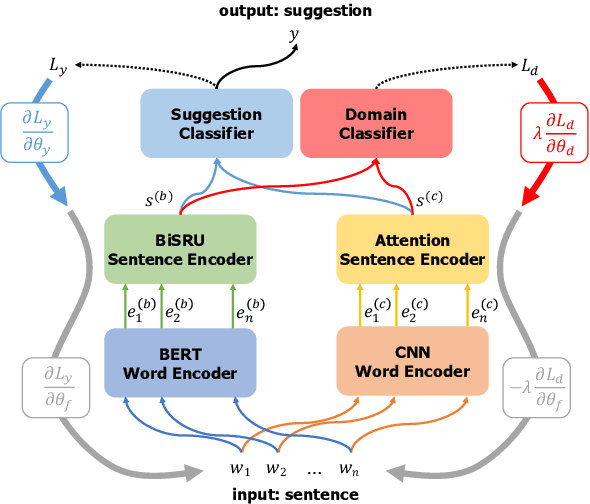
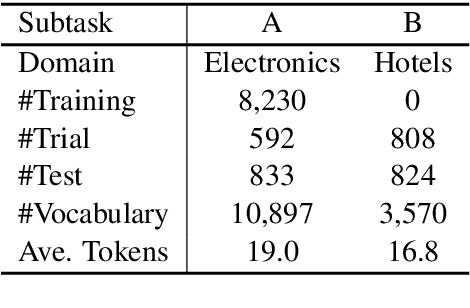
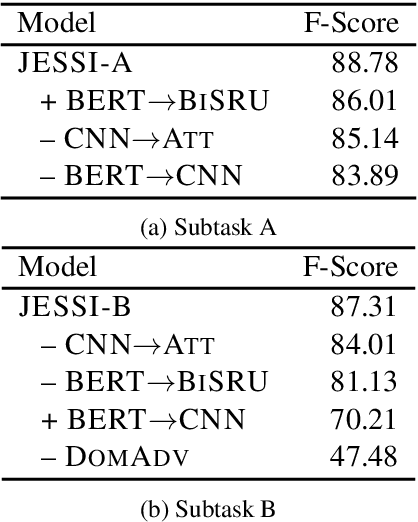
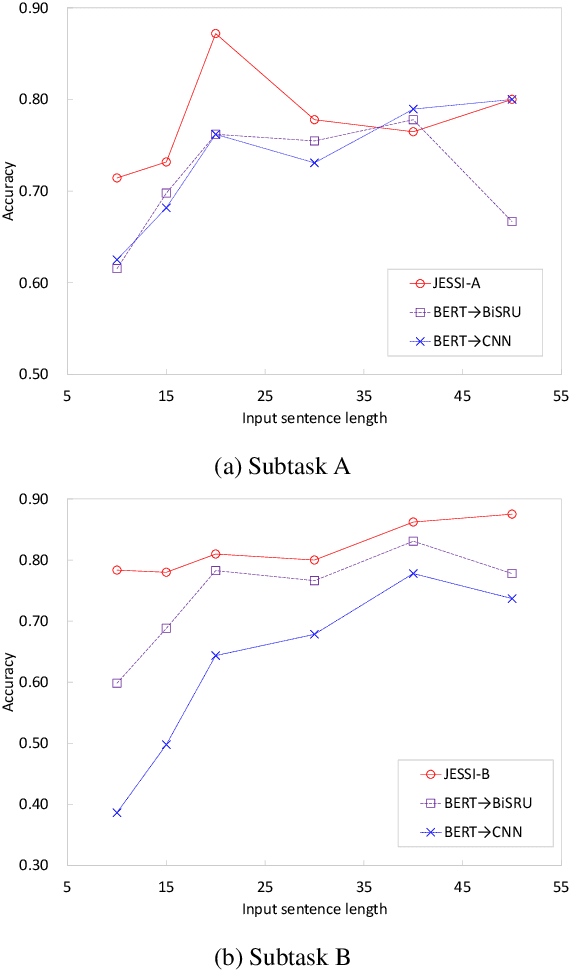
This paper describes our system, Joint Encoders for Stable Suggestion Inference (JESSI), for the SemEval 2019 Task 9: Suggestion Mining from Online Reviews and Forums. JESSI is a combination of two sentence encoders: (a) one using multiple pre-trained word embeddings learned from log-bilinear regression (GloVe) and translation (CoVe) models, and (b) one on top of word encodings from a pre-trained deep bidirectional transformer (BERT). We include a domain adversarial training module when training for out-of-domain samples. Our experiments show that while BERT performs exceptionally well for in-domain samples, several runs of the model show that it is unstable for out-of-domain samples. The problem is mitigated tremendously by (1) combining BERT with a non-BERT encoder, and (2) using an RNN-based classifier on top of BERT. Our final models obtained second place with 77.78\% F-Score on Subtask A (i.e. in-domain) and achieved an F-Score of 79.59\% on Subtask B (i.e. out-of-domain), even without using any additional external data.