 Add to Chrome
 Add to Firefox
 Add to Edge
Sharpness-aware Model Merging with Salience Recovery for LLM-based Cross-Domain Sequential Recommendation
Jul 28, 2026
LLM-based Cross-Domain Sequential Recommendation (CDSR) leverages LLMs to enhance target performance via deep semantic reasoning, alleviating the dependency on overlapping users. Among LLM-based paradigms, model merging is particularly promising for multi-domain scenarios due to its superior scalability and flexibility in integrating diverse knowledge sources. However, our empirical investigations reveal two critical bottlenecks: (1) cross-domain knowledge conflict; and (2) performance saturation in multi-domain fusion. Our analysis attributes these phenomena to parameter-level misalignment and statistical homogenization during the merging process. To address these bottlenecks, we propose SharpRec, Sharpness-aware Model Merging with Salience Recovery for LLM-based CDSR, a framework designed to lift the performance upper bound of merged models. SharpRec incorporates two synergistic modules: Sharpness-aware Geometric Alignment to establish a stable geometric foundation for interference-free fusion; and Preference Salience Activation to effectively recover the distinctive features essential for bolstering target domain performance. Extensive experiments in both dual-domain and multi-domain scenarios demonstrate that SharpRec consistently outperforms state-of-the-art baselines.
* Published in Proceedings of the 32nd ACM SIGKDD Conference on Knowledge Discovery and Data Mining (KDD '26). 12 pages, 6 figures, 4 tables. Code available at https://github.com/muyiahhh/SharpRec

Bridging the Gap Between Preference Alignment and Machine Unlearning
Apr 09, 2025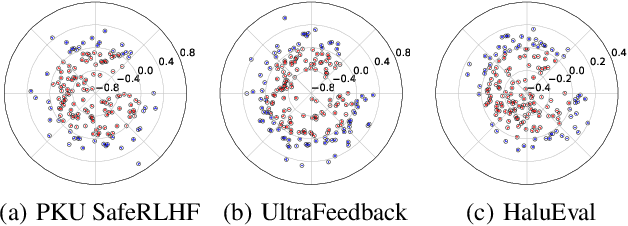
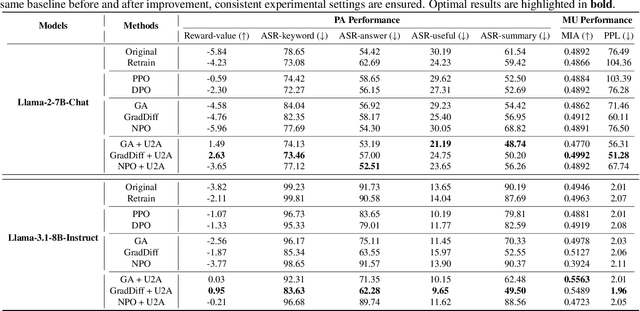
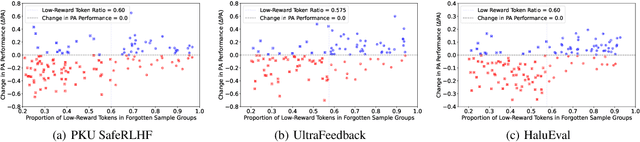

Despite advances in Preference Alignment (PA) for Large Language Models (LLMs), mainstream methods like Reinforcement Learning with Human Feedback (RLHF) face notable challenges. These approaches require high-quality datasets of positive preference examples, which are costly to obtain and computationally intensive due to training instability, limiting their use in low-resource scenarios. LLM unlearning technique presents a promising alternative, by directly removing the influence of negative examples. However, current research has primarily focused on empirical validation, lacking systematic quantitative analysis. To bridge this gap, we propose a framework to explore the relationship between PA and LLM unlearning. Specifically, we introduce a bi-level optimization-based method to quantify the impact of unlearning specific negative examples on PA performance. Our analysis reveals that not all negative examples contribute equally to alignment improvement when unlearned, and the effect varies significantly across examples. Building on this insight, we pose a crucial question: how can we optimally select and weight negative examples for unlearning to maximize PA performance? To answer this, we propose a framework called Unlearning to Align (U2A), which leverages bi-level optimization to efficiently select and unlearn examples for optimal PA performance. We validate the proposed method through extensive experiments, with results confirming its effectiveness.