 Add to Chrome
 Add to Firefox
 Add to Edge
Tether: Autonomous Functional Play with Correspondence-Driven Trajectory Warping
Mar 03, 2026
The ability to conduct and learn from interaction and experience is a central challenge in robotics, offering a scalable alternative to labor-intensive human demonstrations. However, realizing such "play" requires (1) a policy robust to diverse, potentially out-of-distribution environment states, and (2) a procedure that continuously produces useful robot experience. To address these challenges, we introduce Tether, a method for autonomous functional play involving structured, task-directed interactions. First, we design a novel open-loop policy that warps actions from a small set of source demonstrations (<=10) by anchoring them to semantic keypoint correspondences in the target scene. We show that this design is extremely data-efficient and robust even under significant spatial and semantic variations. Second, we deploy this policy for autonomous functional play in the real world via a continuous cycle of task selection, execution, evaluation, and improvement, guided by the visual understanding capabilities of vision-language models. This procedure generates diverse, high-quality datasets with minimal human intervention. In a household-like multi-object setup, our method is the first to perform many hours of autonomous multi-task play in the real world starting from only a handful of demonstrations. This produces a stream of data that consistently improves the performance of closed-loop imitation policies over time, ultimately yielding over 1000 expert-level trajectories and training policies competitive with those learned from human-collected demonstrations.

Eurekaverse: Environment Curriculum Generation via Large Language Models
Nov 04, 2024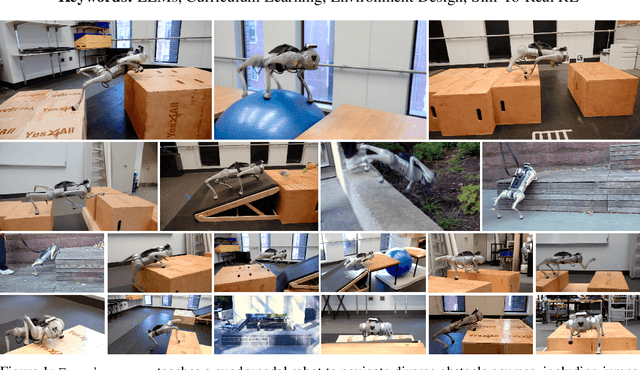
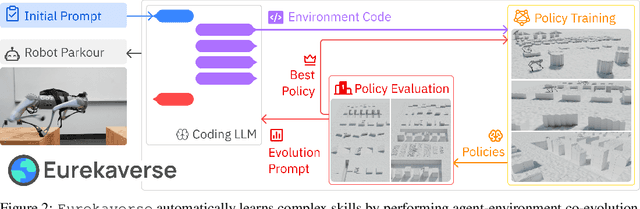
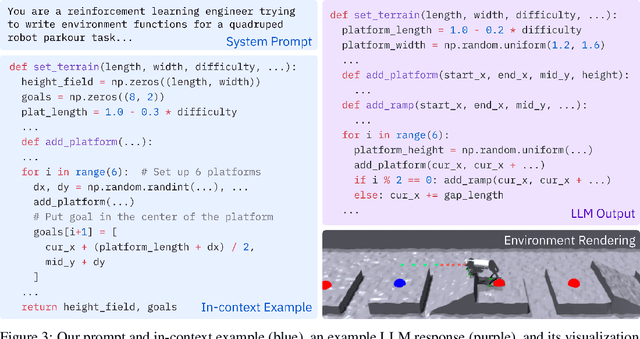
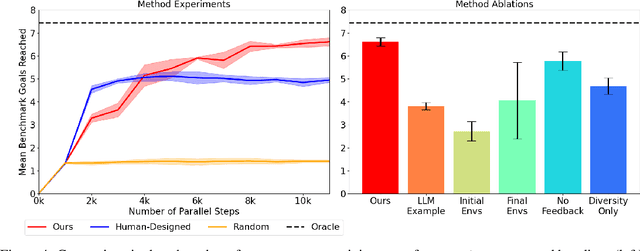
Recent work has demonstrated that a promising strategy for teaching robots a wide range of complex skills is by training them on a curriculum of progressively more challenging environments. However, developing an effective curriculum of environment distributions currently requires significant expertise, which must be repeated for every new domain. Our key insight is that environments are often naturally represented as code. Thus, we probe whether effective environment curriculum design can be achieved and automated via code generation by large language models (LLM). In this paper, we introduce Eurekaverse, an unsupervised environment design algorithm that uses LLMs to sample progressively more challenging, diverse, and learnable environments for skill training. We validate Eurekaverse's effectiveness in the domain of quadrupedal parkour learning, in which a quadruped robot must traverse through a variety of obstacle courses. The automatic curriculum designed by Eurekaverse enables gradual learning of complex parkour skills in simulation and can successfully transfer to the real-world, outperforming manual training courses designed by humans.
DrEureka: Language Model Guided Sim-To-Real Transfer
Jun 04, 2024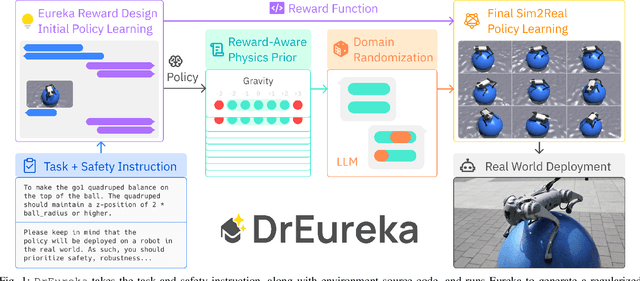
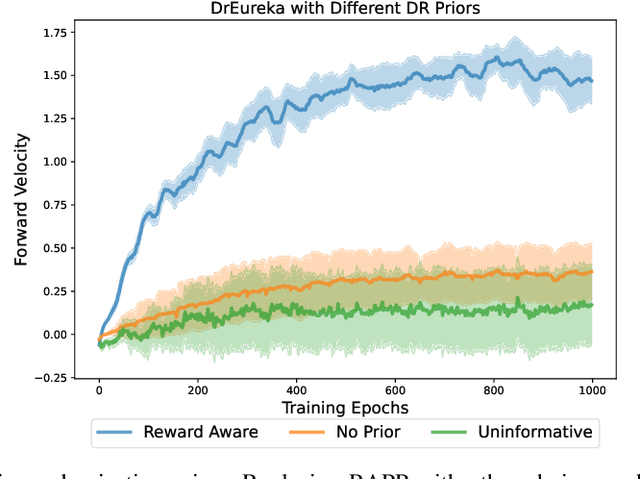

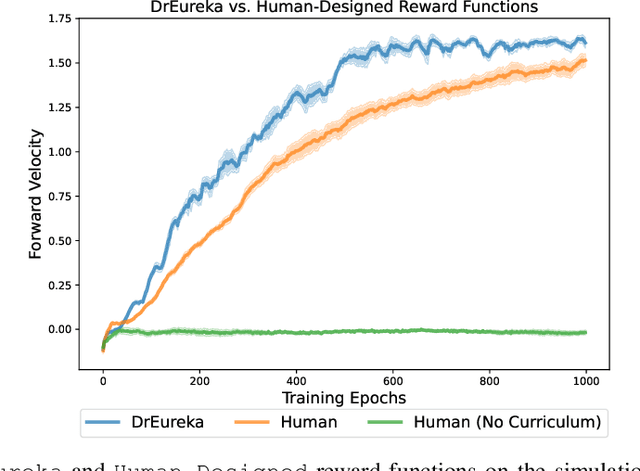
Transferring policies learned in simulation to the real world is a promising strategy for acquiring robot skills at scale. However, sim-to-real approaches typically rely on manual design and tuning of the task reward function as well as the simulation physics parameters, rendering the process slow and human-labor intensive. In this paper, we investigate using Large Language Models (LLMs) to automate and accelerate sim-to-real design. Our LLM-guided sim-to-real approach, DrEureka, requires only the physics simulation for the target task and automatically constructs suitable reward functions and domain randomization distributions to support real-world transfer. We first demonstrate that our approach can discover sim-to-real configurations that are competitive with existing human-designed ones on quadruped locomotion and dexterous manipulation tasks. Then, we showcase that our approach is capable of solving novel robot tasks, such as quadruped balancing and walking atop a yoga ball, without iterative manual design.