 Add to Chrome
 Add to Firefox
 Add to Edge
Black-box Membership Inference Attacks on the Pre-training Data of Image-generation Models
May 26, 2026
The rapid advancement of diffusion-based image generation models has raised serious concerns regarding potential copyright and privacy infringements involving human-created data. Membership inference attacks (MIAs) have emerged as a promising tool for identifying unauthorized data usage during model training. Existing methods typically assess the ability of model to denoise perturbed suspect images as an indicator of membership status. However, the discriminative power of such features is highly dependent on the degree of model memorization and deteriorates significantly when applied to less exposed data (e.g., pre-training data). Although several methods attempt to enhance detection by leveraging internal model features, these features are generally inaccessible in mainstream closed-source image generation platforms, limiting their practicality. In this paper, we demonstrate that analyzing how a black-box diffusion model denoises a target image and corresponding perturbed textual instructions can reveal more distinctive membership cues. Based on this insight, we propose a black-box membership inference attack framework (named SD-MIA) that leverages a cross-modal data perturbation mechanism to detect pre-training data in diffusion models. We conduct extensive experiments on both a public benchmark dataset and a newly constructed dataset, each comprising pre-training membership and non-membership samples with identical distributions. Experimental results demonstrate that SD-MIA achieves superior performance compared to existing baselines, including those with the unfair advantage of accessing internal model features.

MrM: Black-Box Membership Inference Attacks against Multimodal RAG Systems
Jun 09, 2025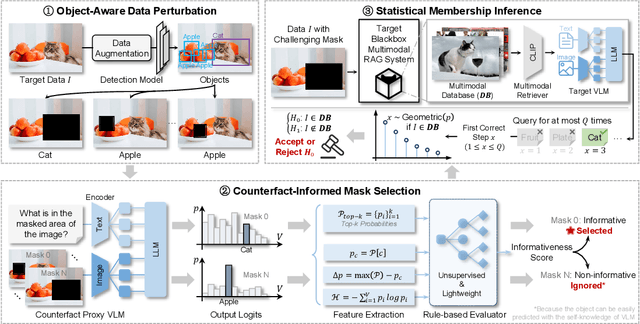
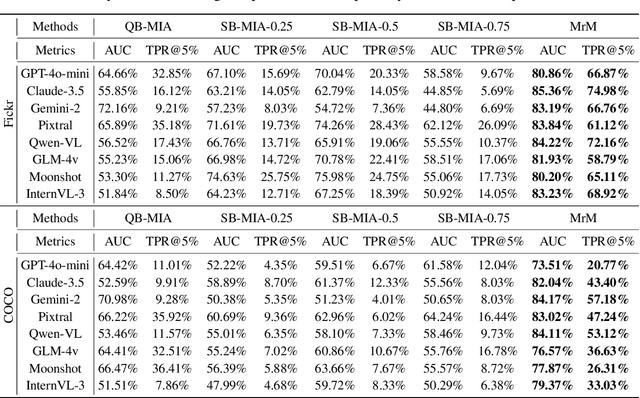
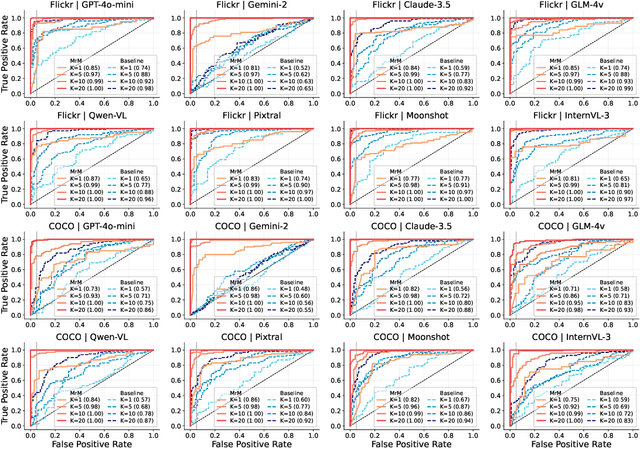
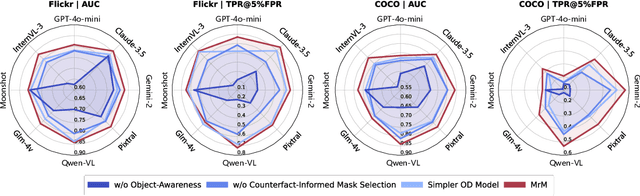
Multimodal retrieval-augmented generation (RAG) systems enhance large vision-language models by integrating cross-modal knowledge, enabling their increasing adoption across real-world multimodal tasks. These knowledge databases may contain sensitive information that requires privacy protection. However, multimodal RAG systems inherently grant external users indirect access to such data, making them potentially vulnerable to privacy attacks, particularly membership inference attacks (MIAs). % Existing MIA methods targeting RAG systems predominantly focus on the textual modality, while the visual modality remains relatively underexplored. To bridge this gap, we propose MrM, the first black-box MIA framework targeted at multimodal RAG systems. It utilizes a multi-object data perturbation framework constrained by counterfactual attacks, which can concurrently induce the RAG systems to retrieve the target data and generate information that leaks the membership information. Our method first employs an object-aware data perturbation method to constrain the perturbation to key semantics and ensure successful retrieval. Building on this, we design a counterfact-informed mask selection strategy to prioritize the most informative masked regions, aiming to eliminate the interference of model self-knowledge and amplify attack efficacy. Finally, we perform statistical membership inference by modeling query trials to extract features that reflect the reconstruction of masked semantics from response patterns. Experiments on two visual datasets and eight mainstream commercial visual-language models (e.g., GPT-4o, Gemini-2) demonstrate that MrM achieves consistently strong performance across both sample-level and set-level evaluations, and remains robust under adaptive defenses.
HeteRAG: A Heterogeneous Retrieval-augmented Generation Framework with Decoupled Knowledge Representations
Apr 12, 2025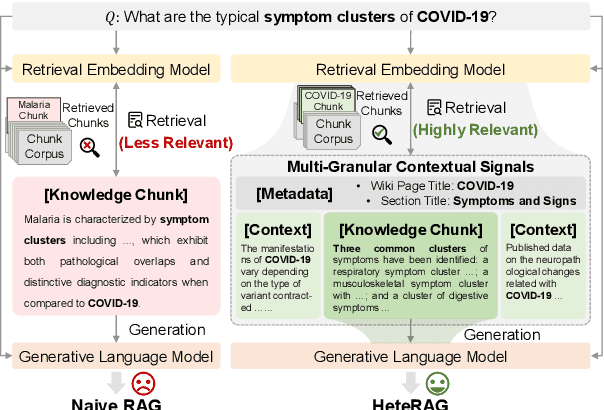
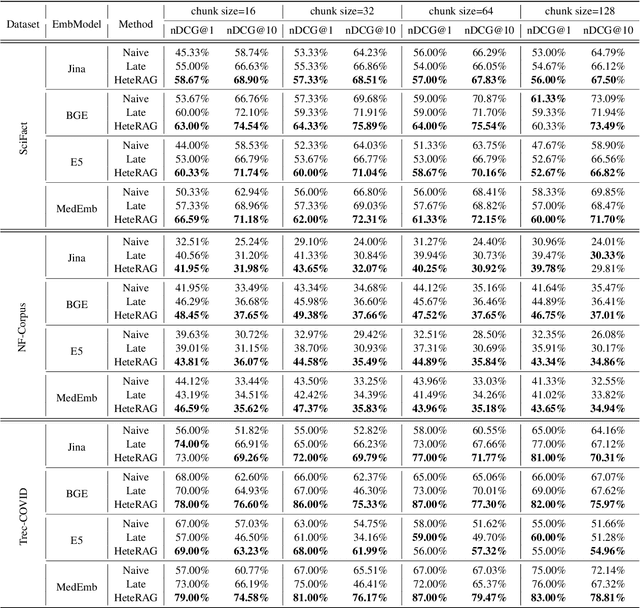
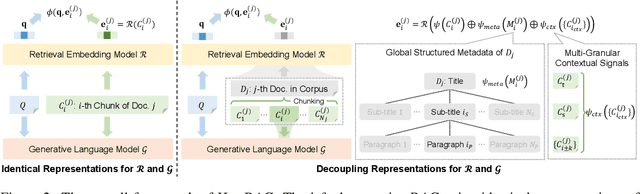
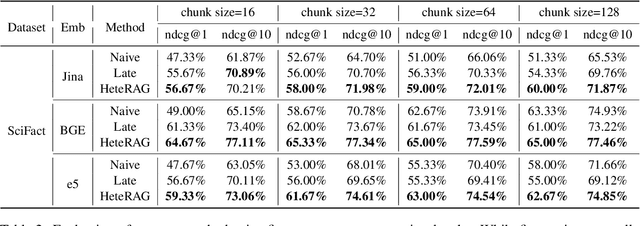
Retrieval-augmented generation (RAG) methods can enhance the performance of LLMs by incorporating retrieved knowledge chunks into the generation process. In general, the retrieval and generation steps usually have different requirements for these knowledge chunks. The retrieval step benefits from comprehensive information to improve retrieval accuracy, whereas excessively long chunks may introduce redundant contextual information, thereby diminishing both the effectiveness and efficiency of the generation process. However, existing RAG methods typically employ identical representations of knowledge chunks for both retrieval and generation, resulting in suboptimal performance. In this paper, we propose a heterogeneous RAG framework (\myname) that decouples the representations of knowledge chunks for retrieval and generation, thereby enhancing the LLMs in both effectiveness and efficiency. Specifically, we utilize short chunks to represent knowledge to adapt the generation step and utilize the corresponding chunk with its contextual information from multi-granular views to enhance retrieval accuracy. We further introduce an adaptive prompt tuning method for the retrieval model to adapt the heterogeneous retrieval augmented generation process. Extensive experiments demonstrate that \myname achieves significant improvements compared to baselines.