 Add to Chrome
 Add to Firefox
 Add to Edge
HiPi: Reproducible High-Fidelity Piezoresistive Sensors for Robotic Manipulation
Jun 09, 2026
Piezoresistive tactile sensors are attractive for robotic manipulation because they are thin, lightweight, low-cost, and scalable to dense large-area sensing. However, existing systems still face a practical trade-off: recent reproducible designs emphasize accessibility and ease of reproduction, whereas high-fidelity readout architectures remain more difficult to fabricate, assemble, and deploy. We present HiPi, a reproducible high-fidelity piezoresistive sensing system for robotic manipulation. Building on a low-crosstalk readout principle, HiPi redesigns the complete hardware stack around reproducibility, deployability, and multi-sensor scalability. The system includes a compact readout PCB compatible with commercial PCB fabrication and assembly services, eliminating manual soldering; a smaller and lower-cost STM32-based MCU module; an optimized communication pipeline that achieves 220 Hz readout in a bimanual setup with four dense tactile arrays (2048 taxels in total); and FPCB-based conductive layers that simplify sensor fabrication and stacking. Experiments with structured 3D-printed contact patterns show that HiPi preserves contact geometry substantially better than a reproducible baseline, improving the average IoU from 0.428 to 0.797 and the average Dice score from 0.539 to 0.886. These results suggest that HiPi bridges an important gap between reproducible fabrication and high-fidelity readout, making dense piezoresistive tactile sensing more practical for bimanual manipulation and multi-fingered robotic systems.

Near-Field Perception for Safety Enhancement of Autonomous Mobile Robots in Manufacturing Environments
Dec 15, 2025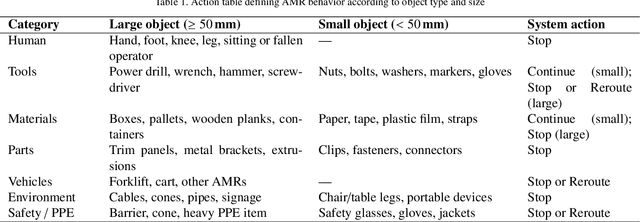
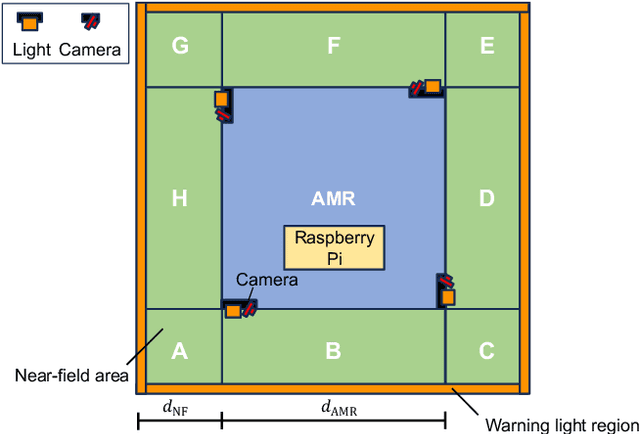
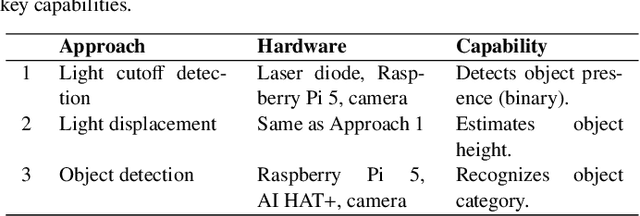
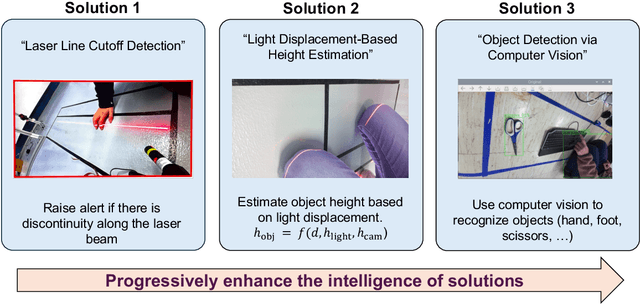
Near-field perception is essential for the safe operation of autonomous mobile robots (AMRs) in manufacturing environments. Conventional ranging sensors such as light detection and ranging (LiDAR) and ultrasonic devices provide broad situational awareness but often fail to detect small objects near the robot base. To address this limitation, this paper presents a three-tier near-field perception framework. The first approach employs light-discontinuity detection, which projects a laser stripe across the near-field zone and identifies interruptions in the stripe to perform fast, binary cutoff sensing for obstacle presence. The second approach utilizes light-displacement measurement to estimate object height by analyzing the geometric displacement of a projected stripe in the camera image, which provides quantitative obstacle height information with minimal computational overhead. The third approach employs a computer vision-based object detection model on embedded AI hardware to classify objects, enabling semantic perception and context-aware safety decisions. All methods are implemented on a Raspberry Pi 5 system, achieving real-time performance at 25 or 50 frames per second. Experimental evaluation and comparative analysis demonstrate that the proposed hierarchy balances precision, computation, and cost, thereby providing a scalable perception solution for enabling safe operations of AMRs in manufacturing environments.