 Add to Chrome
 Add to Firefox
 Add to Edge
LLM-ADAM: A Generalizable LLM Agent Framework for Pre-Print Anomaly Detection in Additive Manufacturing
May 05, 2026
Additive manufacturing (AM) continues to transform modern manufacturing by enabling flexible, on-demand production of complex geometries across diverse industries. Fused filament fabrication (FFF) has extended AM to laboratories, classrooms, and small production environments, but this accessibility shifts process-planning responsibility to users who may lack manufacturing expertise. A syntactically valid slicer profile can still encode thermally or geometrically harmful settings, and subtle G-code edits can alter extrusion, cooling, or adhesion before a print begins. Pre-print G-code screening catches accidental or adversarial machine-program errors before material or machine time is wasted. This paper proposes LLM-ADAM as a generalizable LLM framework for pre-print anomaly detection in AM. The framework decomposes the task into three roles: Extractor-LLM maps a G-code file to a structured process-parameter schema; Reference-LLM converts printer and material documentation into aligned operating ranges; and Judge-LLM interprets a deterministic deviation table and G-code evidence to decide whether a part is non-defective or belongs to an anomaly class. Printers, materials, and LLM backbones are interchangeable test conditions, not fixed assumptions. We evaluate the framework on an N=200 FFF G-code corpus spanning two desktop printer families, two materials, and five classes including non-defective, under-extrusion, over-extrusion, warping, and stringing. The best framework configuration reaches 87.5% accuracy, compared with 59.5% for the strongest engineered single-LLM baseline. The results show that structured decomposition, rather than backbone strength alone, is the dominant source of improvement, with defect classes identified at or near ceiling for leading configurations while residual errors concentrate on conservative false alarms for non-defective samples.

Adaptive few-shot learning for robust part quality classification in two-photon lithography
Jan 13, 2026Two-photon lithography (TPL) is an advanced additive manufacturing (AM) technique for fabricating high-precision micro-structures. While computer vision (CV) is proofed for automated quality control, existing models are often static, rendering them ineffective in dynamic manufacturing environments. These models typically cannot detect new, unseen defect classes, be efficiently updated from scarce data, or adapt to new part geometries. To address this gap, this paper presents an adaptive CV framework for the entire life-cycle of quality model maintenance. The proposed framework is built upon a same, scale-robust backbone model and integrates three key methodologies: (1) a statistical hypothesis testing framework based on Linear Discriminant Analysis (LDA) for novelty detection, (2) a two-stage, rehearsal-based strategy for few-shot incremental learning, and (3) a few-shot Domain-Adversarial Neural Network (DANN) for few-shot domain adaptation. The framework was evaluated on a TPL dataset featuring hemisphere as source domain and cube as target domain structures, with each domain categorized into good, minor damaged, and damaged quality classes. The hypothesis testing method successfully identified new class batches with 99-100% accuracy. The incremental learning method integrated a new class to 92% accuracy using only K=20 samples. The domain adaptation model bridged the severe domain gap, achieving 96.19% accuracy on the target domain using only K=5 shots. These results demonstrate a robust and data-efficient solution for deploying and maintaining CV models in evolving production scenarios.
Near-Field Perception for Safety Enhancement of Autonomous Mobile Robots in Manufacturing Environments
Dec 15, 2025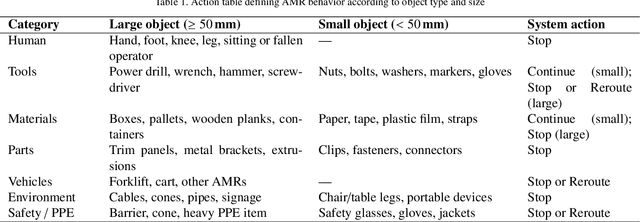
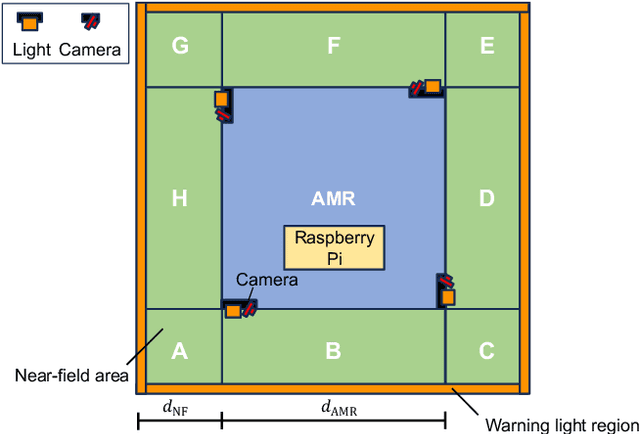
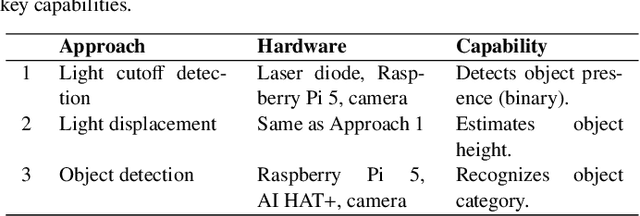
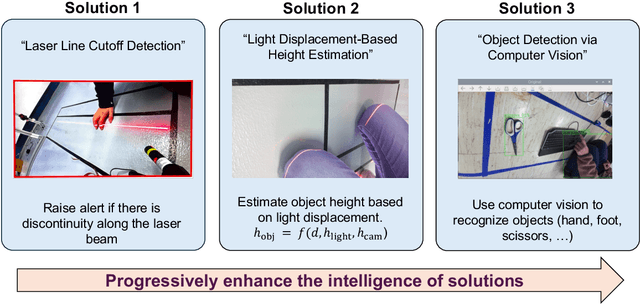
Near-field perception is essential for the safe operation of autonomous mobile robots (AMRs) in manufacturing environments. Conventional ranging sensors such as light detection and ranging (LiDAR) and ultrasonic devices provide broad situational awareness but often fail to detect small objects near the robot base. To address this limitation, this paper presents a three-tier near-field perception framework. The first approach employs light-discontinuity detection, which projects a laser stripe across the near-field zone and identifies interruptions in the stripe to perform fast, binary cutoff sensing for obstacle presence. The second approach utilizes light-displacement measurement to estimate object height by analyzing the geometric displacement of a projected stripe in the camera image, which provides quantitative obstacle height information with minimal computational overhead. The third approach employs a computer vision-based object detection model on embedded AI hardware to classify objects, enabling semantic perception and context-aware safety decisions. All methods are implemented on a Raspberry Pi 5 system, achieving real-time performance at 25 or 50 frames per second. Experimental evaluation and comparative analysis demonstrate that the proposed hierarchy balances precision, computation, and cost, thereby providing a scalable perception solution for enabling safe operations of AMRs in manufacturing environments.