 Add to Chrome
 Add to Firefox
 Add to Edge
Near-Field Perception for Safety Enhancement of Autonomous Mobile Robots in Manufacturing Environments
Dec 15, 2025
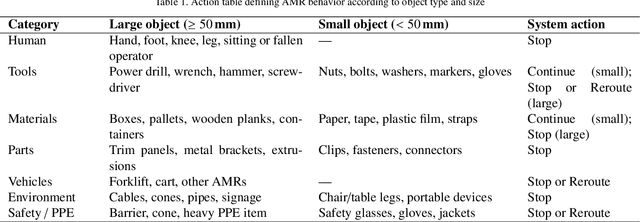
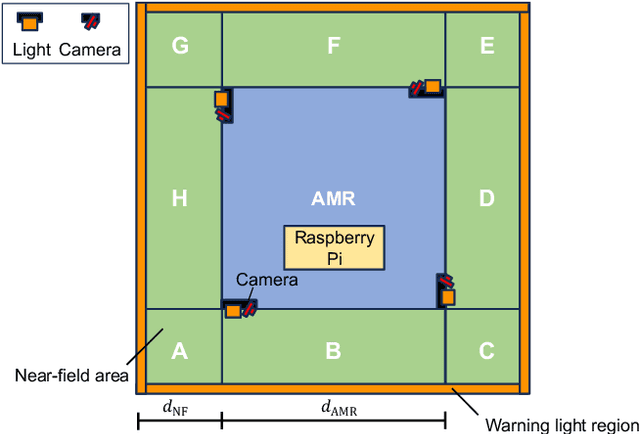
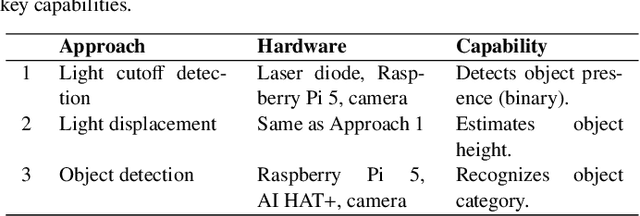
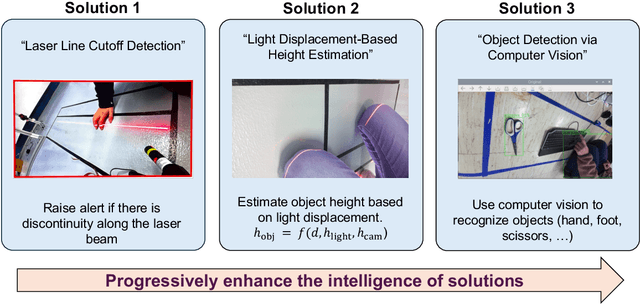
Near-field perception is essential for the safe operation of autonomous mobile robots (AMRs) in manufacturing environments. Conventional ranging sensors such as light detection and ranging (LiDAR) and ultrasonic devices provide broad situational awareness but often fail to detect small objects near the robot base. To address this limitation, this paper presents a three-tier near-field perception framework. The first approach employs light-discontinuity detection, which projects a laser stripe across the near-field zone and identifies interruptions in the stripe to perform fast, binary cutoff sensing for obstacle presence. The second approach utilizes light-displacement measurement to estimate object height by analyzing the geometric displacement of a projected stripe in the camera image, which provides quantitative obstacle height information with minimal computational overhead. The third approach employs a computer vision-based object detection model on embedded AI hardware to classify objects, enabling semantic perception and context-aware safety decisions. All methods are implemented on a Raspberry Pi 5 system, achieving real-time performance at 25 or 50 frames per second. Experimental evaluation and comparative analysis demonstrate that the proposed hierarchy balances precision, computation, and cost, thereby providing a scalable perception solution for enabling safe operations of AMRs in manufacturing environments.

Hierarchical energy signatures using machine learning for operational visibility and diagnostics in automotive manufacturing
Feb 25, 2024Manufacturing energy consumption data contains important process signatures required for operational visibility and diagnostics. These signatures may be of different temporal scales, ranging from monthly to sub-second resolutions. We introduce a hierarchical machine learning approach to identify automotive process signatures from paint shop electricity consumption data at varying temporal scales (weekly and daily). A Multi-Layer Perceptron (MLP), a Convolutional Neural Network (CNN), and Principal Component Analysis (PCA) combined with Logistic Regression (LR) are used for the analysis. We validate the utility of the developed algorithms with subject matter experts for (i) better operational visibility, and (ii) identifying energy saving opportunities.