 Add to Chrome
 Add to Firefox
 Add to Edge
KOALA: Koopman Operator Learning for WiFi-Based Anticipatory Hum
Aug 16, 2026
WiFi Channel State Information (CSI) has emerged as a privacy-preserving alternative to cameras for human pose estimation. However, existing approaches treat pose inference as an instantaneous regression problem and do not model temporal dynamics, making future motion prediction infeasible. Naively applying vision-based prediction methods compounds the estimation noise already present in CSI-derived poses, as autoregressive rollouts amplify errors at every step. We propose KOALA, the framework for human motion prediction directly from WiFi CSI, by lifting noisy CSI-derived pose sequences into a learned Koopman latent space where nonlinear dynamics become linear, enabling multi-horizon prediction via simple matrix-vector products without autoregressive iteration or error accumulation. A residual CSI-conditioned operator resolves the identity attractor problem inherent from Koopman formulations, and an anchor-delta prediction head eliminates the degenerate shortcut of copying the current pose across all horizons. To regularise the lifting and operator jointly, we introduce a Koopman Anchored Latent (KAL) loss that operates in the temporal-encoder feature space, enforcing dynamical consistency across prediction horizons without requiring contrastive, spectral, or auxiliary losses. Experiments on MM-Fi and WiPose show that KOALA achieves robust, consistent performance across both short- and long-term prediction horizons, outperforming all baselines by a substantial margin.
* 27 pages, 3 figures

Digital Twin for O-RAN Towards 6G
Oct 03, 2024In future wireless systems of beyond 5G and 6G, addressing diverse applications with varying quality requirements is essential. Open Radio Access Network (O-RAN) architectures offer the potential for dynamic resource adaptation based on traffic demands. However, achieving real-time resource orchestration remains a challenge. Simultaneously, Digital Twin (DT) technology holds promise for testing and analysing complex systems, offering a unique platform for addressing dynamic operation and automation in O-RAN architectures. Yet, developing DTs for complex 5G/6G networks poses challenges, including data exchanges, ML model training data availability, network dynamics, processing power limitations, interdisciplinary collaboration needs, and a lack of standardized methodologies. This paper provides an overview of Open RAN architecture, trend and challenges, proposing the DT concepts for O-RAN with solution examples showcasing its integration into the framework.
Double Intelligent Reflecting Surface-assisted Multi-User MIMO mmWave Systems with Hybrid Precoding
Nov 26, 2021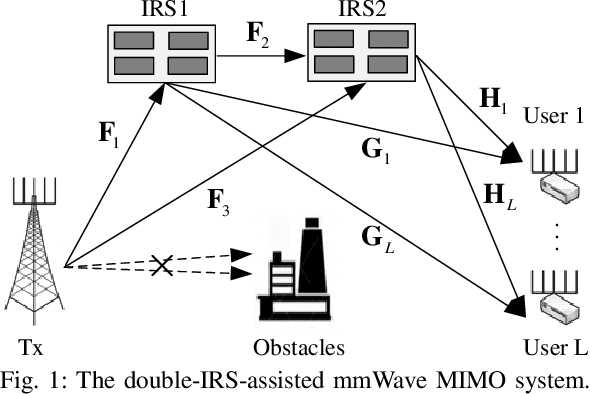
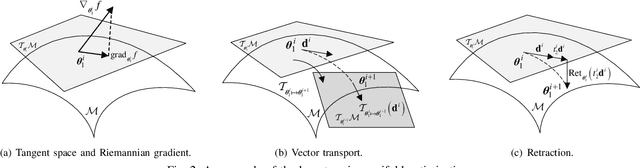
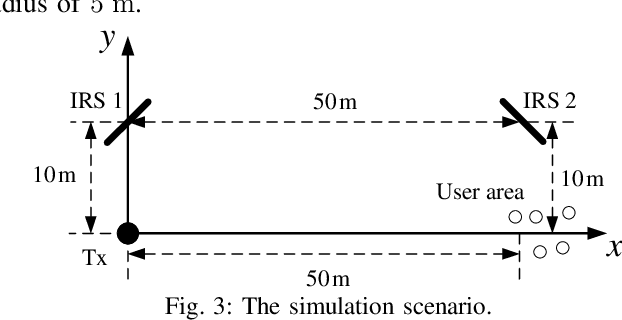
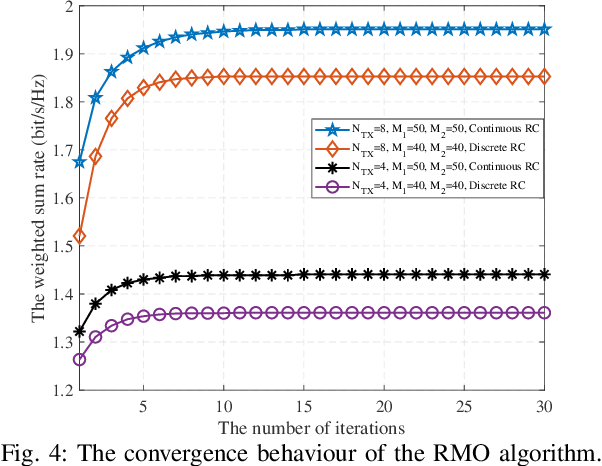
This work investigates the effect of double intelligent reflecting surface (IRS) in improving the spectrum efficient of multi-user multiple-input multiple-output (MIMO) network operating in the millimeter wave (mmWave) band. Specifically, we aim to solve a weighted sum rate maximization problem by jointly optimizing the digital precoding at the transmitter and the analog phase shifters at the IRS, subject to the minimum achievable rate constraint. To facilitate the design of an efficient solution, we first reformulate the original problem into a tractable one by exploiting the majorization-minimization (MM) method. Then, a block coordinate descent (BCD) method is proposed to obtain a suboptimal solution, where the precoding matrices and the phase shifters are alternately optimized. Specifically, the digital precoding matrix design problem is solved by the quadratically constrained quadratic programming (QCQP), while the analog phase shift optimization is solved by the Riemannian manifold optimization (RMO). The convergence and computational complexity are analyzed. Finally, simulation results are provided to verify the performance of the proposed design, as well as the effectiveness of double-IRS in improving the spectral efficiency.