 Add to Chrome
 Add to Firefox
 Add to Edge
Artificial Superintelligence May be Useless: Equilibria in the Economy of Multiple AI Agents
Mar 01, 2026
With recent development of artificial intelligence, it is more common to adopt AI agents in economic activities. This paper explores the economic actions of agents, including human agents and AI agents, in an economic game of trading products/services, and the equilibria in this economy involving multiple agents. We derive a range of equilibrium results and their corresponding conditions using a Markov chain stationary distribution based model. One distinct feature of our model is that we consider the long-term utility generated by economic activities instead of their short-term benefits. For the model consisting of two agents, we fully characterize all the possible economic equilibria and conditions. Interestingly, we show that unless each agent can at least double (not merely increase) its marginal utility by purchasing the other agent's products/services, purchasing the other agent's products/services will not happen in any economic equilibrium. We further extend our results to three and more agents, where we characterize more economic equilibria. We find that in some equilibria, the ``more powerful'' AI agents contribute zero utility to ``less capable'' agents.

To AI or not to AI, to Buy Local or not to Buy Local: A Mathematical Theory of Real Price
May 09, 2023


In the past several decades, the world's economy has become increasingly globalized. On the other hand, there are also ideas advocating the practice of ``buy local'', by which people buy locally produced goods and services rather than those produced farther away. In this paper, we establish a mathematical theory of real price that determines the optimal global versus local spending of an agent which achieves the agent's optimal tradeoff between spending and obtained utility. Our theory of real price depends on the asymptotic analysis of a Markov chain transition probability matrix related to the network of producers and consumers. We show that the real price of a product or service can be determined from the involved Markov chain matrix, and can be dramatically different from the product's label price. In particular, we show that the label prices of products and services are often not ``real'' or directly ``useful'': given two products offering the same myopic utility, the one with lower label price may not necessarily offer better asymptotic utility. This theory shows that the globality or locality of the products and services does have different impacts on the spending-utility tradeoff of a customer. The established mathematical theory of real price can be used to determine whether to adopt or not to adopt certain artificial intelligence (AI) technologies from an economic perspective.
Deep Learning Based Equalizer for MIMO-OFDM Systems with Insufficient Cyclic Prefix
Jul 23, 2020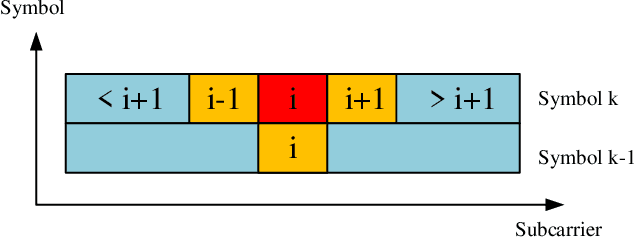
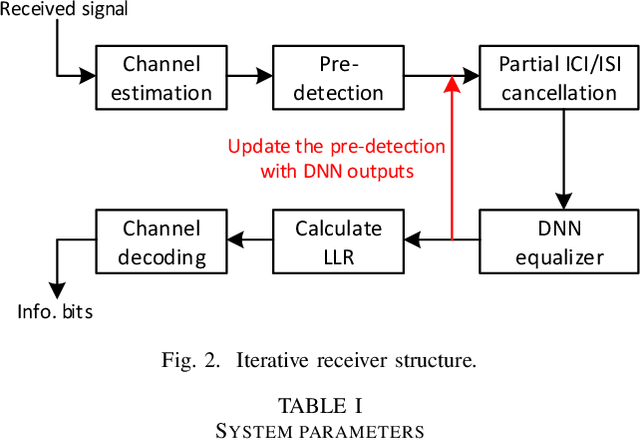
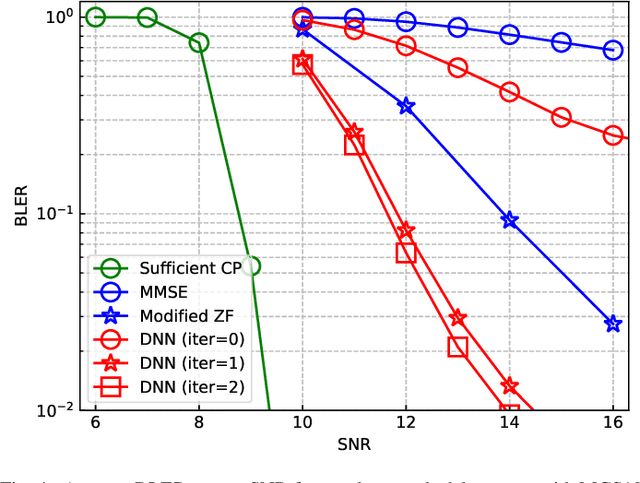
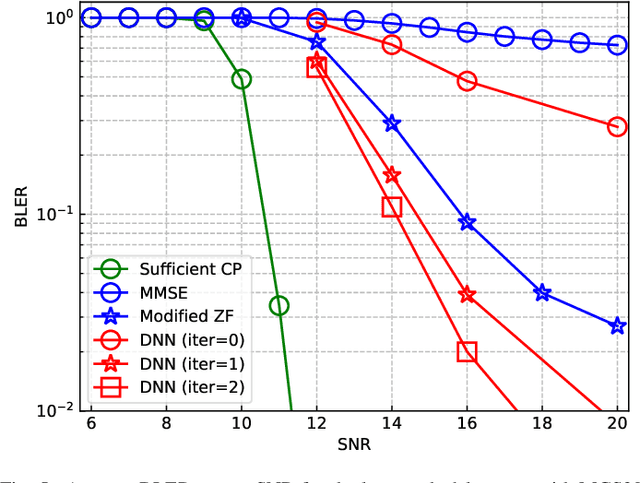
In this paper, we study the equalization design for multiple-input multiple-output (MIMO) orthogonal frequency division multiplexing (OFDM) systems with insufficient cyclic prefix (CP). In particular, the signal detection performance is severely impaired by inter-carrier interference (ICI) and inter-symbol interference (ISI) when the multipath delay spread exceeding the length of CP. To tackle this problem, a deep learning-based equalizer is proposed for approximating the maximum likelihood detection. Inspired by the dependency between the adjacent subcarriers, a computationally efficient joint detection scheme is developed. Employing the proposed equalizer, an iterative receiver is also constructed and the detection performance is evaluated through simulations over measured multipath channels. Our results reveal that the proposed receiver can achieve significant performance improvement compared to two traditional baseline schemes.