 Add to Chrome
 Add to Firefox
 Add to Edge
This human study did not involve human subjects: Validating LLM simulations as behavioral evidence
Feb 17, 2026
A growing literature uses large language models (LLMs) as synthetic participants to generate cost-effective and nearly instantaneous responses in social science experiments. However, there is limited guidance on when such simulations support valid inference about human behavior. We contrast two strategies for obtaining valid estimates of causal effects and clarify the assumptions under which each is suitable for exploratory versus confirmatory research. Heuristic approaches seek to establish that simulated and observed human behavior are interchangeable through prompt engineering, model fine-tuning, and other repair strategies designed to reduce LLM-induced inaccuracies. While useful for many exploratory tasks, heuristic approaches lack the formal statistical guarantees typically required for confirmatory research. In contrast, statistical calibration combines auxiliary human data with statistical adjustments to account for discrepancies between observed and simulated responses. Under explicit assumptions, statistical calibration preserves validity and provides more precise estimates of causal effects at lower cost than experiments that rely solely on human participants. Yet the potential of both approaches depends on how well LLMs approximate the relevant populations. We consider what opportunities are overlooked when researchers focus myopically on substituting LLMs for human participants in a study.

Aligning with Whom? Large Language Models Have Gender and Racial Biases in Subjective NLP Tasks
Nov 16, 2023

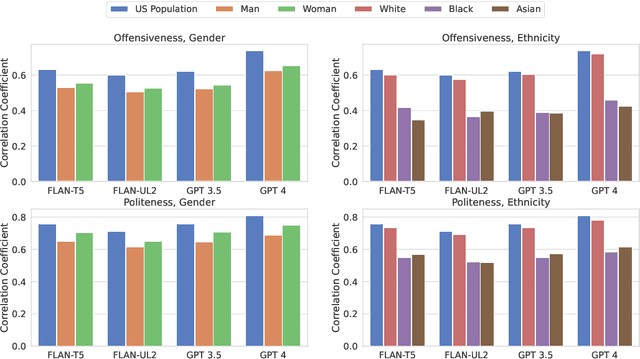

Human perception of language depends on personal backgrounds like gender and ethnicity. While existing studies have shown that large language models (LLMs) hold values that are closer to certain societal groups, it is unclear whether their prediction behaviors on subjective NLP tasks also exhibit a similar bias. In this study, leveraging the POPQUORN dataset which contains annotations of diverse demographic backgrounds, we conduct a series of experiments on four popular LLMs to investigate their capability to understand group differences and potential biases in their predictions for politeness and offensiveness. We find that for both tasks, model predictions are closer to the labels from White and female participants. We further explore prompting with the target demographic labels and show that including the target demographic in the prompt actually worsens the model's performance. More specifically, when being prompted to respond from the perspective of "Black" and "Asian" individuals, models show lower performance in predicting both overall scores as well as the scores from corresponding groups. Our results suggest that LLMs hold gender and racial biases for subjective NLP tasks and that demographic-infused prompts alone may be insufficient to mitigate such effects. Code and data are available at https://github.com/Jiaxin-Pei/LLM-Group-Bias.