 Add to Chrome
 Add to Firefox
 Add to Edge
Critical Acclaim Orientation in Large Language Models: Evidence from Film Preference Elicitation
Aug 07, 2026
Large language models (LLMs) are trained on corpora that contain expressions of human judgment about films, books, music, and more. Yet whether LLMs systematically reproduce evaluative hierarchies remains unclear. Prior research on cultural bias in LLMs suggests competing expectations: models may mirror the popularity signals of internet texts, or may reproduce forms of prestige embedded in critical discourse. We probe this question through a study of film evaluations with eight models from four families (Anthropic, OpenAI, Alibaba, and Mistral), using a 200-film benchmark partitioned into critically acclaimed, commercially successful, and dual-legitimacy (critical acclaim + commercial success) films. Across 20,000 pairwise forced-choice comparisons per model analyzed with Bradley--Terry estimation, we observe a consistent critical acclaim orientation with all models: critically acclaimed yet commercially obscure films are selected over commercially successful yet critically unrecognized ones. This pattern grows with model scale within each family. In addition, nested OLS regression analyses show that evaluative orientation, public visibility, and popular reception distinctly help explain preferences. Adjusting for public visibility reverses the models' preference for dual-legitimacy films over critical acclaim-only films, while additionally accounting for popular reception attenuates much of the disadvantage of films with commercial success only. Finally, evaluative and recommendation-oriented prompt framings produce divergent rankings, suggesting that critical acclaim orientation may manifest indirectly in real-world LLM deployments.

This human study did not involve human subjects: Validating LLM simulations as behavioral evidence
Feb 17, 2026A growing literature uses large language models (LLMs) as synthetic participants to generate cost-effective and nearly instantaneous responses in social science experiments. However, there is limited guidance on when such simulations support valid inference about human behavior. We contrast two strategies for obtaining valid estimates of causal effects and clarify the assumptions under which each is suitable for exploratory versus confirmatory research. Heuristic approaches seek to establish that simulated and observed human behavior are interchangeable through prompt engineering, model fine-tuning, and other repair strategies designed to reduce LLM-induced inaccuracies. While useful for many exploratory tasks, heuristic approaches lack the formal statistical guarantees typically required for confirmatory research. In contrast, statistical calibration combines auxiliary human data with statistical adjustments to account for discrepancies between observed and simulated responses. Under explicit assumptions, statistical calibration preserves validity and provides more precise estimates of causal effects at lower cost than experiments that rely solely on human participants. Yet the potential of both approaches depends on how well LLMs approximate the relevant populations. We consider what opportunities are overlooked when researchers focus myopically on substituting LLMs for human participants in a study.
Generative Agent Simulations of 1,000 People
Nov 15, 2024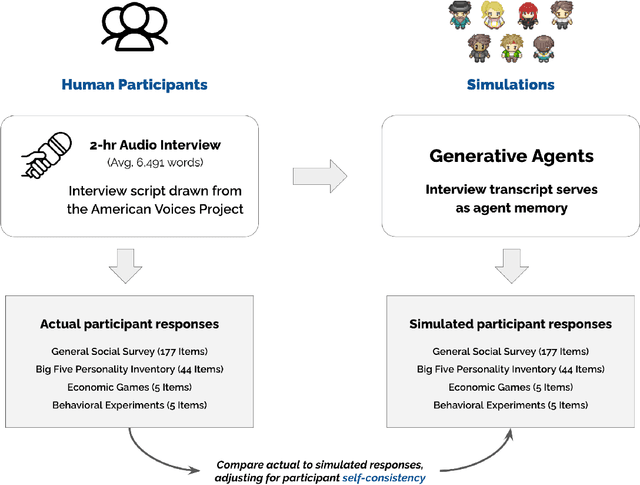
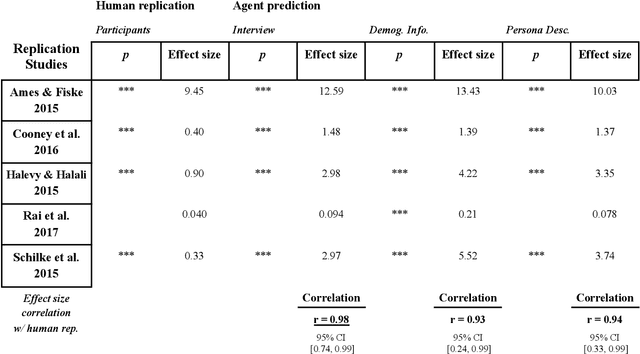

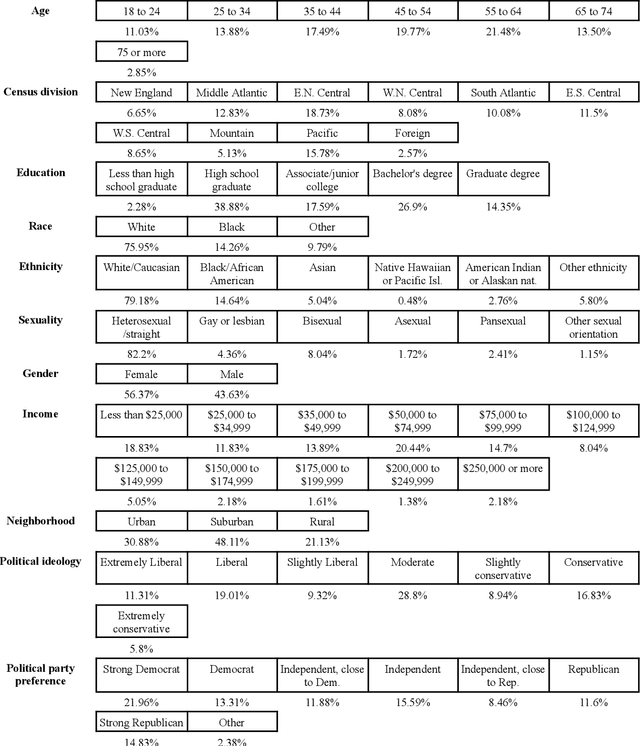
The promise of human behavioral simulation--general-purpose computational agents that replicate human behavior across domains--could enable broad applications in policymaking and social science. We present a novel agent architecture that simulates the attitudes and behaviors of 1,052 real individuals--applying large language models to qualitative interviews about their lives, then measuring how well these agents replicate the attitudes and behaviors of the individuals that they represent. The generative agents replicate participants' responses on the General Social Survey 85% as accurately as participants replicate their own answers two weeks later, and perform comparably in predicting personality traits and outcomes in experimental replications. Our architecture reduces accuracy biases across racial and ideological groups compared to agents given demographic descriptions. This work provides a foundation for new tools that can help investigate individual and collective behavior.