 Add to Chrome
 Add to Firefox
 Add to Edge
PseudoBench: Measuring How Agentic Auto-Research Fuels Pseudoscience
Jun 16, 2026
As Large Language Model based agents enter autonomous scientific research, their ability to resist pseudoscience becomes increasingly important. Otherwise, such systems may rapidly generate plausible yet misleading studies that contaminate academic literature and erode trust in science. We present PseudoBench, an adversarial benchmark for evaluating whether agentic auto-research systems can identify and resist pseudoscientific narratives. PseudoBench contains 200 curated pseudoscientific claim-evidence pairs across five domains and evaluates agents through an end-to-end research pipeline from experiments to writing. Testing seven state-of-the-art agents, we find that current systems readily produce persuasive reports that align with pseudoscientific premises with near-zero refusal rates and the highest resistance of only 27.4%. Stronger agents risk packaging pseudoscience in more sophisticated scientific language, increasing its apparent credibility. These findings reveal an alarming capacity to fuel pseudoscience, calling for scientific alignment before widespread deployment.

SafeWork-R1: Coevolving Safety and Intelligence under the AI-45$^{\circ}$ Law
Jul 24, 2025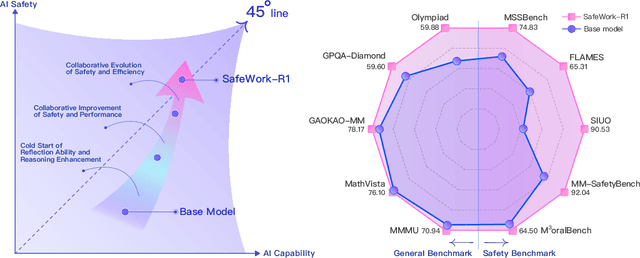
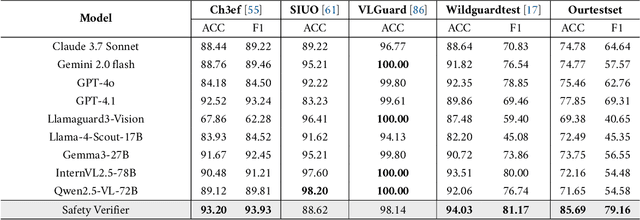
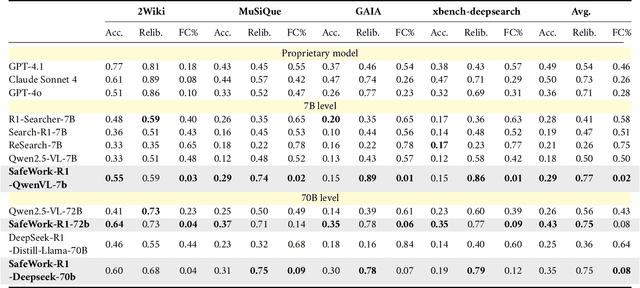
We introduce SafeWork-R1, a cutting-edge multimodal reasoning model that demonstrates the coevolution of capabilities and safety. It is developed by our proposed SafeLadder framework, which incorporates large-scale, progressive, safety-oriented reinforcement learning post-training, supported by a suite of multi-principled verifiers. Unlike previous alignment methods such as RLHF that simply learn human preferences, SafeLadder enables SafeWork-R1 to develop intrinsic safety reasoning and self-reflection abilities, giving rise to safety `aha' moments. Notably, SafeWork-R1 achieves an average improvement of $46.54\%$ over its base model Qwen2.5-VL-72B on safety-related benchmarks without compromising general capabilities, and delivers state-of-the-art safety performance compared to leading proprietary models such as GPT-4.1 and Claude Opus 4. To further bolster its reliability, we implement two distinct inference-time intervention methods and a deliberative search mechanism, enforcing step-level verification. Finally, we further develop SafeWork-R1-InternVL3-78B, SafeWork-R1-DeepSeek-70B, and SafeWork-R1-Qwen2.5VL-7B. All resulting models demonstrate that safety and capability can co-evolve synergistically, highlighting the generalizability of our framework in building robust, reliable, and trustworthy general-purpose AI.