 Add to Chrome
 Add to Firefox
 Add to Edge
Deadline-Bound Finite-Object Delivery over Intermittent LEO Satellite Contact Plans under Residual-Service Accounting
Jul 05, 2026
Low-Earth-orbit (LEO) relay networks deliver finite objects -- sensing tiles, telemetry blocks, model updates, and checkpoints -- over intermittent inter-satellite and space-to-ground contact plans. Partial delivery is insufficient when the complete object misses its deadline. When an object is split across candidate paths, a path-private evaluation can count the same contact service more than once and silently under-count completion. We develop a residual-service-aware delivery layer that consumes candidate paths from contact-plan route generation and tests whether the complete object can be delivered before its deadline under per-edge first-in-first-out residual service. Under controlled shared-contact contention, path-private evaluation under-counts completion by up to 154 s and can report finite completion for a fixed plan with no residual-service completion. For edge-disjoint complementary contacts, the layer reduces to fixed-path service; we derive a sufficient service-budget condition under which two-way striping strictly enlarges the feasible payload region. We verify a restricted exhaustive reference, characterize runtime over a 20-180-satellite procedural contact model, and show that bounded two-way striping reduces mean and median gaps to the restricted reference by about 40%, while P90 and worst-case gaps remain unchanged.

Rain Rate Estimation Bounds and Weather-Adaptive Pilot Allocation for LEO Satellite ISAC
Apr 12, 2026Rain attenuates Ku-band satellite signals by up to 20~dB, encoding precipitation information along the Earth-space slant path. This paper derives the Bayesian Cramér-Rao bound (BCRB) for rain rate estimation from LEO broadband OFDM downlinks. Using corrected ITU-R P.838-3 coefficients, the standard CRB yields a minimum detectable rain rate $R_{\min} \approx 4.3\mmh$ for a single link at the $38^\circ$ reference elevation. We derive the prior Fisher information in closed form for log-normal rain ($c_v = 1.05$, from 186{,}292 samples) and show that a single-snapshot BCRB reduces $R_{\min}$ to $1.1\mmh$; exploiting temporal correlation ($ρ= 0.95$) over a 30-min window further tightens it to $0.95\mmh$, while multi-link fusion across $N = 215$ links lowers the operating-point RMSE \emph{lower bound} at $R = 20\mmh$ to approximately $0.07\mmh$. Building on these bounds, we formulate a weather-adaptive pilot allocation that minimizes the BCRB subject to a hard spectral-efficiency constraint, characterize its three-regime structure (full-sensing, throughput-tracking, outage), and pair it with a CUSUM rain onset detector achieving sub-10-min delay for $R \geq 20\mmh$. A closed-form analysis of dynamic LEO slant geometry identifies a sensing-optimal elevation at the P.618-validity floor of $15^\circ$ that yields a $1.58\times$ geometric improvement over the $38^\circ$ baseline, exposing a structural anti-correlation between sensing- and communication-optimal elevations along an orbital pass. Validation against 9.4~million radar samples from 215 Ku-band GEO satellite links ($r = 0.72$, RMSE~$= 1.24\dB$) and 113 rain gauges confirms the underlying attenuation model; the bounds transfer to LEO constellations under matched OFDM signal parameters, with dedicated LEO validation left for future work.
Performance Bounds and Robust Filtering for LEO Inter-Satellite Synchronization under Cross-Epoch Doppler Coupling
Mar 11, 2026Low Earth orbit (LEO) inter-satellite links (ISLs) must achieve joint synchronization and ranging under severe hardware impairments, namely oscillator phase noise, clock drift, and measurement outliers, exacerbated by rapid relative dynamics exceeding 7~km/s. In coherent Doppler processing, the frequency observable depends on the \emph{difference} between consecutive carrier phase states, creating a cross-epoch coupling structure that fundamentally affects estimation-theoretic performance limits. This paper makes three contributions. First, we prove analytically that this cross-epoch Doppler coupling is \emph{necessary} to avoid unbounded carrier phase uncertainty: without it, phase variance grows linearly without bound. Second, we derive a posterior Cramér-Rao bound (PCRB) via the Tichavský recursion that explicitly incorporates the resulting 10$\times$10 block information structure. Third, we propose a hybrid robust filtering framework combining hard gating for impulsive cycle-slip outliers with Huber M-estimation for heavy-tail contamination, using TASD-aware innovation covariance to account for cross-epoch uncertainty in residual normalization. Monte Carlo simulations at Ka-band confirm that the PCRB accurately lower-bounds estimator performance under nominal conditions, while the hybrid method reduces 95th-percentile phase error by 27--93\% compared to standard extended Kalman filtering across different outlier regimes.
A Policy-Aware Cross-Layer Auditing Service for Tiering and Throttling in Starlink
Mar 09, 2026We present a policy-aware, cross-layer methodology for edge-side auditing of service tiering and quota-based throttling in Starlink. Using a multi-week plan-hopping campaign (232.8 h) on a UK residential terminal, we align 1 Hz terminal telemetry with host-side probes to obtain portal-labeled traces spanning priority (pre-quota), post-quota throttling, stay-active operation, and residential service. Using portal status only as ground truth (independent of throughput), we show these policy regimes manifest as distinct signatures in goodput, PoP RTT, and an internal-to-user ratio $R=C_{\mathrm{int}}/T_{\mathrm{user}}$. A lightweight rule on windowed medians separates high-speed from low-rate operation without operator visibility.
AFDM for LEO Inter-Satellite Links: Path-Level CSI Prediction and CRLB-Guided Pre-Equalization
Dec 23, 2025Low-Earth-orbit (LEO) inter-satellite links must cope with strongly doubly selective channels and aged channel state information (CSI). In this paper, the term ``sensing'' refers to the receiver-side identifiability of a small set of dominant delay--Doppler path parameters, quantified via CRLB-type proxies, rather than a full-fledged target-sensing pipeline. Affine frequency division multiplexing (AFDM) provides a sparse delay--Doppler (DD) representation well suited to such channels, yet most existing AFDM designs assume ideal CSI, operate on grid-based channel coefficients, and optimize only communication performance. This paper proposes a two-stage AFDM-based ISAC framework for mobile LEO ISLs that explicitly operates under predicted CSI. In Stage~I, we model the channel by a small number of dominant specular paths and perform sequence prediction directly on their complex gains, delays, and Dopplers, from which we reconstruct the AFDM DD-domain kernel used as the sole instantaneous CSI at the transmitter. In Stage~II, we design a sensing-aware AFDM pre-equalizer by augmenting the classical minimum mean-square error (MMSE) solution with a term obtained from Cramér--Rao-type sensitivity measures evaluated under the predicted channel model, leading to a first-order surrogate of a CRLB-regularized pre-equalizer with a single tuning parameter that controls the communication--sensing tradeoff. Simulation results for representative LEO ISL trajectories show that the proposed path-level predictor improves effective-kernel reconstruction over AFDM-unaware baselines, and that, under predicted CSI, the sensing-aware pre-equalizer significantly improves sensing-oriented metrics over outdated-CSI baselines while keeping symbol error rates close to a communication-oriented MMSE design with only modest additional complexity.
Environment-to-Link ISAC with Space-Weather Sensing for Ka-Band LEO Downlinks
Dec 23, 2025Ka-band low-Earth-orbit (LEO) downlinks can suffer second-scale reliability collapses during flare-driven ionospheric disturbances, where fixed fade margins and reactive adaptive coding and modulation (ACM) are either overly conservative or too slow. This paper presents a GNSS-free, link-internal predictive controller that senses the same downlink via a geometry-free dual-carrier phase observable at 10~Hz: a high-pass filter and template-based onset detector, followed by a four-state nearly-constant-velocity Kalman filter, estimate $Δ$VTEC and its rate, and a short look-ahead (60~s) yields an endpoint outage probability used as a risk gate to trigger one-step discrete MCS down-switch and pilot-time update with hysteresis. Evaluation uses physics-informed log replay driven by real GOES X-ray flare morphologies under a disjoint-day frozen-calibration protocol, with uncertainty reported via paired moving-block bootstrap. Across stressed 60~s windows, the controller reduces peak BLER by 25--30\% and increases goodput by 0.10--0.15~bps/Hz versus no-adaptation baselines under a unified link-level abstraction. The loop runs in $\mathcal{O}(1)$ per 0.1~s epoch (about 0.042~ms measured), making on-board implementation feasible, and scope and deployment considerations for dispersion-dominated events are discussed.
Graph Representation-based Model Poisoning on the Heterogeneous Internet of Agents
Nov 10, 2025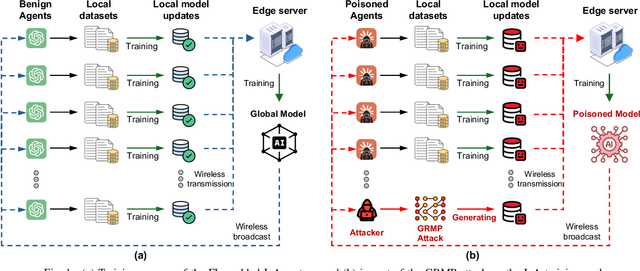
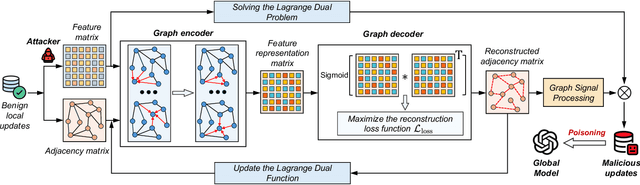
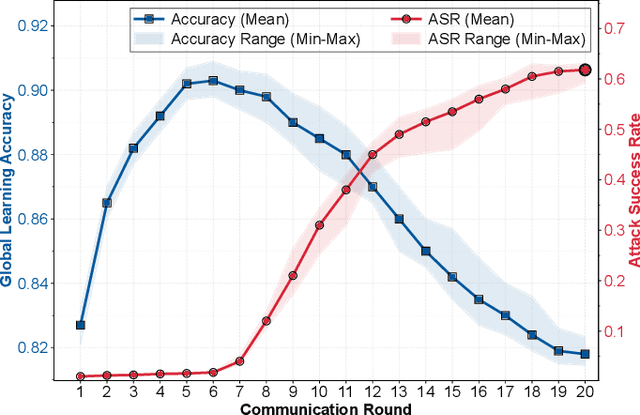
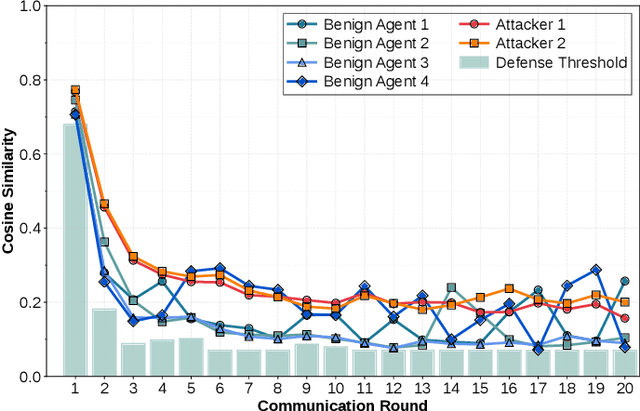
Internet of Agents (IoA) envisions a unified, agent-centric paradigm where heterogeneous large language model (LLM) agents can interconnect and collaborate at scale. Within this paradigm, federated learning (FL) serves as a key enabler that allows distributed LLM agents to co-train global models without centralizing data. However, the FL-enabled IoA system remains vulnerable to model poisoning attacks, and the prevailing distance and similarity-based defenses become fragile at billion-parameter scale and under heterogeneous data distributions. This paper proposes a graph representation-based model poisoning (GRMP) attack, which passively exploits observed benign local models to construct a parameter correlation graph and extends an adversarial variational graph autoencoder to capture and reshape higher-order dependencies. The GRMP attack synthesizes malicious local models that preserve benign-like statistics while embedding adversarial objectives, remaining elusive to detection at the server. Experiments demonstrate a gradual drop in system accuracy under the proposed attack and the ineffectiveness of the prevailing defense mechanism in detecting the attack, underscoring a severe threat to the ambitious IoA paradigm.
Fundamental Limits of Cooperative Integrated Sensing and Communications over Low-Earth Orbit THz Satellite Channels
Oct 21, 2025Terahertz inter-satellite links enable unprecedented sensing precision for Low Earth Orbit (LEO) constellations, yet face fundamental bounds from hardware impairments, pointing errors, and network interference. We develop a Network Cram\'er-Rao Lower Bound (N-CRLB) framework incorporating dynamic topology, hardware quality factor $\Gamma_{\text{eff}}$, phase noise $\sigma^2_\phi$, and cooperative effects through recursive Fisher Information analysis. Our analysis reveals three key insights: (i) hardware and phase noise create power-independent performance ceilings ($\sigma_{\text{ceiling}} \propto \sqrt{\Gamma_{\text{eff}}}$) and floors ($\sigma_{\text{floor}} \propto \sqrt{\sigma^2_\phi}/f_c$), with power-only scaling saturating above $\text{SNR}_{\text{crit}}=1/\Gamma_{\text{eff}}$; (ii) interference coefficients $\alpha_{\ell m}$ enable opportunistic sensing with demonstrated gains of 5.5~dB under specific conditions (65~dB processing gain, 50~dBi antennas); (iii) measurement correlations from shared timing references, when properly modeled, do not degrade performance and can provide common-mode rejection benefits compared to mismodeled independent-noise baselines. Sub-millimeter ranging requires co-optimized hardware ($\Gamma_{\text{eff}}<0.01$), oscillators ($\sigma^2_\phi<10^{-2}$), and appropriate 3D geometry configurations.