 Add to Chrome
 Add to Firefox
 Add to Edge
Counterfactual Residual Data Augmentation for Regression
Jun 26, 2026
Data-driven modeling in real-world regression tasks often suffers from limited training samples, high collection costs, and noisy observations. Inspired by the impact of data augmentation in vision and language, we propose a novel Counterfactual Residual Data Augmentation (CRDA) technique for tabular regression. Our key insight is that once a regressor has modeled the systematic component of the data, the remaining noise can be viewed as an invariant residual that remains stable under small perturbations of carefully selected features. We exploit this residual invariance to generate new, yet realistic, training samples, effectively expanding the dataset without requiring additional real data. Our method is model-agnostic and readily applicable to various types of regressors. In experiments across datasets from a variety of benchmark repositories, on average, CRDA reduces an MLP Regressor's MSE by 22.9% and an XGBoost Regressor's MSE by 6.4%. When compared to existing state-of-the-art data generators and augmentation techniques, CRDA consistently outperforms in MSE reduction. By adding principled counterfactual variations to the training data, our method offers a simple and efficient remedy for noise-prone, small-sample regression settings.

Image-POSER: Reflective RL for Multi-Expert Image Generation and Editing
Nov 15, 2025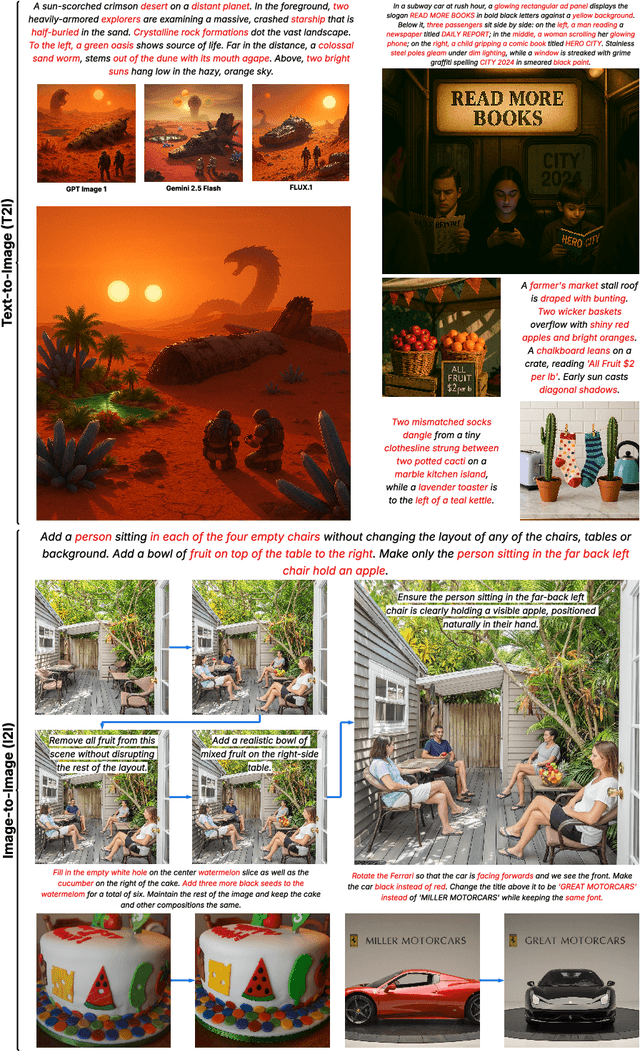
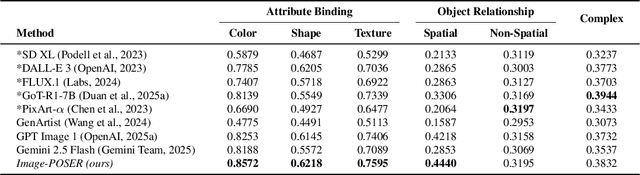
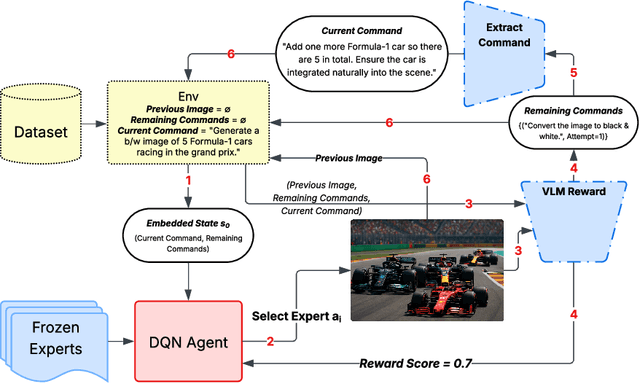
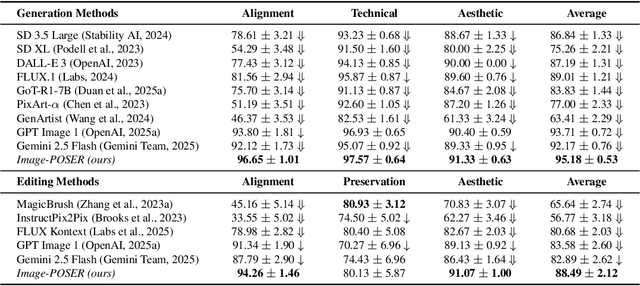
Recent advances in text-to-image generation have produced strong single-shot models, yet no individual system reliably executes the long, compositional prompts typical of creative workflows. We introduce Image-POSER, a reflective reinforcement learning framework that (i) orchestrates a diverse registry of pretrained text-to-image and image-to-image experts, (ii) handles long-form prompts end-to-end through dynamic task decomposition, and (iii) supervises alignment at each step via structured feedback from a vision-language model critic. By casting image synthesis and editing as a Markov Decision Process, we learn non-trivial expert pipelines that adaptively combine strengths across models. Experiments show that Image-POSER outperforms baselines, including frontier models, across industry-standard and custom benchmarks in alignment, fidelity, and aesthetics, and is consistently preferred in human evaluations. These results highlight that reinforcement learning can endow AI systems with the capacity to autonomously decompose, reorder, and combine visual models, moving towards general-purpose visual assistants.