 Add to Chrome
 Add to Firefox
 Add to Edge
3D Transport-based Morphometry (3D-TBM) for medical image analysis
Feb 06, 2026
Transport-Based Morphometry (TBM) has emerged as a new framework for 3D medical image analysis. By embedding images into a transport domain via invertible transformations, TBM facilitates effective classification, regression, and other tasks using transport-domain features. Crucially, the inverse mapping enables the projection of analytic results back into the original image space, allowing researchers to directly interpret clinical features associated with model outputs in a spatially meaningful way. To facilitate broader adoption of TBM in clinical imaging research, we present 3D-TBM, a tool designed for morphological analysis of 3D medical images. The framework includes data preprocessing, computation of optimal transport embeddings, and analytical methods such as visualization of main transport directions, together with techniques for discerning discriminating directions and related analysis methods. We also provide comprehensive documentation and practical tutorials to support researchers interested in applying 3D-TBM in their own medical imaging studies. The source code is publicly available through PyTransKit.

H-DenseFormer: An Efficient Hybrid Densely Connected Transformer for Multimodal Tumor Segmentation
Jul 04, 2023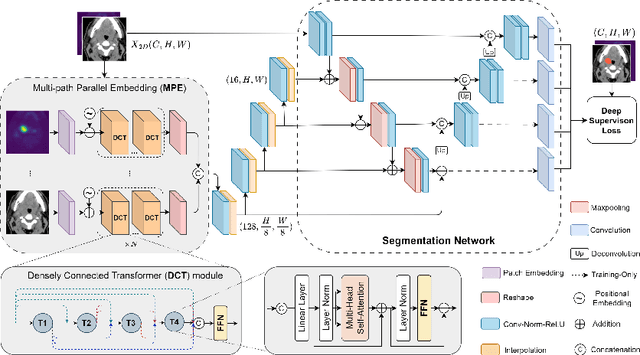

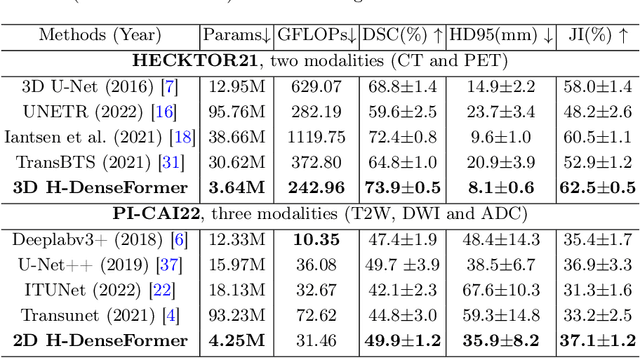

Recently, deep learning methods have been widely used for tumor segmentation of multimodal medical images with promising results. However, most existing methods are limited by insufficient representational ability, specific modality number and high computational complexity. In this paper, we propose a hybrid densely connected network for tumor segmentation, named H-DenseFormer, which combines the representational power of the Convolutional Neural Network (CNN) and the Transformer structures. Specifically, H-DenseFormer integrates a Transformer-based Multi-path Parallel Embedding (MPE) module that can take an arbitrary number of modalities as input to extract the fusion features from different modalities. Then, the multimodal fusion features are delivered to different levels of the encoder to enhance multimodal learning representation. Besides, we design a lightweight Densely Connected Transformer (DCT) block to replace the standard Transformer block, thus significantly reducing computational complexity. We conduct extensive experiments on two public multimodal datasets, HECKTOR21 and PI-CAI22. The experimental results show that our proposed method outperforms the existing state-of-the-art methods while having lower computational complexity. The source code is available at https://github.com/shijun18/H-DenseFormer.