 Add to Chrome
 Add to Firefox
 Add to Edge
3D Transport-based Morphometry (3D-TBM) for medical image analysis
Feb 06, 2026
Transport-Based Morphometry (TBM) has emerged as a new framework for 3D medical image analysis. By embedding images into a transport domain via invertible transformations, TBM facilitates effective classification, regression, and other tasks using transport-domain features. Crucially, the inverse mapping enables the projection of analytic results back into the original image space, allowing researchers to directly interpret clinical features associated with model outputs in a spatially meaningful way. To facilitate broader adoption of TBM in clinical imaging research, we present 3D-TBM, a tool designed for morphological analysis of 3D medical images. The framework includes data preprocessing, computation of optimal transport embeddings, and analytical methods such as visualization of main transport directions, together with techniques for discerning discriminating directions and related analysis methods. We also provide comprehensive documentation and practical tutorials to support researchers interested in applying 3D-TBM in their own medical imaging studies. The source code is publicly available through PyTransKit.

Linear optimal transport subspaces for point set classification
Mar 15, 2024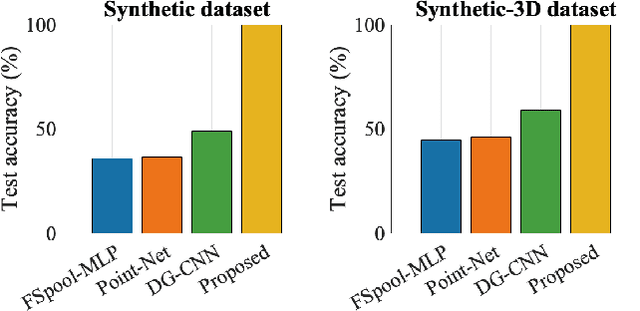
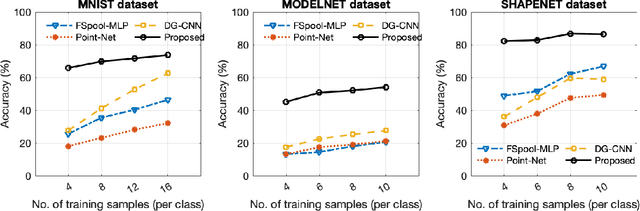
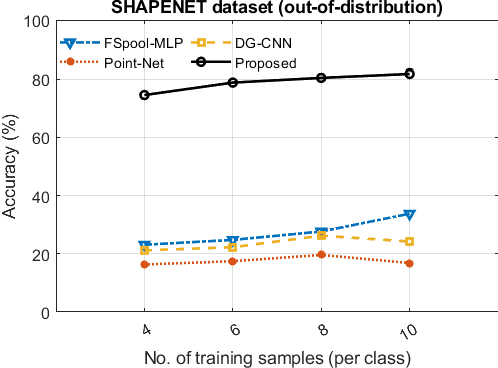
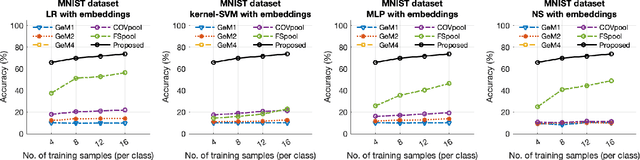
Learning from point sets is an essential component in many computer vision and machine learning applications. Native, unordered, and permutation invariant set structure space is challenging to model, particularly for point set classification under spatial deformations. Here we propose a framework for classifying point sets experiencing certain types of spatial deformations, with a particular emphasis on datasets featuring affine deformations. Our approach employs the Linear Optimal Transport (LOT) transform to obtain a linear embedding of set-structured data. Utilizing the mathematical properties of the LOT transform, we demonstrate its capacity to accommodate variations in point sets by constructing a convex data space, effectively simplifying point set classification problems. Our method, which employs a nearest-subspace algorithm in the LOT space, demonstrates label efficiency, non-iterative behavior, and requires no hyper-parameter tuning. It achieves competitive accuracies compared to state-of-the-art methods across various point set classification tasks. Furthermore, our approach exhibits robustness in out-of-distribution scenarios where training and test distributions vary in terms of deformation magnitudes.
The Radon Signed Cumulative Distribution Transform and its applications in classification of Signed Images
Jul 28, 2023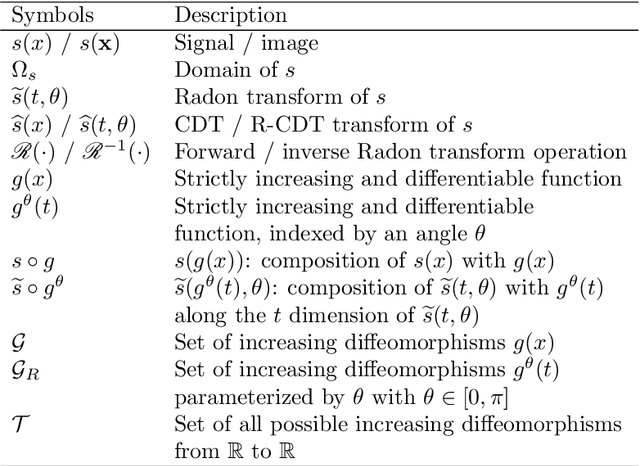
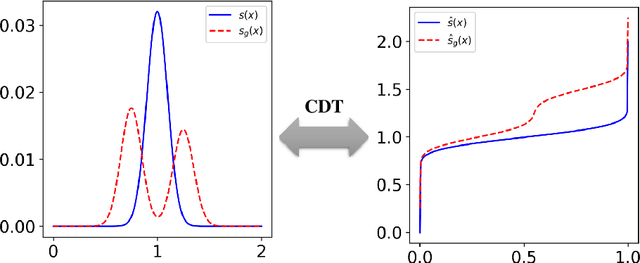
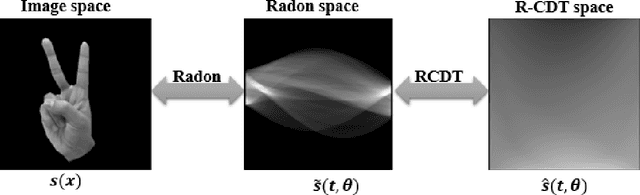
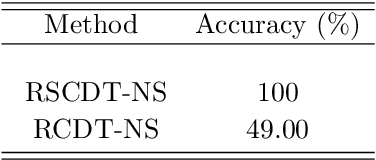
Here we describe a new image representation technique based on the mathematics of transport and optimal transport. The method relies on the combination of the well-known Radon transform for images and a recent signal representation method called the Signed Cumulative Distribution Transform. The newly proposed method generalizes previous transport-related image representation methods to arbitrary functions (images), and thus can be used in more applications. We describe the new transform, and some of its mathematical properties and demonstrate its ability to partition image classes with real and simulated data. In comparison to existing transport transform methods, as well as deep learning-based classification methods, the new transform more accurately represents the information content of signed images, and thus can be used to obtain higher classification accuracies. The implementation of the proposed method in Python language is integrated as a part of the software package PyTransKit, available on Github.