 Add to Chrome
 Add to Firefox
 Add to Edge
RSVideo: Are Your Vision-Language Models Ready for Remote Sensing Videos?
Aug 03, 2026
Remote-sensing videos enable real-time observation of changes in target attributes, short-term activities, and scene evolution. They record motion, actions, interactions, and scene changes that cannot be captured by isolated images. Existing models primarily target single images or discrete temporal observations spanning a long time range. However, a unified evaluation setting for assessing vision-language models on continuous remote-sensing video understanding remains lacking. We introduce RSVideo-10K, a remote-sensing video dataset comprising 10,773 instances, 1.47 million frames, and 17.02 hours of footage, containing both unmanned aerial vehicles and satellite platforms. Its fixed evaluation benchmark, RSVideo-Bench, contains 2,731 test instances and evaluates two complementary aspects of remote-sensing video understanding: L1 Perception and L2 Reasoning, spanning seven capability groups and 17 tasks. Evaluations show that current vision-language models still struggle to recover small local evidence, track short-lived states, and use scene-constrained spatial relations. Based on this analysis, we further propose RSVideo, a reinforcement learning framework for small-target spatiotemporal focusing that selects question-relevant regions across frames and suppresses redundant background tokens. RSVideo achieves a maximum absolute improvement of 9.01% with InternVL3.5-14B and attains the highest accuracy of 40.63% with Qwen3.6-27B across 26 open-source vision-language backbones.Codes will be available at https://github.com/HongjieZhou0329/RSVideo.

UMMAN: Unsupervised Multi-graph Merge Adversarial Network for Disease Prediction Based on Intestinal Flora
Jul 31, 2024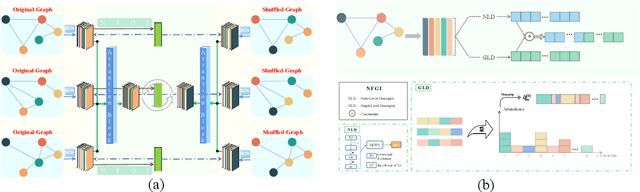
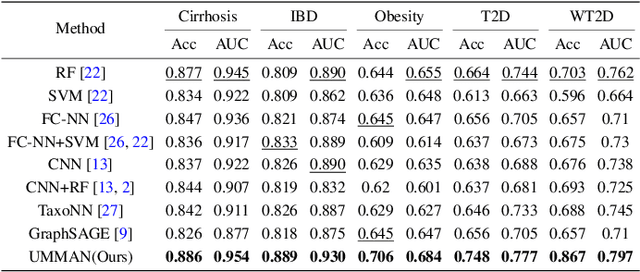
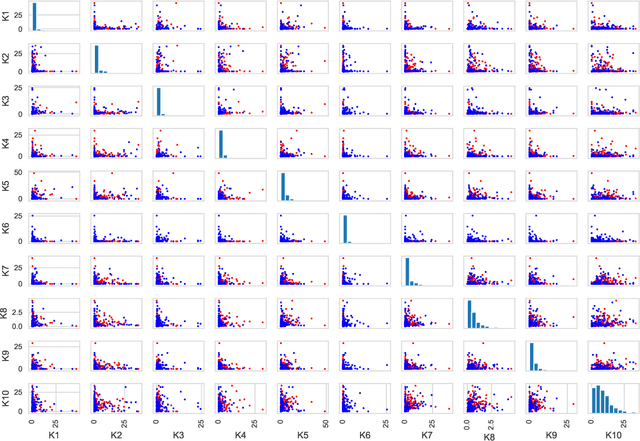
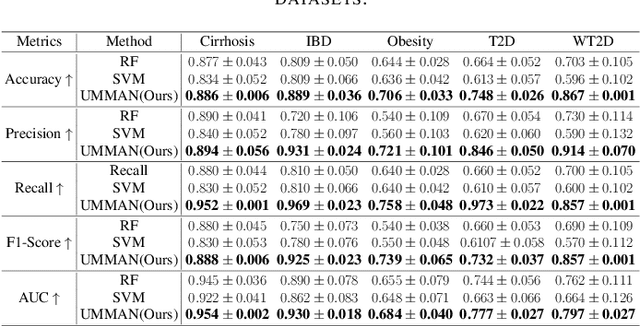
The abundance of intestinal flora is closely related to human diseases, but diseases are not caused by a single gut microbe. Instead, they result from the complex interplay of numerous microbial entities. This intricate and implicit connection among gut microbes poses a significant challenge for disease prediction using abundance information from OTU data. Recently, several methods have shown potential in predicting corresponding diseases. However, these methods fail to learn the inner association among gut microbes from different hosts, leading to unsatisfactory performance. In this paper, we present a novel architecture, Unsupervised Multi-graph Merge Adversarial Network (UMMAN). UMMAN can obtain the embeddings of nodes in the Multi-Graph in an unsupervised scenario, so that it helps learn the multiplex association. Our method is the first to combine Graph Neural Network with the task of intestinal flora disease prediction. We employ complex relation-types to construct the Original-Graph and disrupt the relationships among nodes to generate corresponding Shuffled-Graph. We introduce the Node Feature Global Integration (NFGI) module to represent the global features of the graph. Furthermore, we design a joint loss comprising adversarial loss and hybrid attention loss to ensure that the real graph embedding aligns closely with the Original-Graph and diverges from the Shuffled-Graph. Comprehensive experiments on five classical OTU gut microbiome datasets demonstrate the effectiveness and stability of our method. (We will release our code soon.)